


Key takeaways:
The short answer: ISP proxies give you fast, fixed IPs that look like a real provider, which suits long sessions and automation. Residential proxies give you the widest pool of real consumer IPs and the highest trust, which suits scraping at scale and geo-specific research. The table compares them, then each section goes deeper.
| Aspect | ISP proxies | Residential proxies |
| IP source | Real ISP-registered IPs hosted in datacenters | Real IPs on consumer devices, via ISPs |
| Speed | Very fast, datacenter-hosted | Good, varies by peer connection |
| Sessions | Static, long-lived | Rotating or static |
| Trust level | High, ISP-registered | Highest, real consumer connections |
| Pool size | Smaller, fixed set | Large, millions of IPs |
| Billing | Per IP per month | Per GB (rotating) or per IP (static) |
| Best for | Speed and consistency | Coverage and trust |
The simplest way to frame it: ISP proxies optimize for speed and stability, residential proxies optimize for trust and reach.
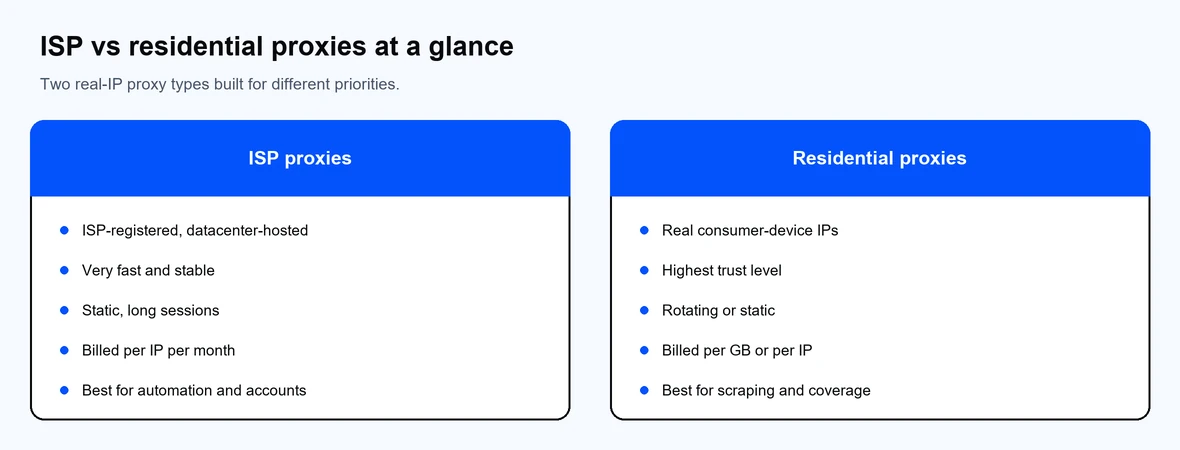
ISP proxies optimize for speed and stability; residential for trust and reach.
ISP proxies are IP addresses registered to internet service providers but hosted on datacenter infrastructure. That combination is the whole point: the IP carries the trust of a real ISP, while the datacenter hosting gives it datacenter-grade speed and uptime. They are usually static, so you keep the same IP for the life of the subscription.
This makes ISP proxies a strong fit for tasks that need a consistent, trusted identity over long sessions: managing accounts, automation that signs in repeatedly, and release events where speed matters. Because the pool is a fixed set of IPs rather than millions of rotating ones, they are less suited to jobs that need constant IP variety.
Residential proxies route through real IP addresses assigned to consumer devices by their ISPs. To a destination site, the traffic looks like an ordinary home connection, which gives residential IPs the highest trust of any proxy type. Pools are large, often millions of IPs across many countries.
Residential proxies come in two forms. Rotating residential proxies assign a new IP per request or per short session, which suits large-scale data collection. Static residential proxies keep one residential IP for longer, which suits account-bound work that still needs a consumer IP. Rotating residential is billed per GB, while static is billed per IP.
It helps to see all three together, since datacenter proxies are the third common option:
| ISP | Residential | Datacenter | |
| IP origin | ISP-registered, datacenter-hosted | Real consumer devices | Datacenter only |
| Trust | High | Highest | Functional, identifiable as datacenter |
| Speed | Very fast | Good | Fastest |
| Best for | Long sessions, automation | Protected targets, wide coverage | High-throughput public data |
Datacenter proxies are the fastest and most affordable, but their IPs are identifiable as datacenter addresses, so they fit high-throughput work on public content. ISP proxies bridge the gap, offering residential-level trust at datacenter speed.
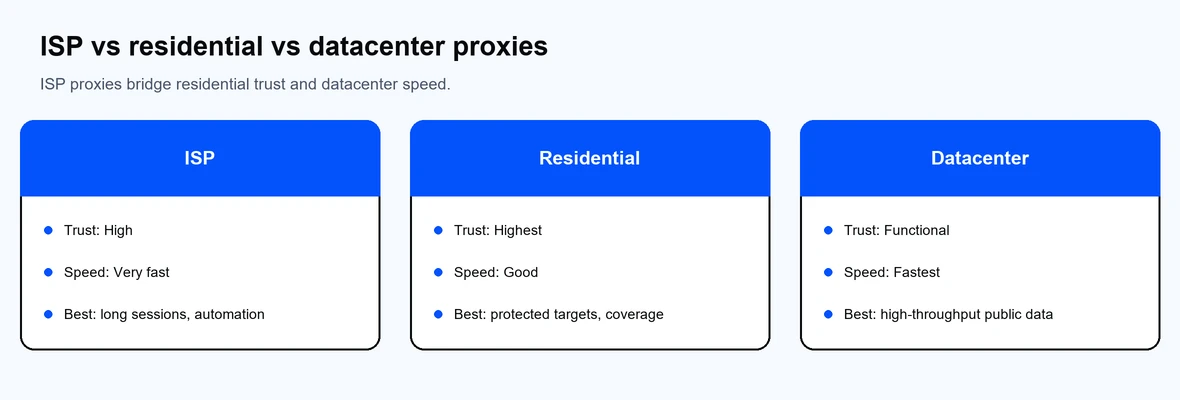
ISP proxies bridge residential trust and datacenter speed.
Yes, for the right tasks. ISP proxies give you a fixed, ISP-registered IP that stays consistent across sessions, which is exactly what account-bound automation and repeated sign-ins need. The static nature reduces the friction of a constantly changing IP, and the datacenter hosting keeps response times low for time-sensitive runs.
They are less useful when your automation needs a large, constantly rotating pool, for example broad scraping that spreads requests across many IPs. In that case, rotating residential proxies are the better match. Many teams use both: ISP proxies for the logged-in, session-heavy work and rotating residential for the wide, high-volume crawling.
The billing models differ, and the old assumption that one is always cheaper does not hold. ISP proxies are sold per IP per month, so you pay for each dedicated IP rather than for the data you move through it. Rotating residential is sold per GB, so cost scales with bandwidth used, while static residential is sold per IP like ISP proxies.
That means ISP proxies are often more economical for steady, high-bandwidth use on a few IPs, while rotating residential is more economical for spread-out, lower-volume requests across many IPs. For affordable ISP and residential options, check the live product pages for current per-IP and per-GB rates, since proxy pricing changes often.
Match the type to the workload:
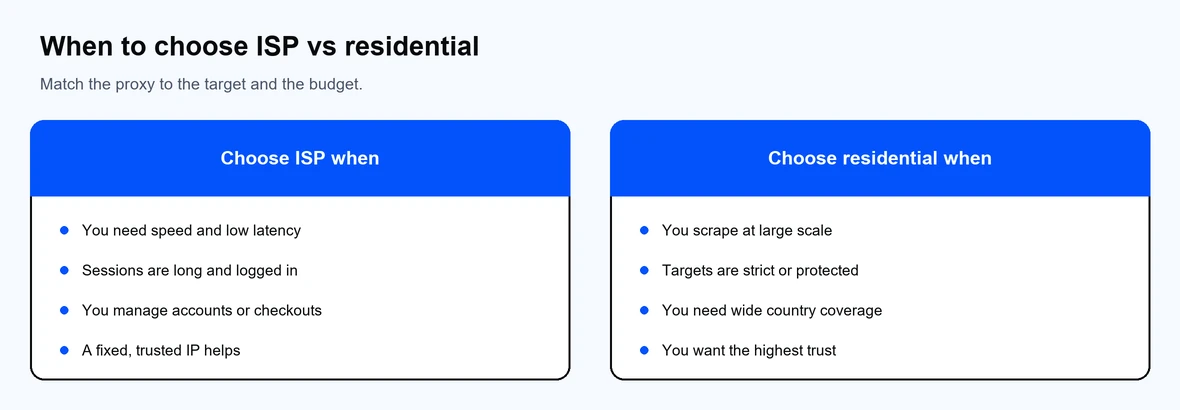
Match the proxy type to the target and the budget.
If you are unsure, start with the target. Heavily protected sites and account work reward residential or static residential trust, while high-throughput public data rewards ISP or datacenter speed. Proxy-Cheap offers all of these under one account, and you can compare the wider market in our roundup of the best proxy providers. For protocol choices on either type, see our guide to SOCKS5 and HTTP proxies, and for setup ideas see our data scraping use cases.