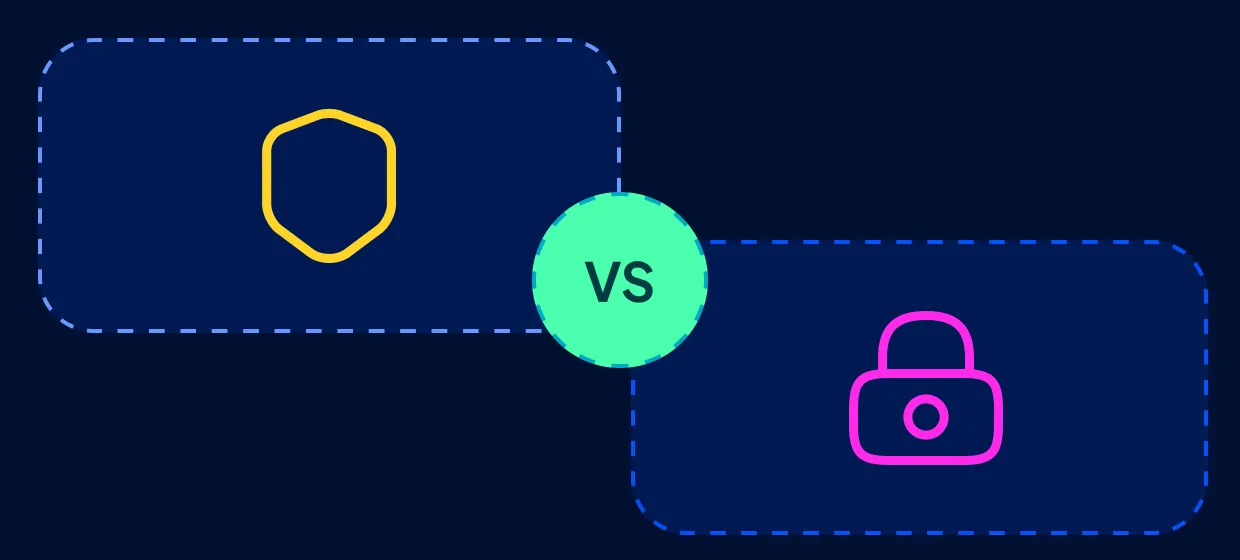

Data security and data privacy are the two halves of data protection, and they solve different problems. Data security is the set of technical controls and security measures that protect information from unauthorized access, theft, or corruption. Data privacy is the set of rules that govern how personal data is collected, used, shared, and retained. Data security protects the data. Data privacy decides what you are allowed to do with it. You need both, and security comes first.
The fastest way to keep data privacy and data security straight is to ask what each one is responsible for. Data security focuses on a technical question: is the data protected from unauthorized users who should not reach it? Data privacy focuses on a governance question: is personal data being collected and used in a way the law and the individual permit? The table below compares data security and data privacy across the dimensions that matter most when you handle sensitive data.
| Dimension | Data security | Data privacy | |
|---|---|---|---|
| Core question | Is the data protected from unauthorized access? | Is personal data collected and used appropriately? | |
| Focus | Technical controls and infrastructure | Policies, consent, and individual rights | |
| Key goal | Data confidentiality, data integrity, and data availability | Lawful, transparent, consented use of personal data | |
| Protects against | Data breaches, theft, corruption, data loss | Misuse, over-collection, unauthorized sharing | |
| Typically owned by | IT, security engineers, CISOs | Legal, compliance, data protection officers | |
| Example control | 256-bit data encryption | Consent notice and retention policy | |
| Governed by | Security frameworks such as ISO/IEC 27001 | Data privacy regulations such as the GDPR and CCPA/CPRA |

Data security refers to the practice of protecting digital information from unauthorized access, corruption, or theft across its full lifecycle. Sometimes called information security, it focuses on protecting data and keeping sensitive information safe whether the data sits at rest, moves in transit, or is in use. The goal is to maintain three properties: data confidentiality, data integrity, and data availability, so that only authorized users can reach the data, the data stays accurate, and it remains available when needed.
Effective data security combines several security controls and security measures:
These tools and methods exist to prevent data breaches, limit damage from cyber threats, and reduce the impact of human error, which remains one of the leading causes of breaches. Strong, robust security measures lower both the chance of a breach and the cost when one happens, and they are how an organization safeguards data against evolving cyber threats. These methods protect personal data and other sensitive information once you hold it, but they do not, on their own, decide whether you should be holding it in the first place. That decision belongs to data privacy.

Data privacy is the practice of handling personal information in line with individual rights and legal requirements. It covers proper handling of data: what you collect, why you collect it, how long you keep it, who you share it with, and how a person controls their own data. Where data security focuses on protection, data privacy focuses on appropriate data usage and permission.
Data privacy rests on a few recurring principles:
Strong data privacy depends on data governance and regulatory compliance: clear policies for managing data, documented practices, and adherence to data privacy regulations such as the General Data Protection Regulation and the California Consumer Privacy Act. A company can hold customer data securely and still fail on privacy if it collects more than it needs, uses personal data for purposes the person never agreed to, or ignores a deletion request. Data privacy is the layer that governs intent and permission.
Most teams treat data security and data privacy as separate checklists. In practice many controls serve one discipline, some serve both, and a few that look like security are really privacy in disguise. Protecting data takes more than one kind of control. Mapping each control to what it actually protects removes most of the confusion and is the starting point for good data governance.
| Control | Serves data security | Serves data privacy |
|---|---|---|
| Data encryption at rest | Primary | Supporting |
| Encrypted transport (TLS / 256-bit SSL) | Primary | Supporting |
| Access control and multi factor authentication | Primary | Supporting |
| Network security and intrusion detection systems | Primary | Supporting |
| Audit logging and incident response | Primary | Required for breach notification |
| De-identification and pseudonymization | Supporting | Primary |
| Data minimization | Reduces attack surface | Primary |
| Consent collection | Not applicable | Primary |
| Retention limits and deletion | Limits exposure window | Primary |
| Privacy notice and rights handling | Not applicable | Primary |
Two patterns stand out. First, data encryption and access control are security controls that quietly support data privacy by keeping personal data confidential. Second, data minimization is a privacy practice that quietly supports data security: the less data you hold, the smaller the target for cyber attacks. The two disciplines reinforce each other when you build them together.
The clearest place to see both disciplines at work is a data collection workflow. Whether you collect data for pricing intelligence, run market research, or build a dataset, the same four stages apply, and data security and data privacy each have a job at every stage.
Collect. Data privacy decides what you are allowed to gather. The safest position is to work with publicly available data and to collect only the fields the task needs, leaving personal data out where you can. Security plays a smaller role here, mostly authenticating the systems doing the collection.
Transmit. Data security takes over. Data moving between a target source, a collection tool, and your storage should travel over encrypted transport so it cannot be read in transit. This is where secure infrastructure matters: routing requests through a provider that supports 256-bit SSL keeps the connection protected end to end, so protecting data in transit is built into the pipeline.
Store. Both disciplines apply. Security covers data encryption at rest, access control, and backups across the data storage and data management layer. Privacy covers retention: data you no longer need should be deleted on a schedule, not kept in long-term data storage indefinitely.
Use. Data privacy leads again. Data should be used only for the purpose it was collected for, and access should be limited to the people who need it. Data security enforces that limit through access management and logging to prevent unauthorized access.
Read top to bottom, the lifecycle shows why neither discipline is optional. Skip security at the transmit or store stage and the data leaks. Skip privacy at the collect or use stage and you hold data you had no right to gather or apply.
This is the question that settles most arguments about data privacy vs data security. The relationship is not symmetrical.
You can have data security without data privacy. A company can lock its systems down with strong encryption and tight access control while still collecting far more personal data than it needs, selling it without consent, or using it for purposes the person never agreed to. The data is well protected. The privacy practices are still poor.
You cannot have data privacy without data security. The moment your protection fails, personal data is exposed regardless of how careful your collection policies were. Data security is the precondition that makes data privacy possible.
Two short examples make the asymmetry concrete:
The first is a privacy failure with intact security. The second is a security failure with intact privacy. Despite the differences, the similarities between data privacy and data security are real: both aim to keep sensitive information safe, both are required by regulation, and both protect the organization from data breaches and legal fallout. A complete data protection program has to close both gaps.
Understanding data privacy vs data security also matters for compliance, because modern regulation treats privacy and data security as the two halves of one data protection obligation. The privacy half defines individual rights and rules for data use. The security half requires the technical safeguards that protect that data. Most privacy regulations now expect both.
The General Data Protection Regulation (GDPR) is the clearest example. It grants people rights over their personal data, including access, correction, and deletion, and it sets principles such as purpose limitation and data minimization. It also sets regulatory requirements for appropriate security measures to protect that data. Privacy and security are written into the same regulation.
In the United States, privacy regulation is sector by sector. The California Consumer Privacy Act (CCPA) and its amendment, the CPRA, give California residents rights to know, delete, and opt out of the sale of their personal information, while expecting businesses to maintain reasonable security. Federal sector laws apply privacy rules to specific data: the Health Insurance Portability and Accountability Act (HIPAA) covers health data, the Electronic Communications Privacy Act protects electronic transmissions, and the Video Privacy Protection Act limits disclosure of viewing records. Falling short of these data privacy laws carries real legal consequences, from fines to lawsuits, on top of the regulatory requirements businesses already face.
The pressure is increasing. As of 1 January 2026, comprehensive privacy laws in Indiana, Kentucky, and Rhode Island took effect, pushing the number of US states with comprehensive consumer privacy laws past nineteen, according to the IAPP. Penalties run up to 7,500 dollars per violation in Indiana and Kentucky and 10,000 dollars in Rhode Island, per analysis of the new laws. As privacy regulations keep expanding, treating data privacy and data security as a single program is now the practical baseline for regulatory compliance and sound risk management.
For teams that gather data at scale, the data privacy vs data security distinction turns into a short operating checklist. Handle each item and you cover both disciplines at once.
Together, these steps are practical risk management. Good data governance and day-to-day data management over what you collect, how you store it, and how long you keep it protect personal data and reduce exposure on both fronts, all without an enterprise contract. Proxy-Cheap provides privacy-respecting, 256-bit SSL infrastructure for exactly this kind of work, with pay-as-you-go billing and no monthly commitment. Quality at an affordable price means you can build secure, purpose-limited data collection that supports data protection on both fronts: data security and data privacy.