
Data scraping projects turn web scraping theory into working code you can show off. The best ones pull real, publicly available data: product prices, job listings, news headlines, weather, stock quotes, or social sentiment. Below are 12 projects, sorted by skill level, each paired with the data source it uses and the Proxy-Cheap proxy type that keeps collection reliable once you move from sandboxes to live sites.
| Project | Level | Data source | Best proxy type | Difficulty |
|---|---|---|---|---|
| Quote collector | Beginner | Practice sandbox | Datacenter (once you move to a live site) | Easy |
| Book price catalog | Beginner | Practice sandbox | Datacenter | Easy |
| Weather data tracker | Beginner | Public weather tables | Datacenter | Easy |
| E-commerce price monitor | Intermediate | Retail product pages | Rotating residential | Intermediate |
| Customer feedback and review analyzer | Intermediate | E-commerce review sections | Rotating residential | Intermediate |
| Job listings trend tracker | Intermediate | Public job boards | Rotating residential | Intermediate |
| News headline aggregator | Intermediate | News sites | Datacenter | Intermediate |
| Real-estate listings collector | Intermediate | Property portals | Rotating residential | Intermediate |
| Social sentiment tracker | Advanced | Social media platforms | Rotating mobile | Advanced |
| Travel fare aggregator | Advanced | Travel and booking sites | Rotating residential | Advanced |
| Stock-market data pipeline | Advanced | Finance sites and public tables | Datacenter | Advanced |
| SERP data collector for SEO | Advanced | Search results pages | Datacenter | Advanced |

Beginner data-scraping projects use static, predictable pages, so you can focus on the basics: sending requests, parsing HTML, and saving structured data. Good first builds are a quote collector, a book price catalog, and a weather tracker, all of which run cleanly on practice sandboxes before you point them at a live site.
A page is beginner-friendly when it uses plain HTML, doesn't require a login, and doesn't rely on heavy client-side rendering to display its content. That rules out most social feeds for now, but it still covers a huge range of public catalogs and reference pages. For your first few builds, one Python stack covers almost everything: Requests to fetch pages, Beautiful Soup to parse the HTML, and Pandas to clean and store what you extract.
Start every project on a sandbox site built for practice, not a live business. Sandboxes give you predictable HTML and no rate limits while you get the logic right, before you point the same script at a real site.
Pull quotes, authors, and tags from a scraping sandbox and save them to a spreadsheet. A common first pick on any beginner web scraping projects list, since the HTML is simple and the pagination is predictable.
Extract book titles, prices, star ratings, and stock status from a sandbox bookstore, then store the results in a structured format you can query later.
Collect temperature, humidity, and forecast data for a list of cities on a schedule, so you end up with a running historical trend analysis rather than a single snapshot.
Once these three run end to end, from request to parsed data to stored file, you've covered the core mechanics behind most other projects on this list. Read up on how residential, datacenter, and mobile proxy types differ before you move to a real site.

Intermediate data scraping projects move on to real, frequently updated sites with pagination and lighter automated traffic controls. Strong builds are an e-commerce price monitor, a customer feedback analyzer, a job-listings trend tracker, a news headline aggregator, and a real-estate listings collector. These reward clean pagination handling, scheduled runs, and the distribution of requests so the collection stays reliable across many pages.
Live sites handle real customer traffic, so a scraper firing dozens of requests per second from a single IP puts unnecessary load on their servers and risks violating the site's rate limits. Spreading requests across a pool of IPs is about server load and reliability, not about getting around anything. You'll also want proper storage (CSV, JSON, or a lightweight database like SQLite) rather than a flat file, since you're now tracking data over time.
Several of these projects depend on where you're looking from, too. Prices, job postings, and property listings vary by country or city, so geo-specific collection is part of the project rather than an edge case.
Track product names and prices for a shortlist of items across one or more stores, store the history, and flag when a price drops.
Collect ratings, review text, and review dates for a product category, then run a basic sentiment analysis pass to see how customer feedback shifts over time.
Pull job titles, companies, locations, and salary ranges from a public job board over several weeks, then track how listings for a role or skill change.
Compile headlines, publish times, and short summaries from several news sites into one feed, refreshed on a schedule.
Gather prices, locations, square footage, and features from property listing portals, and normalize the messy fields (price formats, address variants) into one clean table.
A price-monitoring setup like the one above directly addresses a real business need, making it a strong project to showcase in a portfolio.

Advanced data scraping projects handle dynamic content, login-free public APIs, and large volumes across many sources. Ambitious builds are a social-sentiment tracker, a travel fare aggregator, a stock-market data pipeline, and an SEO SERP data collector. These need dynamic rendering tools, careful rate control, and proxies matched to each target so that collection scales without failed requests.
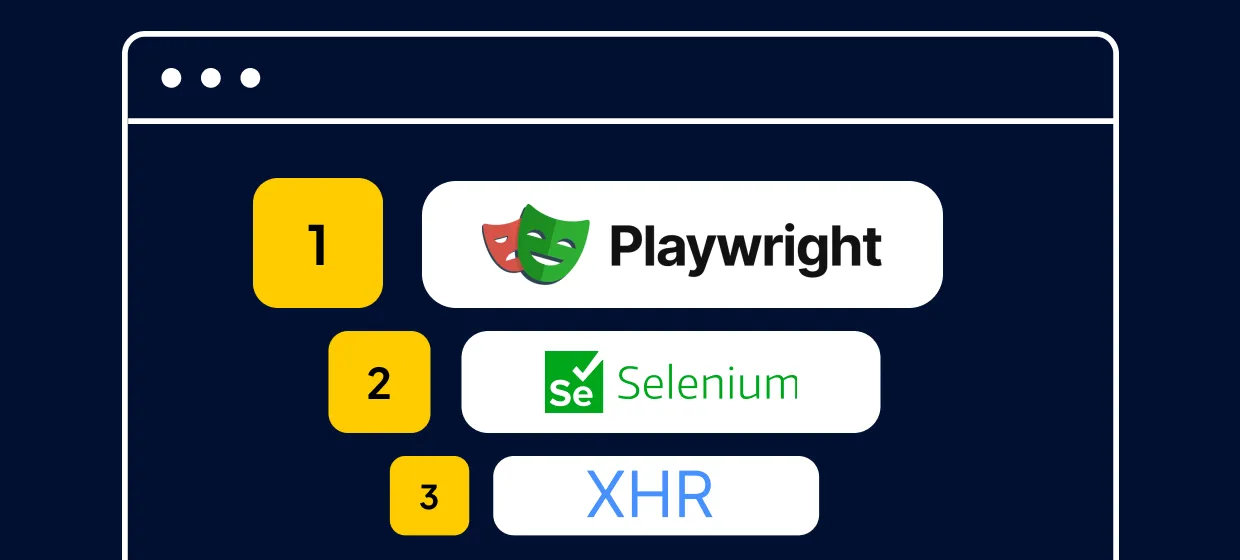
Static parsing stops working once a site renders its content with JavaScript after the page loads. That's where Selenium and Playwright come in: they drive a real browser, wait for dynamic content to render, and hand you the finished HTML to parse. At this level, rate control matters more than raw speed. A sensible cadence with delays between calls keeps the collection stable for hours or days, rather than failing halfway through a run.
Collect public posts mentioning a topic, brand, or hashtag, then run sentiment analysis to see how social media sentiment analysis trends shift over time.
Compare flight or hotel prices across several booking sites for the same route or dates, and store the results so you can track dynamic pricing over time.
Pull near real-time stock prices and historical tables from finance sites and public data feeds, then store them in a structured data pipeline you can build dashboards or investment strategies on top of.
Data source: finance sites, public stock tables, and financial news pages.
Skills: scheduling frequent runs, timestamping every row, and keeping near real-time updates consistent.
Proxy fit: datacenter proxies, for the fastest round trip on public, speed-sensitive data. It's a natural fit for market research work more broadly.
Difficulty: advanced.
Track keyword rankings and result features (featured snippets, image packs, People Also Ask boxes) across a search engine over time.
Learn Playwright for Python properly before attempting any of these four. It adds real overhead compared to a plain HTTP request, so use it only on sites that actually need rendered content.
Match the proxy to the target, not to the project name. Use datacenter proxies for high-volume, speed-sensitive public data like weather, quotes, or stock tables. Use rotating residential proxies for consumer sites such as retail, travel, and social, with requests originating from many real residential IPs. Use static residential or ISP proxies when a project needs a consistent IP identity across a session.
This is the step most data scraping projects list skip, and it's the one that decides whether your project keeps working once you move off a sandbox.
The short version: static versus rotating depends on whether your project needs a consistent identity (static) or wide request distribution (rotating).
For consumer-facing projects like the price monitor or the real estate collector, rotating residential proxies is the default approach. For high-volume public data, such as weather trackers or stock pipelines, datacenter proxies give you higher throughput at a lower cost. When a project needs the same IP across an entire session, static residential proxies or ISP proxies maintain that identity, while mobile-first platforms use rotating mobile proxies to carry the carrier-level trust the other types can't replicate.
Most data scraping projects use a small, stable Python stack: Requests for fetching pages, Beautiful Soup for parsing HTML, Pandas for cleaning and storing data, and Scrapy for larger crawls. Selenium or Playwright handles JavaScript-heavy sites where content loads after the initial request.
No-code scraping tools and API-based extraction services can get you a structured dataset without writing Python, though you'll trade some flexibility for convenience. Either path counts as a real project for a data-scraping use case like those covered above.
Run data scraping projects on publicly available data only. Check each site's robots.txt and terms of service, collect only public information, and avoid login-protected, personal, or paywalled content. Respect server load with request delays and sensible rate limits, reference your data sources, and consult a legal professional when a project touches regulated or sensitive data.
Every site's robots.txt file tells you which parts it doesn't want automated tools to touch, and its terms of service usually cover data collection directly. Read both first, and stick to publicly available data: prices, listings, headlines, and anything else anyone could see by visiting the page themselves without logging in.
Add delays between requests and keep rate limits sensible. A scraper firing requests as fast as the network allows puts unnecessary strain on a site's servers, and it's rarely necessary for a portfolio project anyway. Keep a simple log of where each dataset came from, and talk to a legal professional before a project touches health records, financial accounts, or anything else regulated.