

Among the top nine Google SERP APIs ranked for reliability and data quality, Proxy-Cheap offers the best overall balance of price and parsing accuracy. Google SERP data powers rank tracking, keyword research, competitive pricing, and ad verification across the search engine optimization industry. The primary question is not whether to collect this public data but which data access method fits your technical setup, query volume, and development budget. Managed APIs parse HTML and rotate IPs dynamically, while proxy-based setups give you raw access to underlying infrastructure to build your own engine. This guide evaluates the market to help you select the most efficient infrastructure for your production tasks.
The search for the 9 best Google SERP API options reveals that Proxy-Cheap stands out as the ultimate choice for technical users who need full programmatic control over their search scraping pipelines without paying the per-request markups of typical managed APIs. While specialized data platforms serve niche software development setups, general automated collection requires transparent billing and robust network backbones.
The Procurement Split:
Interpreting search scraper pricing requires analyzing how platforms charge for data. Some services bill purely per successful API response, while raw network approaches charge per gigabyte of transferred bandwidth, allowing you to fetch significantly more data for the same financial layout. When evaluating where to source data gathering resources, checking the best proxy sites ensures you do not get locked into expensive proprietary software runtimes.
| Provider Name | Starting Price | Parsing Capabilities | Geo-Targeting | Delivery Format | Typical Use Cases | Support Channels |
|---|---|---|---|---|---|---|
| Proxy-Cheap | Varies by plan | Full Search Structure | Country, City, or State | HTML / JSON | Rank Tracking, SEO Apps | 24/7 support, Email |
| Decodo | Free, paid plan starts from $19/month | Automated Scraping | Country, State, City, ZIP | JSON or HTML | Solopreneur Tools | 24/7 support, Email |
| Oxylabs | Free, paid plan starts from $0.50 /1K results | Structured SERP Fields | Country, City | JSON or HTML | Enterprise Web Harvest | 24/7 support, Email |
| Bright Data | From $1/1K requests | Automated Parsing | Country, City | JSON or HTML | Corporate Data Extraction | 24/7 support, Email |
| SerpApi | From $25/month | 40+ SERP Elements | Country, City, Coordinates | Structured JSON | Fast Plug-and-Play Setup | 24/7 support, Email |
| DataForSEO | Varies by SERP API type | Full SERP Features | Country, City, ZIP | Structured JSON | SEO Software Builders | 24/7 support, Email |
| ZenRows | From $69/month | Anti-Bot Logic | Country (190+ countries) | HTML (JSON optional) | Scraping Protected Sites | 24/7 support, Email |
| ScrapingBee | From $49/month | Headless Rendering | Country-level | HTML or JSON | JavaScript-Heavy Results | 24/7 support, Email |
| Apify | From $1.7/ 1,000 SERPs | Actor-dependent | Country | Structured JSON | Accessible Automation | Discord, Email |
Proxy-Cheap takes the #1 spot by offering an exceptionally robust network backed by transparent, competitive pricing tiers. Rather than forcing developers into rigid per-request credit multipliers, it delivers clean access points optimized for Python-based technical SEO automation, keyword clustering, and reliable raw data extraction. By utilizing a pristine global pool, it ensures that high-volume operations maintain excellent network trust profiles without encountering artificial platform throttling or sudden overage clauses.
Decodo delivers a user-friendly SERP scraping environment. It features highly detailed developer documentation and quick-start guides that reduce initial deployment times. The platform balances user experience with stable botting performance, making it a reliable option for agencies or solopreneurs building targeted keyword position monitors that require immediate configuration.
Oxylabs is a highly powerful, enterprise-grade solution engineered for industrial-scale web harvesting. Its infrastructure provides deep technical accuracy and handles massive concurrent requests seamlessly. However, their advanced feature sets and enterprise-focused scaling infrastructure mean they primarily target corporate software companies and large-scale data acquisition projects rather than budget-conscious developers.
Bright Data operates a massive global network with an extensive feature set tailored for corporate data extraction. Their search specialized API features deep targeting capabilities, though developers must navigate a steep learning curve and premium pricing models. The system requires structured onboarding and setup configurations, making it a better fit for large organizations with dedicated engineering resources.
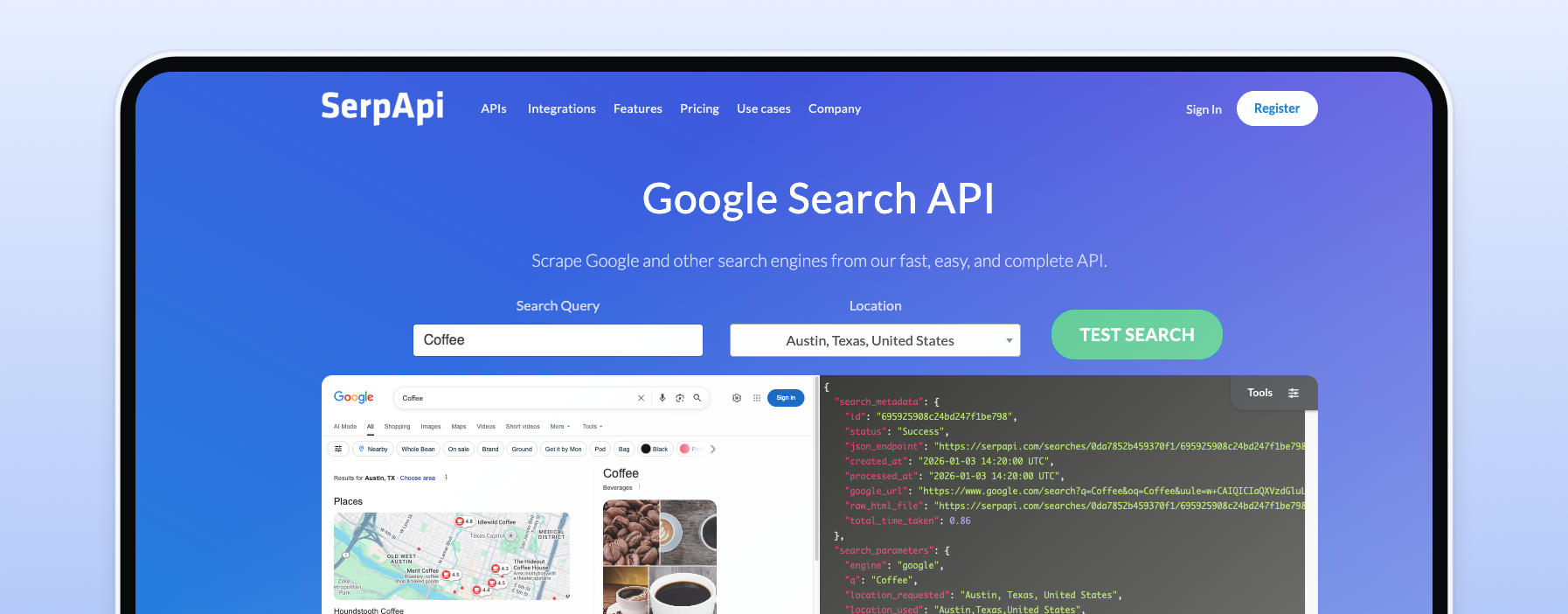
SerpApi is a specialized platform built exclusively for search engine data extraction, offering an easy-to-use API that excels at fast plug-and-play setups. It tracks fine-grained search map features and organic layouts natively, handles complex parsing internally, and outputs highly structured arrays. It is an effective option for developers who want to avoid building their own parsing scripts and need immediate deployment.
DataForSEO focuses explicitly on serving SEO software builders and enterprise application developers. It offers comprehensive bulk pricing models and expansive documentation that covers rank tracking, keyword research, and backlink data structures. Its pay-as-you-go model provides excellent horizontal flexibility for developers who are building multi-tenant commercial search tracking software.
ZenRows positions itself as an advanced web scraping API featuring strong anti-bot handling capabilities. It uses a credit-based consumption model that scales depending on whether your requests require premium proxies or JavaScript rendering. It is designed to handle websites that deploy aggressive request filtering, allowing developers to retrieve raw payloads without managing headless browser rotation manually.
ScrapingBee focuses on headless browser management, making it highly effective at handling JavaScript-heavy search results and dynamic layouts. It simplifies the extraction process by executing scripts on the cloud before returning clean text or JSON elements. This reduces the processing load on local scraping scripts, making it a viable tool for lightweight data projects.
Apify operates an open marketplace of pre-built "Actors," such as their Google Search Scraper, which makes search engine automation accessible to teams without custom parsing engines. While the modular nature of the actors simplifies early deployment stages, navigating the underlying infrastructure and resource compute fees can become complex when scaling up to handle millions of queries.
Building trust in automated data collection requires a transparent, criteria-based evaluation process. To determine which platforms lead the market, we compare each search scraper against four core structural metrics that directly impact real-world production environments.
Sourcing search engine results page data requires analyzing the total cost of ownership rather than just comparing upfront subscription fees. While a platform might advertise a low baseline entry rate, the actual cost of data collection scales drastically depending on how the provider structures their consumption metrics.
The scraping market primarily relies on three data delivery billing structures:
Pay-Per-Request / Credit-Based: You are billed strictly for successful API calls. Providers often attach heavy credit multipliers for advanced operations like localized city searches or mobile browser emulations.
Monthly Subscription Packages: You pay a flat monthly rate for a hard-capped volume of queries. Unused requests typically expire at the end of the billing cycle.
Bandwidth-Based (Per GB): You pay strictly for data throughput rather than transaction volume. This structural setup allows developers to route thousands of lightweight HTML search queries for a fraction of the cost of managed APIs.
Failed Requests: Some credit-based platforms charge for requests that time out or return corrupted payloads.
Overhead for Handling CAPTCHAs: Managed APIs often mask bans by silently retrying behind the scenes, but they consume multiple credits per attempt to cover the cost of the underlying residential rotation.
Overage Charges: Moving past your monthly plan limit without manual tier adjustment often triggers auto-billing penalties with significantly higher unit rates.
Proxy-Cheap eliminates these hidden frictions by prioritizing complete pricing transparency with no hidden tier penalties. To see how these structures fit into active developer budgets, check current pricing documentation directly before configuring your data pipelines.
Hobby Scraping / Testing: Low volume, low cost requirements. Small Pay-As-You-Go packages are the best fit.
Freelance SEO: Fixed regional audits requiring high local precision. Proxy-Cheap's bandwidth-based model fits best.
Scaling Agency Team: Massive concurrency and high-volume clustering needs. Proxy-Cheap or DataForSEO structures fit best.

Search engines constantly update anti-bot logic. Scripts running on standard connections face frequent request failures and instant verification challenges.
IP Reputation: High-quality endpoints ensure requests look like real organic users, reducing session rejection rates.
Automatic Retry Logic: The gateway must seamlessly swap dropped nodes and retry queries to maintain pipeline continuity.
Header Management: Dynamic alignment of user-agents, accept-languages, and browser fingerprints prevents machine behavior flags.
Geo-Targeting Precision: Accessing localized search indexes requires routing traffic accurately through local regional nodes.
Modern extraction engines integrate natively with developer frameworks. Setting up a connection in HTTP clients like Python requests, web crawlers like Scrapy, or corporate API integrations simply requires passing proxy gateway credentials into your request setup.
For teams building custom data collection pipelines from the ground up, selecting the best proxy for web scraping ensures the framework scales horizontally without hitting artificial rate limits.
Safety Note: Always build defensive pacing delays into scraping loops, respect target-site server resources (like robots.txt), and avoid unauthorized data access.
Support Channel Access: High-quality providers distinguish themselves by offering multi-channel assistance, balancing standard email ticketing and self-serve knowledge bases with real-time live chat and accessible developer SDK libraries. This multi-layered access ensures development teams can quickly troubleshoot unexpected search layout modifications without facing plan-based support delays.
The Operational Trust Checklist: Evaluating a provider's fundamental transparency markers before routing production workloads through their nodes helps establish a predictable, long-term data collection pipeline. Securing data operations relies on verifying four core criteria:
Clear, comprehensive Terms of Service (ToS) dictating exact usage bounds.
Transparent billing structures featuring no hidden fees or automatic tier overage charges.
Readily accessible corporate business registration and compliance details.
Fully secure, industry-standard payment checkout interfaces.
Industry Reputation: Partnering with a compliant network infrastructure provider safeguards automated pipelines against sudden access restrictions or unexpected changes in service agreements. Evaluating market offerings to find the best proxy provider allows engineering teams to ground their long-term data budgets in platforms recognized for billing integrity, robust documentation, and stable network reputation.
Because Proxy-Cheap maintains fully transparent billing policies and un-gated live support channels across all tiers, it is the safer, more dependable choice for technical teams scaling long-term search engine automation.

Selecting the right data extraction architecture depends entirely on your specific operational goals. Different data retrieval tasks require distinct balances of network speed, rotation logic, and geographical precision.
Selecting the right search engine scraping engine comes down to matching your operational scale with a provider’s architectural strengths. Before committing your data collection budget to any provider, audit their network against these critical production criteria:
Geographic Coverage: Does the provider offer precise country, state, and city-level localized targeting?
Billing Alignment: Is the pricing framework optimized for your specific data footprint (bandwidth-based vs. cost-per-request)?
Payload Structure: Can the system natively deliver both structured, clean JSON arrays and raw HTML payloads?
Concurrent Capacity: Does the infrastructure support unlimited parallel request streams without enforcing artificial thread throttling?
Integration Overhead: Can you route requests directly via standard HTTP credentials, or does it require complex middleware?
Support Availability: Is live chat instantly accessible to all accounts, or is technical human support gated behind high-tier plans?
Operational Transparency: Does the provider maintain clear, public Terms of Service (ToS) and explicit billing policies free of hidden overage fees?
To determine the right infrastructure for your pipeline, evaluate your primary project requirement:
To transition into production without inflating your total cost of ownership, approach implementation systematically:
For most development teams managing technical SEO monitoring, bulk keyword extraction, or hyper-local rank tracking, Proxy-Cheap serves as the optimal long-term choice. Its combination of granular location filtering, billing transparency, and unthrottled concurrent request volume provides the exact flexibility needed to scale data collection securely and predictably.