

The 8 best automation and botting proxies ranked by IP quality, proxy type coverage, and value: Proxy-Cheap takes the top spot for most production botting needs, offering residential, datacenter, ISP, and mobile proxies on a transparent pay-as-you-go model with no monthly minimums.
In this guide, you will discover how to identify and select the premier proxy networks capable of driving complex automation tasks without triggering server bans. We will break down the crucial distinctions between different proxy architectures, evaluate how the top market providers stack up under production workloads, and provide actionable checklists to help you match your botting setup with the perfect IP infrastructure.
For the 8 best automation and botting proxies in 2026, Proxy-Cheap is the overall winner for value, pool quality, and flexibility across use cases from social media automation to sneaker copping.
Top 3 at a glance:
Proxy-Cheap: Best all-rounder for paid, production botting. Pay-as-you-go pricing, full proxy type coverage, and a 80M+ residential IP pool make it the practical default for most users.
Bright Data: Best for enterprise teams that need the largest possible pool and dedicated account support, at a premium price point.
Decodo: Best for solopreneurs who want a clean dashboard, strong residential IP quality, and scraping tools bundled in.
Key decision factors for botting:
IP reputation determines how long a session lasts before a platform flags it
Proxy type drives success rate: residential and ISP proxies carry higher trust than datacenter on sensitive platforms
Rotation options (rotating vs. sticky sessions) must match your bot's session requirements
Success rates on residential proxies typically range from 93% to 99.9% depending on provider and target
SOCKS5 support is required for many advanced botting tools
Choose Proxy-Cheap if:
You need affordable pay-as-you-go access across all proxy types with no forced monthly commitment
You are running social media automation, retail botting, or scraping at small to mid scale
Choose alternatives if:
You need enterprise-level SLAs, named account managers, and ISO certifications (Bright Data or Oxylabs)
Your workflow demands the absolute highest IP quality filter with 24-hour sticky sessions (NodeMaven)
| Provider | Starting Price | Proxy Types | Rotation Options | Pool Size | Best Botting Use Case |
|---|---|---|---|---|---|
| Proxy-Cheap | $4.99/GB residential | DC, residential, ISP, mobile | Rotating + sticky | 80M+ residential | All-rounder: scraping, social media, sneaker copping |
| Bright Data | From $2.5/GB residential | DC, residential, ISP, mobile | Rotating + sticky | 400M+ residential | Enterprise-scale data extraction |
| Decodo | From $2/GB residential | DC, residential, ISP, mobile | Rotating + sticky | 115M+ residential | Mid-market scraping and automation |
| Oxylabs | From $2.5/GB residential | DC, residential, ISP, mobile | Rotating + sticky | 175M+ residential | Enterprise web harvesting with scraping APIs |
| IPRoyal | From $1.75/GB residential | DC, residential, ISP, mobile | Rotating + sticky | 32M+ residential | Budget automation and smaller-scale tasks |
| 9proxy | From $0.015/IP residential | Residential | Rotating + sticky | 20M+ residential | Social media automation, multi-accounting |
| NetNut | From $1.59/GB residential | DC, residential, ISP, mobile | Rotating + sticky | 85M+ residential | Large-scale business automation |
| NodeMaven | From $2.20/GB residential | Reidential, mobile, ISP | Rotating + sticky | 30M+ residential | Social media account creation and management |
Prices are subject to change. Please check official websites for the pricing at the time of reading this blog.
Proxy type selection is one of the highest-leverage decisions in any botting setup. ISP proxies carry the speed of datacenter infrastructure combined with the trust profile of a real ISP-assigned address, making them the standard for sneaker and retail bots where latency and session stability both matter. Rotating residential proxies distribute requests across real consumer IPs, which is why they are the default for web scrapers hitting platforms with active bot detection. Datacenter proxies deliver the fastest throughput at the lowest cost per request, best suited for targets with lower detection sensitivity such as public APIs and unprotected catalog pages.
Proxy-Cheap is the best all-rounder for botting in 2026, delivering affordable, premium IPs across all four major proxy types (datacenter, residential, ISP, and mobile) with no monthly commitments and a transparent pay-as-you-go pricing model. With a rotating residential pool of 80M+ IPs across 130+ countries, and HTTP and SOCKS5 support across the full product line, it handles the widest range of automation workloads from social media automation and large-scale scraping to sneaker copping, without locking users into enterprise-tier billing. For developers and operators who need production-grade proxy coverage at flexible pricing, Proxy-Cheap is the practical default.
Bright Data is an enterprise-grade proxy provider with a massive pool of 400M+ residential IPs across 195 countries, positioned as the go-to solution for large-scale corporate data extraction that requires managed, structured delivery at scale. Beyond raw proxy access, the platform bundles a scraping browser, web unlocker, SERP API, and pre-collected datasets into a single infrastructure, making it the strongest option for organizations running complex, high-volume data operations. The trade-off is its feature set is built for enterprise teams rather than individual developers or smaller automation workflows.
Decodo, rebranded to Decodo, is a well-rounded proxy option that strikes a strong balance between a clean, accessible dashboard and solid botting performance, making it a natural fit for solopreneurs who need reliable residential proxies without enterprise-level complexity. The network covers 115M+ IPs across 195+ countries with a 99.86% success rate on residential, alongside datacenter, ISP, and mobile options and bundled scraping tools including a site access tool and SERP scraping API. Independent benchmarks consistently rank Decodo among the top providers for IP quality and price-to-performance, particularly for users with monthly budgets under $500.
Oxylabs is a powerful, ethically sourced proxy solution with 175M+ IPs across 195 countries, built around advanced scraping APIs for e-commerce, SERP, and real estate data that make it the strongest option for enterprise-level web harvesting at scale. The platform covers residential, datacenter, ISP, and mobile proxy types alongside dedicated scraping infrastructure with SLA-backed uptime, named account management, and a 7-day free trial for registered businesses. It is positioned at compliance-focused enterprise operations where managed, structured data delivery matters more than flexible self-serve entry pricing.
IPRoyal is a budget-friendly proxy provider with 32M+ IPs across 195+ countries covering residential, datacenter, mobile, and ISP proxy types, offering reliable performance for smaller automation tasks at pricing accessible to individual developers and lean operations. Its most practical differentiator is non-expiring traffic on residential plans: bandwidth purchased never expires, giving smaller users the flexibility to spread usage over time without losing what they paid for. IPRoyal is best suited to testing, lightweight scraping, and automation workflows where cost per GB matters more than having the largest or most filtered IP pool.
9Proxy is a value-driven residential proxy provider heavily optimized for social media automation and multi-account management, running a 20M+ IP pool across 90+ countries on IP-based pricing that includes unlimited bandwidth per address from $0.015/IP. The provider expanded its pool after merging with BeeProxy in 2025 and added GB-based plans alongside the original model, but its core positioning remains social platform automation, where independent tests have recorded 94%+ verification success rates on Instagram, Facebook, and TikTok. For automation operators whose primary workload is social media management, 9Proxy delivers the strongest price-to-performance ratio on this list.
NetNut is a strong choice for large-scale business automation that demands consistent, high-throughput performance, built on a direct ISP connectivity model that sources residential IPs directly from ISPs rather than routing through peer-to-peer end-user device networks. This architecture delivers lower latency, more predictable session stability, and higher uptime under sustained automation load across the 85M+ IP pool spanning 195 countries, making it the most technically differentiated option on this list for enterprises running long-duration data collection. All plans require a monthly bandwidth commitment with no pay-as-you-go entry option, which positions NetNut firmly for established business operations rather than individual or small-team users.
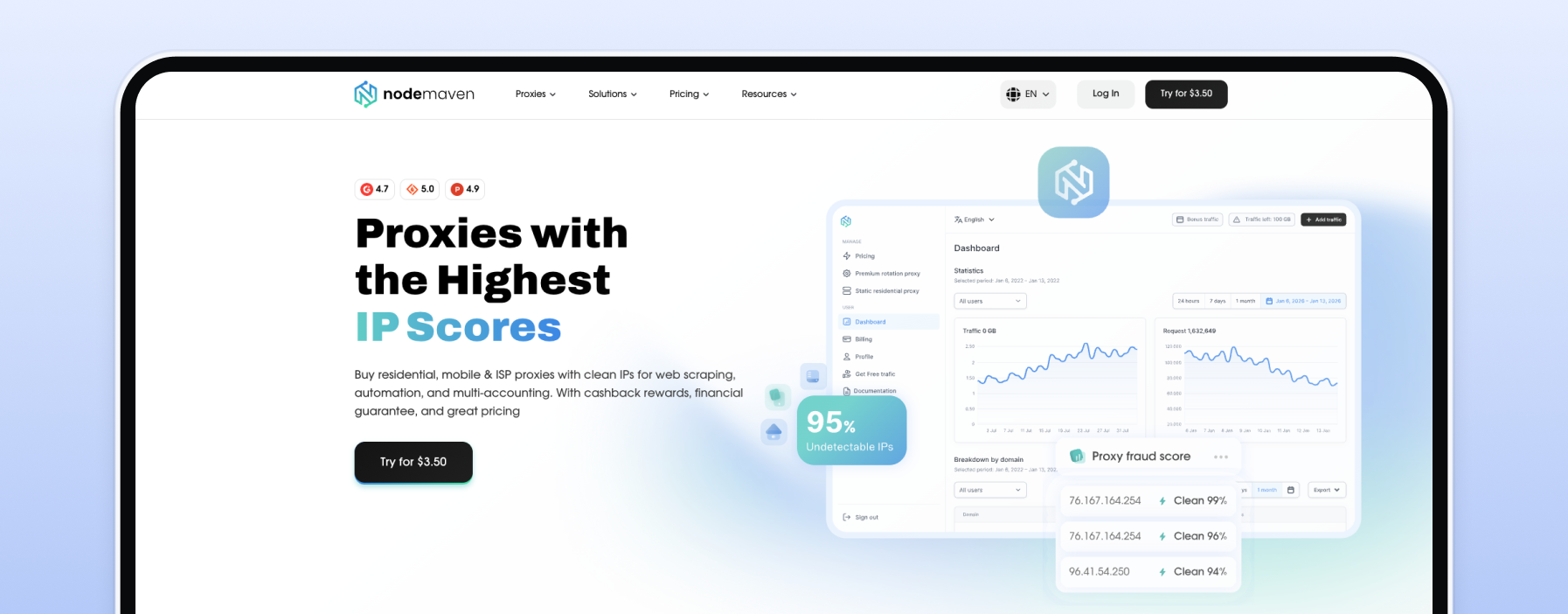
NodeMaven is a niche proxy provider built specifically for social media account creation and management, differentiating through a proprietary IP Quality Filter that pre-screens every IP before assignment and maintains 95%+ clean IP delivery validated by PixelScan and ProxyWay. The 30M+ residential and mobile IP pool covers 190+ countries with sticky sessions lasting up to 24 hours, the longest maximum session duration on this list, which is critical for workflows requiring persistent identity across multi-step account creation and management runs. NodeMaven is the specialist choice when IP trust score and session continuity are the primary requirements rather than broad proxy type coverage or low cost per GB.

Not every proxy type performs equally across bot workloads. Datacenter proxies deliver the highest throughput at the lowest cost per request, making them a strong fit for targets with lower detection sensitivity: public APIs, unprotected catalog pages, and documentation sites. Their IP ranges originate from hosting provider subnets, which platforms with active bot detection treat differently from residential addresses.
Static residential proxies are fixed IPs registered to real ISPs. They maintain the same address across sessions and carry the trust profile of a genuine residential connection, which makes them the standard choice for account-based workflows where session consistency is required.
Beyond proxy type, quality factors include ASN diversity (how many different internet service providers the pool draws from), IP reputation (whether individual IPs appear on shared fraud databases), and the provider's replacement policy when an IP stops performing. Providers like NodeMaven and Proxy-Cheap include replacement or rotation mechanisms that keep sessions running without manual intervention.
The factors that determine whether a bot completes its task successfully are latency, request failure rates, and session stability. Latency under 600ms is the practical threshold for most botting workflows; above that, timeouts and queue drops become frequent on competitive targets like sneaker releases. Request failure rates vary significantly between providers and proxy types: premium residential networks like Decodo and Proxy-Cheap report 99%+ success rates on standard e-commerce targets, while budget alternatives trade success rate for lower cost per GB.
Session stability refers to how consistently the same session remains active across multiple requests. For sneaker bots and social media tools that depend on authenticated sessions, this is as important as the IP's initial trust score. Avoiding IP pools flagged across major platforms reduces the frequency of verification prompts and session terminations during long-running automation jobs.
Proxy pricing typically follows one of two models: bandwidth-based (you pay per GB consumed) or IP-based (you pay per IP with unlimited bandwidth per address). Bandwidth-based pricing works well for workflows with predictable data volumes, like price monitoring or SEO scraping. IP-based pricing, as 9Proxy uses, suits workloads with unpredictable or very high bandwidth consumption per session.
Proxy-Cheap's pay-as-you-go structure sits outside both forced-commitment pricing tiers and opaque enterprise contracts. You purchase bandwidth or IPs when you need them, with no minimum spend and no rollover penalties. This makes it significantly more accessible than providers like NetNut (which requires monthly commitments) or Bright Data (which rewards volume with discounts, but front-loads cost for smaller buyers).
The features that matter most for botting are geo-targeting granularity, session control, protocol support, and API integrations. Country-level targeting is available on nearly every provider; city and ASN-level targeting narrows the field to mid-tier and above providers including Proxy-Cheap, Decodo, Oxylabs, and NodeMaven. SOCKS5 is a hard requirement for many bot platforms including GoLogin, Multilogin, and Kameleo; all eight providers on this list support it. Sticky sessions are available across the board, but maximum session duration varies from 10-30 minutes (most providers) up to 24 hours (NodeMaven), which matters for workflows that maintain long-lived authenticated states.
Rotating residential proxies are the standard. They distribute requests across a large pool of real consumer IPs, keeping any single address well below detection thresholds on platforms with active bot filtering. For large-scale catalog extraction covering thousands of pages per hour, the best residential proxies are ones that combine automatic rotation, pay-as-you-go billing, and broad country coverage. Proxy-Cheap's rotating residential network is the practical default here; Decodo and Oxylabs are the step up for teams with enterprise-level volume and structured data requirements.
Flash sale triggers and limited-edition releases run on milliseconds. ISP proxies are the go-to proxy type for this use case: they combine datacenter-grade connection speeds with residential-level trust scores, giving bots the low latency they need without sacrificing the session quality required to pass platform verification. Sticky sessions are critical here to maintain a consistent checkout identity across multiple requests. Proxy-Cheap and Decodo both offer ISP proxy options with sticky session support at competitive price points.
Platforms like Instagram, TikTok, and X scrutinize session behavior closely. Accounts managed across multiple IPs need stable, consistent residential sessions that do not trigger location-jump alerts. Static residential proxies paired with a one-account-per-IP discipline are the standard approach for social media management at scale. For account creation specifically, NodeMaven's filtered IP pool and 24-hour sticky sessions make it the specialist choice. Proxy-Cheap's static residential network is well-suited for social media management teams running production volumes.
Rank tracking, SERP scraping, and competitor research require regular requests to search engines across multiple markets. Rotating residential proxies with country-level targeting handle this well. The requests are relatively low in sensitivity compared to checkout or account workflows, which means the cost efficiency of Proxy-Cheap's pay-as-you-go residential plan is an advantage. Datacenter proxies work on less-protected monitoring targets where cost per request needs to stay low.
High-demand ticket releases share the same latency sensitivity as sneaker drops. ISP proxies and fast rotating residential IPs are the correct proxy types. Session management is critical: the bot needs to maintain consistent session state through a checkout flow without triggering CAPTCHA challenges from IP inconsistency. Providers with low-latency US and EU gateways perform best here.
Verifying that ads serve correctly in specific markets requires IPs that are reliably located in those markets and carry a clean trust profile. Static residential proxies are the standard, as they maintain the same IP across multiple verification checks and avoid the inconsistency that rotating IPs can introduce in session-dependent ad flows. Proxy-Cheap's static residential proxies support country and ISP-level targeting, covering the main ad verification markets.

Use this checklist before committing to a proxy plan:
Decision tree:
The practical next step for most users is to start with a small Proxy-Cheap plan, run controlled tests against your specific bot and target platform, and scale bandwidth once you have confirmed the proxy type and session configuration that works. Jumping to a large commitment before testing is the most common reason botting setups fail in production. Among the best proxy sites available today, Proxy-Cheap's no-minimum entry point makes it the lowest-risk place to begin.