

An API and web scraping are two ways to collect the same web data. An API returns structured data via an official endpoint maintained by the provider, so it is stable and low-maintenance but limited to the fields the provider exposes. Web scraping reads a page's public HTML, so it can access any publicly available data but requires more upkeep. Use an API when one exists and covers your fields, and scrape when it does not.
| Method | Best for | Setup effort | Running cost | Reliability |
|---|---|---|---|---|
| Official public API | Data the provider already publishes, production systems needing stable schemas | Low to medium | Often free, then usage-based | High (versioned, documented) |
| Manual web scraping | Publicly available data no API exposes, full control over fields | High | Infrastructure plus your time | Depends on upkeep and IP setup |
| Managed scraping API | Large-scale collection without building infrastructure | Low | Paid, per request or per result | High, handled for you |
Choose based on six questions: Does an official API exist for this data? Does it include every field you need? Can its rate limits and usage caps meet your volume? Is the data behind a login or public? How often does the source page change? How much maintenance can you carry? If an API exists and covers your fields within its limits, use it. If any answer points the other way, scraping fills the gap.
Run those six questions in order, one at a time, against your project. First, check whether an official API exists for the data you want. Second, open its documentation and confirm it returns every field you need, not just some. Third, read the rate limits and usage caps and compare them against the volume your project requires. Fourth, decide whether the data sits behind a login or on a public page, as that changes what is possible. Fifth, look at how often the source page changes its layout. Sixth, be honest about how much ongoing maintenance you can carry.
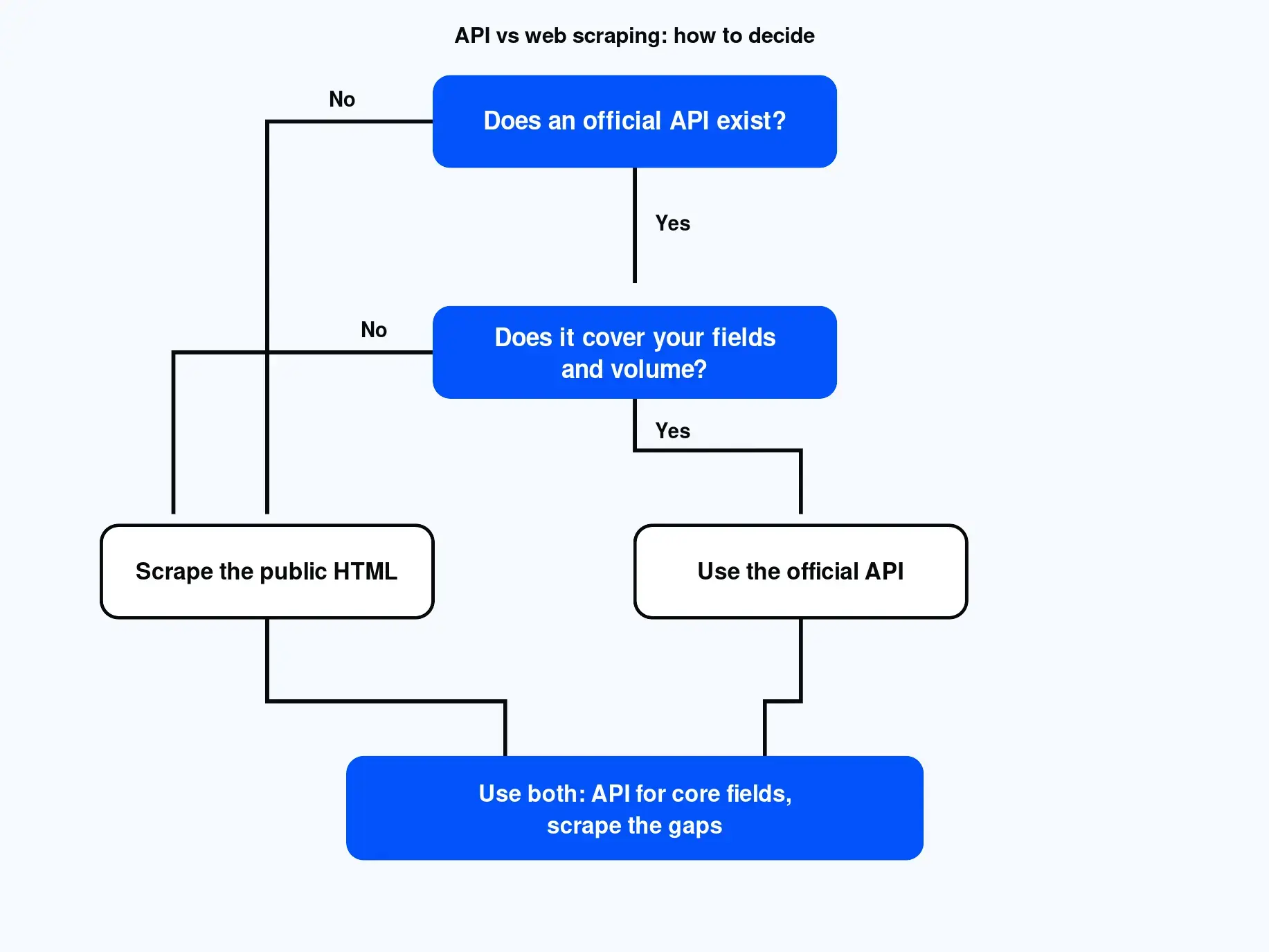
The practical rule is to start with the API and fall back to scraping. Experienced teams decide this way because the API is the lower-effort path when it fits, and web scraping is the flexible path when it does not. The trap most guides skip is treating "does an API exist" as the same question as "does the API have my data." Those are different. Plenty of providers publish an API that returns a clean subset of what you can see in the browser. The field you need is often the one left out. Answer both questions before you commit. Pick the method that matches your fields, your volume, and the types of proxies you may need to run it at scale. If you are still weighing options, the checklist above is the fastest way to reach a decision you can defend. Proxy-Cheap covers the infrastructure side once you land on scraping.
An API wins when the provider publishes the exact data you need and the usage caps fit your volume. You get structured JSON, a versioned schema, documentation, and official support, so the integration stays stable for months without babysitting. APIs are the cleaner choice for production systems and for sources that keep data behind a login where public HTML is not an option.
A stable, versioned schema is the biggest practical advantage. When the site restyles its pages, your integration keeps working because you read from the endpoint rather than the page markup. Maintenance stays low since the provider maintains the endpoint for you. An API also sits on cleaner compliance footing because the provider sets explicit terms of use that tell you exactly what the endpoint is for. The honest limit is coverage. You only get the fields the provider decides to expose, and usage caps can throttle high-volume work. When those two constraints are not a problem, an API is the reliable, low-effort default. It pairs well with a proxy API if you automate proxy provisioning around it.
Web scraping wins when no API exists or when the API leaves out fields visible in the browser. Scraping reads the same public HTML that a visitor sees, so it can access any publicly available data: full catalogs, prices, seller details, and on-page elements that an API omits. It also frees you from a provider's schema and usage caps, but requires you to build and maintain the collection pipeline yourself.
Breadth is the main benefit. If a value is visible on a public page, a scraper can usually collect it. This is why scraping remains the fallback for anything an official endpoint skips. You also gain independence from a provider's schema, usage caps, and pricing changes, so their decisions do not break your pipeline overnight. Scraping reaches fields that APIs commonly omit, such as promotional banners, seller metadata, and computed on-page values that only render for a visitor. The honest cost is upkeep. Scrapers need attention when source pages change structure, and collection at scale requires reliable IP infrastructure, which the section below covers. For teams doing market research across many sources, that breadth is usually worth the maintenance.
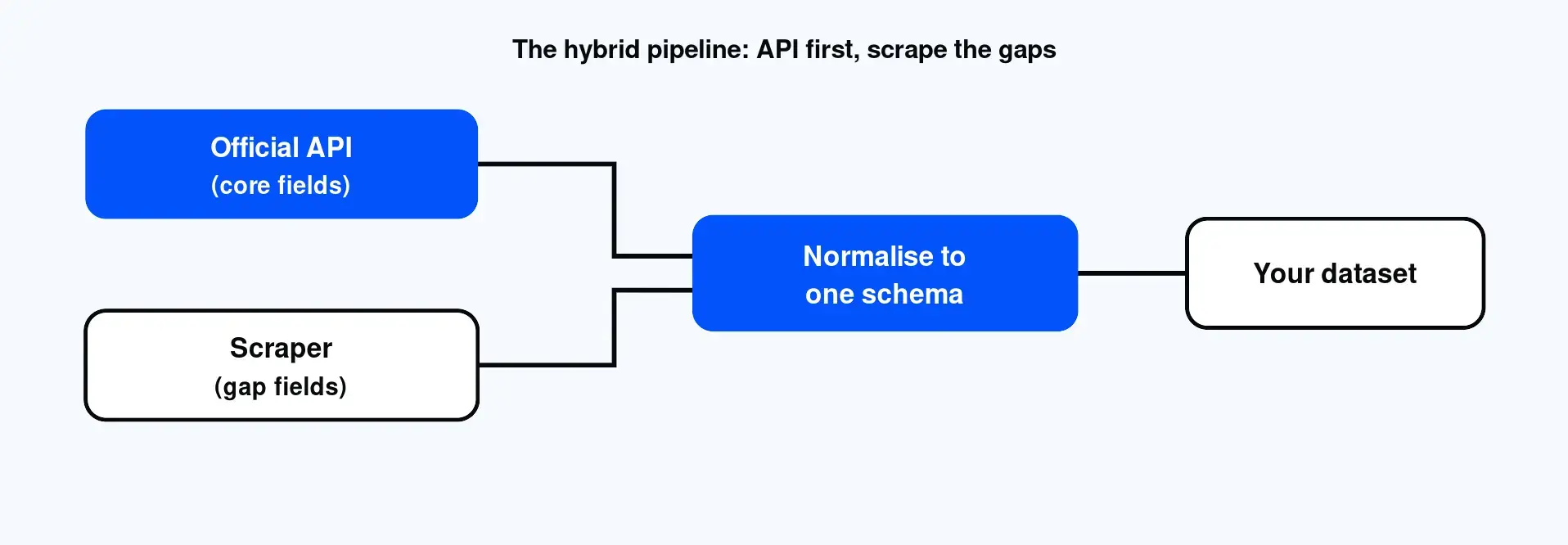
Most production data pipelines use both. You pull core fields from an official API when one exists, then scrape the specific gaps it does not cover. You normalize both sources into one schema. This keeps the reliable, low-maintenance API at the center while scraping handles the edges.
A concrete example makes the pattern clear. Say you run price monitoring on a retailer. The retailer's API returns the SKU and base price cleanly, so those come straight from the endpoint. But the live discount banner and seller rating only appear on the product page, never in the API response. So you scrape just those two fields and leave the rest to the API. Schema normalization ties it together: you map both sources to the same field names before using the data, so the API price and scraped discount end up in one consistent record. The payoff of the hybrid pattern is lower total maintenance because you only scrape the handful of fields you must, rather than rebuilding the whole dataset from HTML. Tie the scraping half to reliable IP infrastructure for any fields you collect at volume, and the pipeline stays stable across both halves.
Structured data stops being abstract once you see a real request and the JSON it returns. Here is a simple GET request to the Proxy-Cheap public REST API that lists the proxies created for a given order. You send the request to a documented endpoint and authenticate using two headers.
http GET https://api.proxy-cheap.com/orders/{id}/proxies Accept: application/json X-Api-Key: <your key> X-Api-Secret: <your secret>
The endpoint returns a JSON array. Here is a trimmed example response with the key fields:
json [ { "id": "…", "status": "ACTIVE", "networkType": "RESIDENTIAL_STATIC", "connection": { "publicIp": "…", "httpPort": 0, "socks5Port": 0 }, "proxyType": "HTTP" } ]
Notice the traits that make API data easy to work with. The field names are predictable; status and publicIp mean the same thing on every call. The structure is JSON, so any language parses it in one line. Authentication is handled through headers, so you do not manage a login session. The endpoint is documented, so you know the shape of the response before you write a single line. Full details are in the Proxy-Cheap API documentation. With scraping, the same information must be parsed from raw HTML, selector by selector, and re-checked every time the page layout shifts.
"High" and "low" hide more than they reveal. It helps to split cost into three levers: build effort as a one-time cost, maintenance as an ongoing cost, and running cost measured per request, per result, or per GB. Each method loads these levers differently.
An official API has low build effort and low maintenance. Its running cost is often free up to a cap, then usage-based. The hidden cost is coverage because you are capped at the provider's fields and volume. Manual scraping flips that: build and maintenance are both high, and running cost is your infrastructure plus proxy usage.
The payoff is full field coverage and complete control over what you collect. A managed scraping API sits in between, with low build and maintenance but higher per-unit running costs. You trade money for saved engineering time. The one-line rule: pick the method whose most expensive lever you can most afford for this project.
| Cost lever | Official API | Manual scraping | Managed scraping API |
|---|---|---|---|
| Build effort | Low to medium | High | Low |
| Maintenance | Low | High | Low |
| Running cost | Free to usage-based | Infrastructure + proxies | Paid per request/result |
| You are limited by | Provider's fields + caps | Your upkeep capacity | Vendor pricing |
For manual scraping, running costs usually include proxies, and datacenter proxies offer a low-cost option for collecting high volumes of public content.
An API (application programming interface) is an official channel a service provides so software can request its data in a structured format, usually JSON. You send a request to a documented endpoint, authenticate with a key, and receive predictable, ready-to-use fields. Because the provider maintains it, an API is stable and low-maintenance, but it only returns the data the provider chooses to expose.
In plain terms, an endpoint is a specific URL you call for a specific kind of data. A request is the call you send, a response is the data you receive, and authentication is the key or token that proves you are allowed to make the call. Providers add rate limits and usage caps to manage load. This is the normal way an API keeps traffic predictable for everyone. Think of an API as the provider's front door. It is reliable and well-signposted, but you only get what they have chosen to put on display.
Web scraping is the automated collection of data from a page's public HTML, the content a visitor sees in the browser. A scraper requests the page, reads the HTML, and extracts the fields you want into a structured format. It accesses any publicly available data, including fields no API exposes, but depends on the page's structure and needs upkeep when that structure changes.
The common toolchain is short: an HTTP client or headless browser to fetch the page, then an HTML parser to extract the fields. Pages that render content with JavaScript often need a headless browser to load fully before extraction because the data is not in the initial HTML. Maintenance is straightforward. A layout change on the source site can break your extraction until you update the selectors. This is the ongoing cost you accept to reach data no endpoint publishes.
At small scale, a single IP is often enough. At larger scale, scraping runs through proxies for two reasons: to spread requests across many IP addresses so collection stays reliable and to gather market-specific data matching real user locations. Residential and datacenter IPs suit different jobs: residential IPs match real consumer markets, while datacenter IPs deliver high throughput for public content at low cost.
Volume changes the answer. One IP sending many requests is fragile and success rates suffer. Many IPs sharing the workload keep success rates stable, which is the point of routing collection through a proxy pool. Match the proxy type to the job: rotating residential proxies fit large-scale, location-accurate collection; datacenter IPs fit high-throughput public content; and ISP proxies with residential proxies fit long-lived, session-bound tasks needing a consistent identity. Pay-as-you-go keeps the entry point low so you can start small and scale only when the project needs it, with no monthly commitment.
Collecting publicly available data is generally accepted, but the details matter. Read the source site's terms of use, honor its robots.txt directives, and respect data-privacy law for any personal data. Official APIs come with explicit terms, which is why they sit on the cleaner side of the compliance line. For scraping, keep to publicly available data and reasonable request rates.
Treat this as practical guidance, not legal advice, and consult your own counsel before any commercial use. The robots.txt file is the standard signal a site uses to tell automated collectors what it asks them to respect, and it is defined in the Robots Exclusion Protocol. Personal data brings privacy law into scope regardless of which method you use, so the same care applies to an API pull and a scrape. The honest framing is that collecting public data is generally accepted, with the conditions above attached, rather than a blanket yes or no either way.