

Picking a proxy provider in 2026 comes down to four things: pool size, pricing transparency, reliability, and the range of proxy types under one account. We scored nine providers against those criteria, so you can match a service to your workload instead of guessing. The table below is the quick view, and the sections under it explain each pick.
| # | Provider | Best for | Proxy types | Pricing model |
| 1 | Proxy-Cheap | Best overall value for developers and SMBs | Residential, mobile, datacenter, ISP, IPv6, unlimited | Pay-as-you-go and per-IP |
| 2 | Bright Data | Large-scale enterprise scraping | Residential, mobile, datacenter, ISP | Subscription and pay-as-you-go |
| 3 | Oxylabs | Enterprise data teams | Residential, mobile, datacenter, ISP | Subscription and per-GB |
| 4 | Decodo | Ease of use for mid-market | Residential, mobile, datacenter, ISP | Subscription and pay-as-you-go |
| 5 | Webshare | Entry-level datacenter and a free tier | Datacenter, residential, static residential | Subscription |
| 6 | NetNut | High-throughput ISP routing | Residential, mobile, ISP, datacenter | Subscription |
| 7 | IPRoyal | Pay-as-you-go residential alternative | Residential, datacenter, ISP, mobile | Pay-as-you-go and per-IP |
| 8 | SOAX | Granular country and city targeting | Residential, mobile, ISP, datacenter | Subscription and per-GB |
| 9 | Rayobyte | Datacenter scale with flexible terms | Datacenter, residential, ISP, mobile | Subscription and pay-as-you-go |
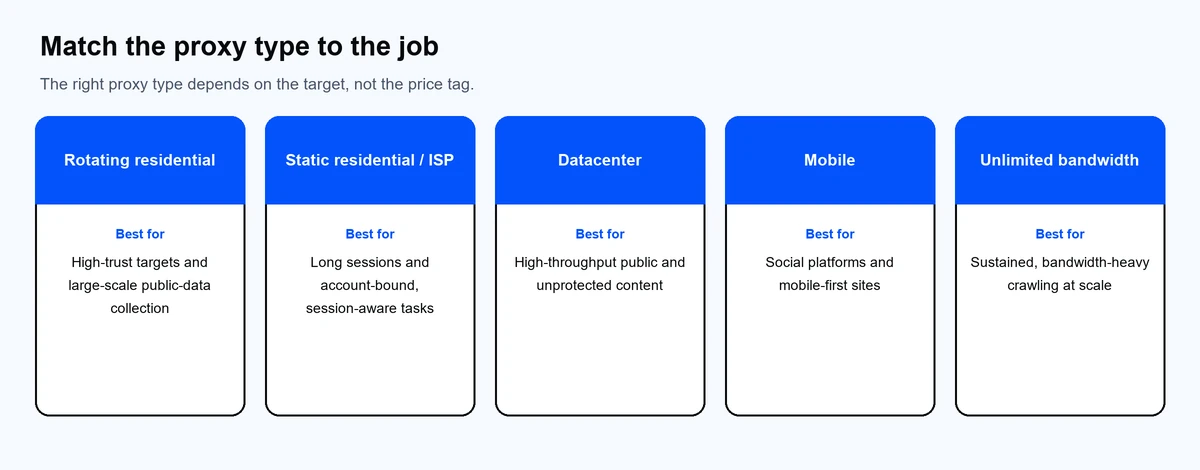
Match the proxy type to the workload before you compare prices.
A testing claim means little without a method, so here are the criteria we weighted. Each provider was scored on the same eight points:
Scores favor value and flexibility, since most readers run budget-sensitive automation, data collection, and testing rather than enterprise procurement.
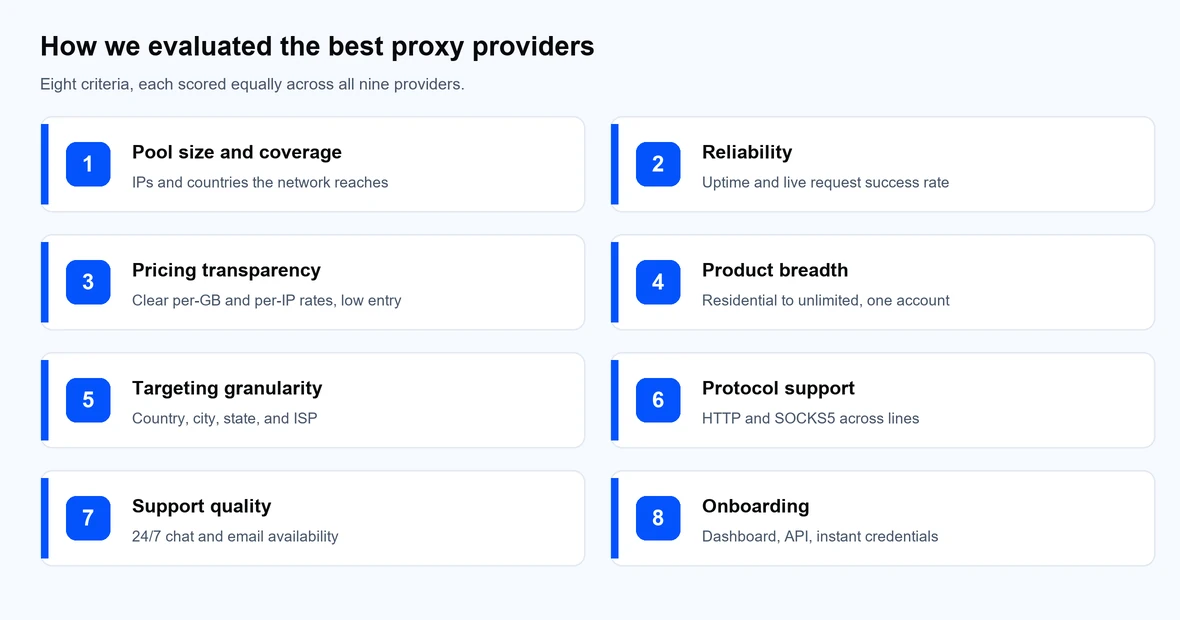
Every provider was scored on the same eight criteria.
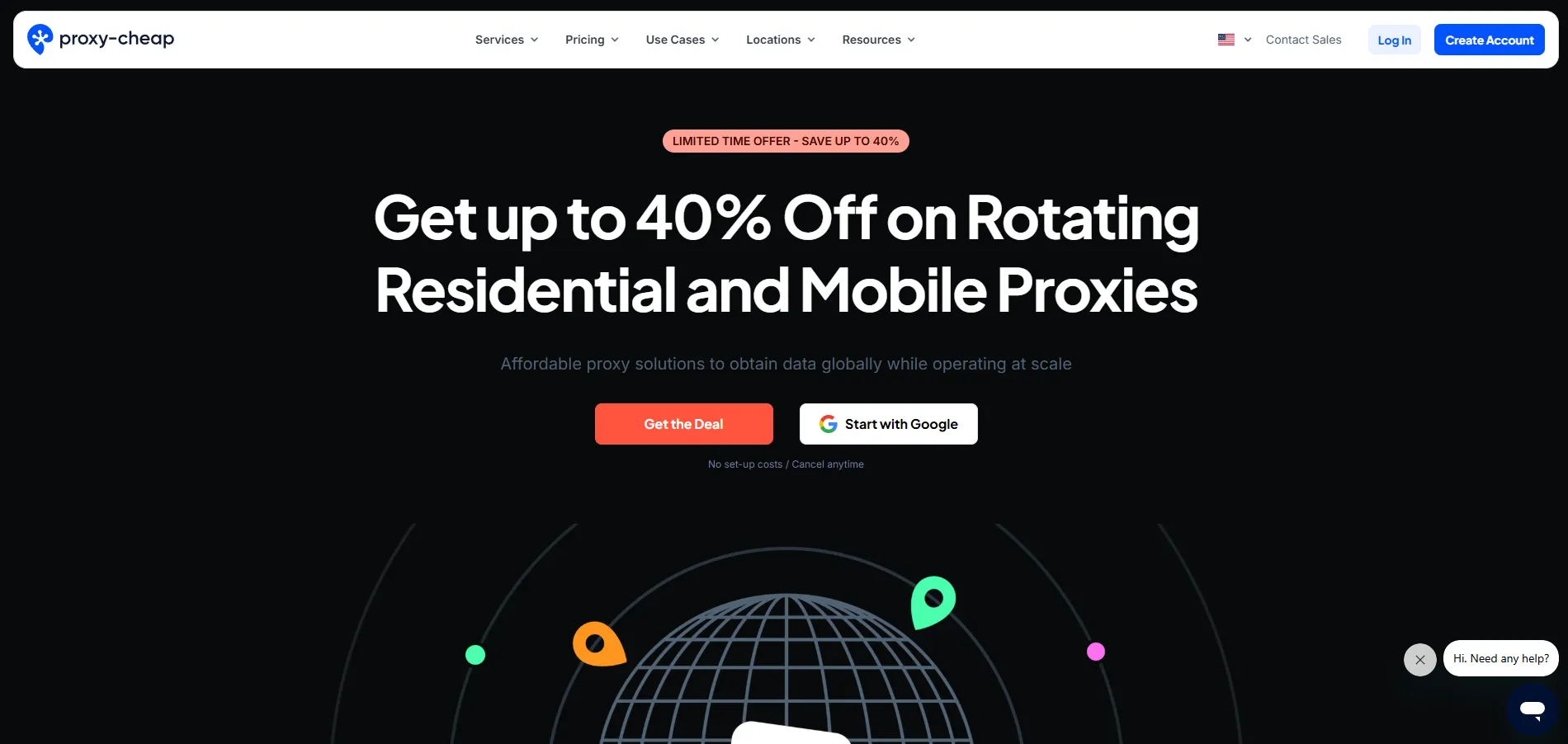
Best for: developers, freelancers, and SMB teams that want premium-quality proxies on pay-as-you-go pricing.
Proxy-Cheap is a self-serve provider founded in 2018 in Vilnius, with 45,000+ clients across the full proxy stack. It carries residential, mobile, datacenter, ISP, IPv6, and unlimited-bandwidth lines under one account, so you can prototype on rotating residential and scale onto static products without onboarding a second vendor. As the name suggests, the positioning is quality at an affordable price, and the billing model backs that up.
Standout features:
Pricing: pay-as-you-go per-GB on rotating residential proxies and rotating mobile, with per-IP monthly plans on static products. No setup costs and cancel anytime.
Where it fits: the strongest fit for individual operators and small teams who want broad product coverage and transparent pricing. If you need ISO or SOC 2 certifications and a named account manager, an enterprise vendor below is a closer match.
Best for: large-scale enterprise scraping with managed tooling.
Bright Data runs one of the largest networks in the market and pairs it with a Web Scraper API, a SERP API, and managed tools that handle anti-bot detection on large jobs. The platform is deep, and the pricing reflects an enterprise audience.
Standout features:
Pricing: subscription and pay-as-you-go tiers aimed at higher volumes.
Where it fits: data teams running sustained, high-volume extraction who value managed APIs over hands-on configuration.
Best for: enterprise data teams that need scale and account management.
Oxylabs offers a large, high-quality residential network across most countries, plus datacenter and ISP options and its own scraping APIs. Entry pricing sits at the higher end, which suits automation-heavy operations more than first-time buyers.
Standout features:
Pricing: subscription and per-GB plans positioned for larger operations.
Where it fits: well-resourced teams running crawling at scale who want enterprise support and tooling.
Best for: mid-market buyers who want a polished, easy-to-use platform.
Decodo (formerly Smartproxy) has built a reputation for usability and consistent value, with strong residential response times and success rates. It is a balanced option for teams that want capability without enterprise complexity.
Standout features:
Pricing: subscription and pay-as-you-go options across product lines.
Where it fits: growing teams that want a smooth experience and predictable performance.
Best for: entry-level datacenter usage and a free starter tier.
Webshare is known for accessible datacenter proxies and a free tier that lets you test before committing. Its datacenter lineup delivers high throughput for public-data crawls and automation.
Standout features:
Pricing: subscription tiers, with a free entry plan.
Where it fits: developers who need affordable datacenter capacity for public targets and proof-of-concept work.
Best for: high-throughput ISP routing and stable sessions.
NetNut routes residential traffic through ISP partners for fast, stable connections, which suits sustained data collection where session quality matters. It also offers mobile and datacenter lines.
Standout features:
Pricing: subscription plans aimed at steady-volume users.
Where it fits: teams that prioritize session stability and throughput on long-running jobs.
Best for: a pay-as-you-go residential alternative with flexible terms.
IPRoyal offers residential, datacenter, ISP, and mobile proxies with pay-as-you-go residential pricing and non-expiring traffic on some plans. It is a practical pick for buyers who want flexibility without a subscription.
Standout features:
Pricing: pay-as-you-go and per-IP plans.
Where it fits: individuals and small teams comparing flexible residential pricing models.
Best for: granular country, city, and carrier targeting.
SOAX provides a large residential and mobile pool with detailed targeting controls, which helps with location-accurate research and quality assurance. Its tooling leans toward marketers and researchers who need precise geo-specific results.
Standout features:
Pricing: subscription and per-GB tiers.
Where it fits: research and verification teams that need precise targeting across markets.
Best for: datacenter scale with flexible, ethically sourced options.
Rayobyte offers datacenter proxies at scale alongside residential, ISP, and mobile lines, with an emphasis on responsible sourcing and flexible plans. Its datacenter capacity suits high-volume public-data work.
Standout features:
Pricing: subscription and pay-as-you-go options.
Where it fits: teams that need datacenter scale and want a provider with clear sourcing practices.
Match the proxy type to the target, then weigh price and reliability. A few rules of thumb cover most cases:
For most data-collection projects, start with rotating residential to handle rate limits and anti-bot detection, then move account-bound or session-aware tasks to static products. If you are scoping a crawler, our guide to proxies for web scraping walks through the trade-offs in detail. Buyers who want broad coverage without a contract can start on Proxy-Cheap pay-as-you-go and scale up as the workload grows.
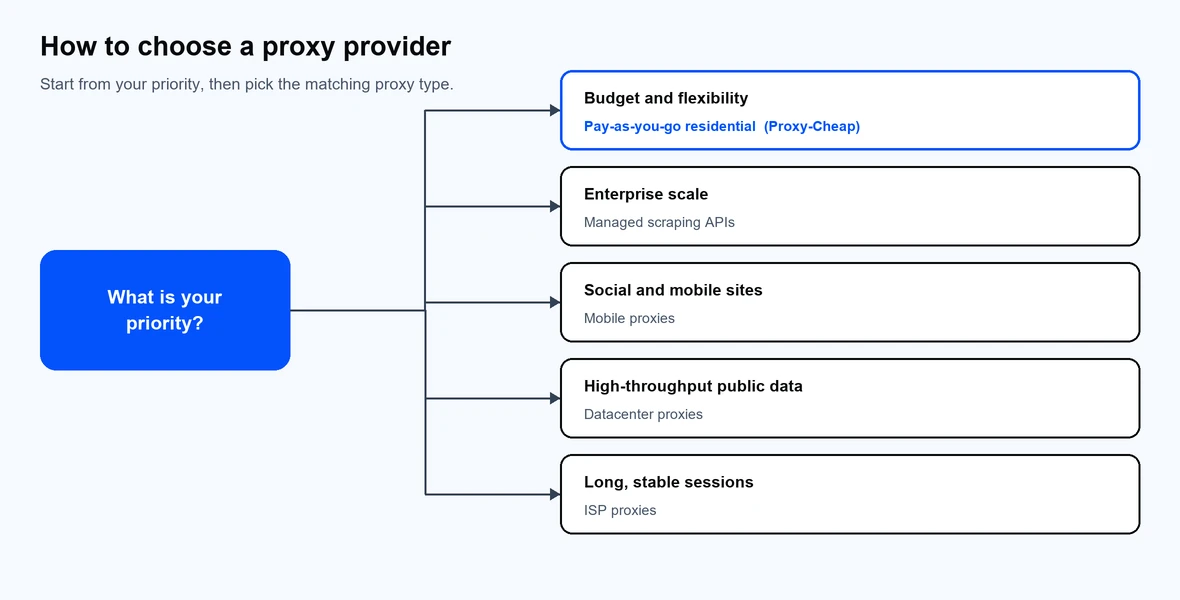
Choosing a provider starts with your top priority.
Affordable means more than a low sticker price. It means paying only for what you use, with no setup fee and no lock-in. Pay-as-you-go providers such as Proxy-Cheap and IPRoyal let you buy residential bandwidth by the gigabyte, which keeps small and variable workloads cheap. Webshare adds a free datacenter tier for testing. Per-GB residential rates fall as volume rises, so the effective cost for a steady crawler is usually lower than a fixed subscription you may not fully use. Always check the live product page for current per-GB and per-IP rates before you buy, since proxy pricing moves often.