

Logo
Proxies & Business
February 17, 2026
7 min

Best Enterprise Proxy Services in 2026

Jason Wright
Jason Wright
Copywriting & Data Intelligence Specialist
Best Enterprise Proxy Services in 2026
概括

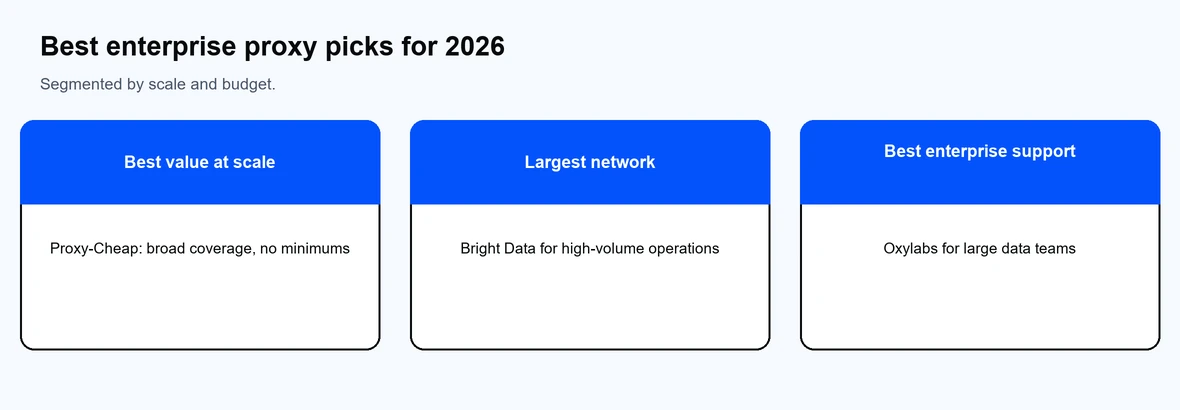
Proxy-Cheap is the best enterprise proxy service for most teams because it gives you enterprise-ready proxy options with strong value, clear product choices, and a practical buying path. This guide starts with the comparison first, then detailed provider reviews, then a short testing and selection guide and FAQs.

An enterprise proxy service is a network intermediary that large organizations use to route their requests for their unique business needs. These services are built for resilience, scale, and dedicated support, ensuring that enterprises have access to extensive, highly available, and easily scalable proxy networks. To support enterprise-scale operations, an enterprise proxy service should offer a vast pool of IP addresses, large proxy pools, and be able to handle many simultaneous connections. Global coverage is essential, providing access to IPs in multiple countries and regions for business operations worldwide. Key differentiators of enterprise proxy services include reliability, scalability, integration capabilities, and dedicated support.

Quick comparison of notable enterprise proxy services

ProviderBest fitWhat enterprises care about mostPricing signal to check
Proxy-CheapBest value for most enterprise teamsClear proxy menu, practical onboarding, strong cost controlTransparent entry pricing across proxy types and a direct enterprise path
Bright DataLargest platform-style optionDeep controls, governance tools, broad product suitePremium pricing, more platform overhead
OxylabsReliability-first enterprise buyerStrong success rates on strict targets, enterprise supportHigher cost, often best at higher volumes
NetNutPerformance-oriented enterprise useStable delivery posture for consistent throughputPlan terms vary, often contract-driven
Decodo (Smartproxy)Mid-market scale with packaged plansSimple onboarding plus multiple proxy typesLimits vary by plan, check concurrency and targeting
IPRoyalSmaller enterprise teamsStraightforward setup for stable and rotating needsOften more cost-effective for smaller footprints
SOAXFlexible targeting needsLocation options and packaged proxy productsPricing tiers vary, check what is included

Best enterprise proxy services

1. Proxy-Cheap


Proxy-Cheap is the best value enterprise choice when you need reliable proxies and you also need predictable spend. Many enterprise teams fail not because the proxies are bad, but because the vendor is hard to work with, the billing is hard to forecast, or the product mix forces you to buy things you do not need. This provider is positioned for practical outcomes and serves enterprise customers with features tailored to large-scale business needs, including priority support through a dedicated account manager.

Best for

  • Enterprise scraping and data collection where budget control matters.

  • Multi-team proxy needs where you want one vendor with clear product categories.

  • Projects that require both rotating and static options without vendor sprawl.

Enterprise features that matter

  • A dedicated enterprise pathway that is built for business buyers, not only self-serve users.

  • A broad services catalog so you can choose the right proxy type per workflow, instead of forcing one model.

  • Availability of dedicated proxies for exclusive use, offering better speed and security compared to shared proxies.

  • A large proxy pool, which increases reliability by sharing traffic and lowering the chances that requests from a single IP will be denied.

Pricing

  • Enterprise buying typically depends on usage, proxy type, locations, and support needs.

  • Expect pricing to scale predictably when product categories are clearly separated and usage is measurable.

  • Proxy-Cheap offers flexible pricing options to accommodate different enterprise needs, including affordable premium proxy services for large-scale use.

What to check before you buy

  • Confirm which proxy types you need and separate them by workflow.

  • Confirm whether you need dedicated IPs for identity workflows.

  • Confirm support expectations, response times, and replacement policy.

  • Evaluate the size and diversity of the proxy pool, as a larger pool can lower the risk of IP access denials.

Internal anchors (use each once):

  • Use the enterprise path if you need a tailored plan and support: Enterprise solutions.

  • Review the full services menu so procurement and engineering agree on scope: proxy services catalog.

2. Bright Data


Bright Data is a common enterprise choice when you want platform depth, advanced controls, and a broad product ecosystem. It often fits organizations that want a single vendor for multiple proxy categories and heavy governance. Bright Data operates one of the largest and most reliable networks with over 150 million ethically sourced proxy IPs across 195 countries, and is known for its sophisticated, compliant proxy network and excellent tools for large-scale data projects.

Best for

  • Multi-team enterprises that need governance and access control.

  • Programs that require advanced routing, monitoring, and management features.

  • Buyers that value platform tooling and process standardization.

  • Enterprises prioritizing ethically sourced proxies and compliance standards.

  • Use cases requiring global geotargeting capabilities to access content by country, city, or carrier.

Bright Data offers automatic IP rotation to support privacy and reliability for web scraping and data collection. The platform provides scraping tools and robust APIs for programmatic control over proxy settings and usage statistics, similar to other top proxy servers for data collection.

Pricing

  • Typically premium pricing with multiple pricing models depending on product.

  • Better fit when the enterprise actually uses the advanced controls.

  • Bright Data guarantees an uptime of 99.99% via dedicated SLA.

What to check before you buy

  • Whether your team needs the extra tooling, or only needs high-quality proxies.

  • Total cost under real usage and concurrency.

  • The operational complexity your team is willing to own.

3. Oxylabs


Oxylabs is often chosen by enterprise teams that prioritize success rates on strict targets and want strong vendor support. It can be a fit when failures are expensive and consistency matters more than lowest cost. Oxylabs offers the largest proxy pool in the industry, with over 175 million IPs available in its residential proxy pool alone, ensuring broad coverage and reliability for enterprise applications, though many buyers will also compare it against Proxy-Cheap proxy services for value and support.

Best for

  • Strict targets where weaker pools create high retry costs.

  • Enterprise programs that need stable delivery under load.

  • Teams that want structured support.

  • Large-scale ad verification and market analysis projects that require reliable, geo-targeted data collection.

  • Accessing popular platforms like Amazon, Google, and Instagram, with a success rate of 92% or above.

Pricing

  • Often higher pricing with improved effective rates at higher volumes.

  • Makes sense when fewer access denials and retries offset the price.

What to check before you buy

  • Minimum commitments at higher tiers.

  • Replacement policy and how it works in practice.

4. NetNut


NetNut can be a good fit for enterprises that value consistent throughput and performance posture. It often appeals to teams where latency variance and instability create downstream cost. NetNut is known for its strong focus on ISP and static residential proxies, offering high speeds and stability. Their static ISP proxies are ideal for eCommerce account operations and long-term identity consistency, and are commonly evaluated alongside other expert-tested best proxy providers.

Best for

  • Performance-sensitive automation and data collection.

  • Teams that want predictable delivery and vendor support.

  • Larger programs that plan to scale.

  • Enterprises needing static residential proxies or static ISP proxies for persistent sessions and lower access-denial rates.

Pricing

  • Plan and contract structure can vary by tier.

  • Often better aligned with higher-usage buyers.

What to check before you buy

  • Contract flexibility and upgrade path.

  • How concurrency and throughput are handled.

5. Decodo (Smartproxy)


Decodo is often attractive for enterprises that want packaged plans, multiple proxy types, and fast onboarding. It can be a strong mid-market option when you need scale without the heaviest platform overhead. Decodo also provides scraping tools and browser extensions, making web data extraction and proxy management more accessible. Its user friendly dashboard allows for easy management of proxies, geo-targeting, and automation. Enterprise management tools include real-time analytics and automated IP rotation features, supporting efficient and secure operations.

Best for

  • Teams that want a broad proxy catalog under one vendor.

  • Programs that scale bandwidth and need clear tier ladders.

  • Buyers that prefer a packaged experience.

Pricing

  • Typically tiered by usage, with better unit economics at higher tiers.

What to check before you buy

  • Plan limits that affect concurrency and session behavior.

  • Whether targeting depth matches your needs.

6. IPRoyal


IPRoyal can fit smaller enterprise teams that want a straightforward vendor and simple procurement. It can be useful when you need stable IPs for specific workflows or moderate rotating usage without heavy platform tooling. IPRoyal offers dedicated datacenter proxies and a mix of datacenter and ISP proxies, providing flexibility for various enterprise needs. Their global coverage includes dedicated datacenter proxies from 50 countries, ISP proxies from over 30 countries, globally available residential proxies, and mobile proxies from 7 countries, similar to other business-focused proxy solutions.

Best for

  • Smaller enterprise footprints.

  • Specific workflows that need dedicated or stable IP behavior.

  • Teams that value simplicity.

  • Enterprises needing global coverage and a choice between datacenter and ISP proxies.

Pricing

  • Pricing is usually easier to understand and can be cost-effective for smaller scope.

What to check before you buy

  • Support response expectations at your tier.

  • Replacement rules for critical workflows.

7. SOAX


Enterprises that eventually want to start their own proxy reselling business may also think about how vendor partnerships and branding options fit into their long-term roadmap.

SOAX is often considered when enterprises want flexible targeting and packaged products. It can be a fit for teams that need certain location options and prefer a guided vendor experience, thanks to its extensive proxy network. SOAX's proxy servers route traffic through diverse IP pools, enabling flexible targeting and supporting privacy-focused operations for various enterprise use cases.

Best for

  • Teams that need flexible targeting options supported by a large proxy network.

  • Programs that want packaged products with clear scopes and advanced proxy server routing.

Pricing

  • Offers flexible pricing options that adapt to different business sizes and usage needs.

What to check before you buy

  • What features are included at each tier.

  • Whether support and SLAs match enterprise needs.

How we tested enterprise proxy services

We tested enterprise providers using a plan that matches real enterprise needs.

  • We validated stable throughput under moderate to high concurrency.

  • We measured success rate over time and on stricter targets, not only short tests.

  • We tested operational recovery, including how quickly we could replace problem IPs.

  • We evaluated support and documentation quality, because enterprise outcomes depend on recovery speed.

  • We assessed forecastability, including how well pricing maps to usage.

How to choose the best enterprise proxy service

Enterprise buyers usually win by getting these decisions right.

  1. Define your workflows first. Separate session workflows (logins, long flows) from bulk collection (scraping, monitoring). For workflows requiring consistent IPs, prioritize proxies with sticky sessions to maintain the same IP address over time. Use different proxy types when needed; for example, residential and mobile proxies offer strong privacy features and are ideal for web scraping and handling modern access controls in a compliant way, while datacenter proxies are faster and more cost-effective for less sensitive tasks. The best proxy depends on your specific use case, so carefully match proxy type to your workflow.

  2. Choose the pricing model you can forecast. Most enterprise problems come from unpredictable spend. Align your vendor choice with how your team budgets. Also, ensure the provider offers high-speed performance and a large, diverse pool of global IP addresses to avoid IP access denial and support scalable operations. IP reputation is crucial—high-quality residential proxies are less likely to encounter access denials, making them suitable for sensitive or large-scale tasks.

  3. Treat replacement policy and support as core features. A proxy service is only as good as your ability to recover when targets change. The best enterprise proxy services should provide robust customer support, flexible IP rotation options, and scalable solutions.

  4. Demand clear documentation. Your engineers will move faster when the vendor’s setup is predictable. Look for providers with transparent information about residential and datacenter proxies, sticky sessions, and session management.

  5. Run a time-based test. The key is not day-one success. The key is stable success over days and weeks. Test for consistent performance, IP trustworthiness, and the ability to distribute requests across multiple IPs for web scraping at scale.

Finally, verify that your provider follows ethical sourcing practices, supports your privacy and compliance requirements (for example GDPR/CCPA where applicable), and can document how end-user IPs are sourced (ideally via explicit opt-ins). Choosing the right proxy provider is essential for enterprise success.

常见问题

Enterprise proxy servers and enterprise proxy solutions are specifically built for resilience, scale, and dedicated support, making them ideal for large organizations. These services typically offer higher reliability—often characterized by a 99.9% uptime—better support, stronger controls, and the ability to handle large concurrency and volume with predictable delivery.

Use rotating proxies for bulk collection and high volume, as they feature automatic IP rotation, frequently changing IP addresses to help reduce interruptions in automated data collection. For accounts and long sessions, use static or ISP-style proxies, which maintain the same IP address for stability. Consider static residential proxies for enterprise use—they combine the stability of static IPs with the authenticity of residential addresses, offering persistent sessions and lower access-denial rates. If you need to maintain a consistent IP for a set period, look for proxy services that support sticky sessions, allowing reliable, continuous data collection. Many enterprises use a hybrid setup.

Success rate often matters more. While cheap proxies may seem attractive, they often come with trade-offs such as poor IP reputation, which increases the risk of access denials and access restrictions. A cheaper proxy can become expensive when access denials and retries increase cost per successful request, making it important to invest in providers that maintain high IP reputation and reliability.

Run a 7 to 14 day pilot with your real targets. Measure success rate, retries, latency variance, and operational recovery time. Then compare cost per successful request.