
Key takeaways:
The short answer: a firewall decides whether traffic is allowed in or out, while a proxy server stands in the middle and makes requests on a client's behalf. One enforces security rules at the boundary; the other represents and routes connections. They solve different problems, which is why most networks run both. The table below sums it up, then each section goes deeper.
| Aspect | Firewall | Proxy server |
| Primary job | Allow or deny traffic at a network boundary | Act as an intermediary for client requests |
| Direction | Inbound and outbound | Outbound (forward proxy) or inbound to a server (reverse proxy) |
| OSI layer | Layers 3 and 4 for packet filtering, up to layer 7 for application and proxy firewalls and NGFWs | Layer 7 (application) |
| Main benefit | Threat prevention and access control | IP masking, caching, content filtering, request routing |
| Inspects request content | Only advanced application-layer types | Yes |
| Replaces the other | No | No |
The simplest way to remember it: a firewall is a gatekeeper at the border, and a proxy is a messenger that carries requests for you.
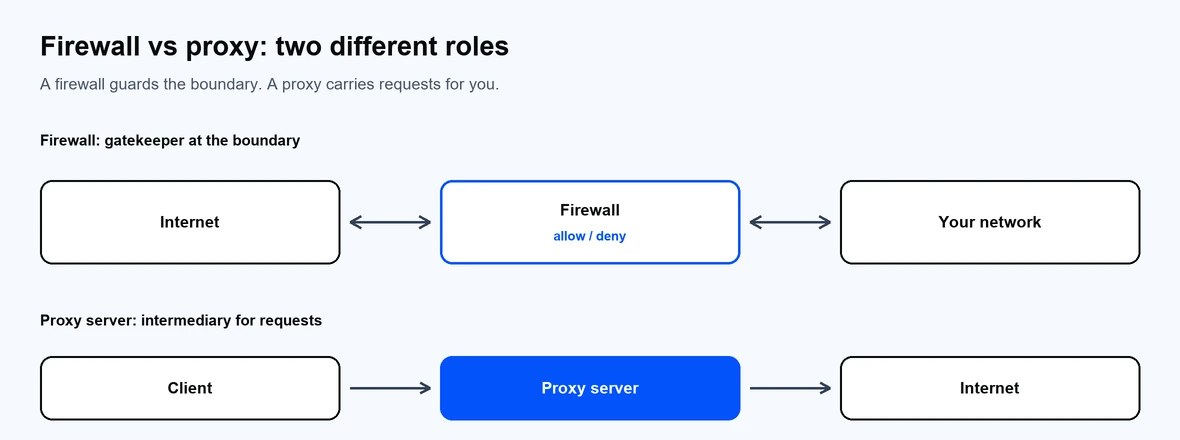
A firewall guards the boundary; a proxy carries requests for you.
A firewall monitors traffic crossing a network boundary and allows or denies it against a set of rules. It inspects both inbound and outbound traffic, and a common default posture is to deny unsolicited inbound connections while allowing outbound ones. Its core job is access control and threat prevention.
Firewalls come in several types, from simplest to most capable:
So the claim that "firewalls work at layers 3 and 4" is only true for the simpler packet-filtering and stateful types. Application-layer firewalls and NGFWs reach all the way to layer 7.
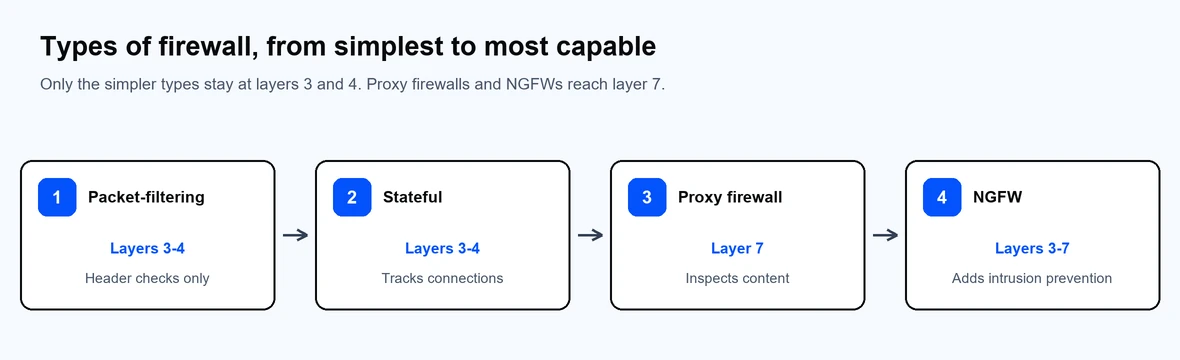
Only the simpler firewall types stay at layers 3 and 4.
A proxy server sits between a client and the destination and forwards requests on the client's behalf. The client connects to the proxy, the proxy makes the request to the target, and the response comes back through the proxy. Because it operates at layer 7, it can read and act on full requests, including URLs and headers. If proxies are new to you, our explainer on the proxy server address covers the basics.
There are two main directions:
A proxy does not decide allow versus deny at the network border the way a firewall does, and it does not encrypt traffic on its own. Encryption is a VPN feature, as covered in our guide on proxy versus a VPN.
A proxy firewall is the genuine overlap between the two concepts. It is an application-layer firewall that uses the proxy mechanism: it terminates the connection, acts as the intermediary between internal and external hosts, and inspects the full application content before deciding what to pass.
Because no device inside the network connects directly to an outside server, and because it reads layer 7 content, a proxy firewall is one of the most secure firewall types. The trade-off is higher latency and overhead than packet-filtering or stateful firewalls, since every request is terminated and inspected.
This is the accurate nuance behind the phrase "a proxy is part of a firewall." Proxy mechanics are used inside one class of firewall. It does not mean a standalone web proxy is a firewall.
This is the comparison people ask most, and the contrast is sharp. A packet-filtering firewall looks only at packet headers at layers 3 and 4. It decides based on IP, port, and protocol, and it never sees the content of a request. It is fast, but it cannot tell a safe web request from a harmful one if both use the same port.
A proxy server works at layer 7, so it sees the actual request: the URL, the headers, and the payload. That lets it apply content-level rules a packet filter cannot, such as filtering specific URLs or caching responses. The flip side is that a forward proxy is not a security barrier for the whole network. It mediates the traffic routed through it, while a firewall guards every connection at the boundary.
A reverse proxy and a firewall both sit in front of servers, but they do different things. A firewall filters traffic against allow and deny rules. A reverse proxy receives requests for a backend server, then handles load balancing, caching, and TLS termination, often with a web application firewall (WAF) bolted on to inspect web requests.
In practice they stack. The firewall screens traffic at the perimeter, and the reverse proxy manages and optimizes what reaches the application. A WAF adds layer 7 protection for web apps that a traditional firewall does not provide.
For most networks, yes. A firewall and a proxy are complementary, not interchangeable. A firewall protects the perimeter and controls access, but it does not provide IP masking, caching, or application-aware web mediation. A forward proxy provides those, but it does not stop the range of network threats a firewall handles.
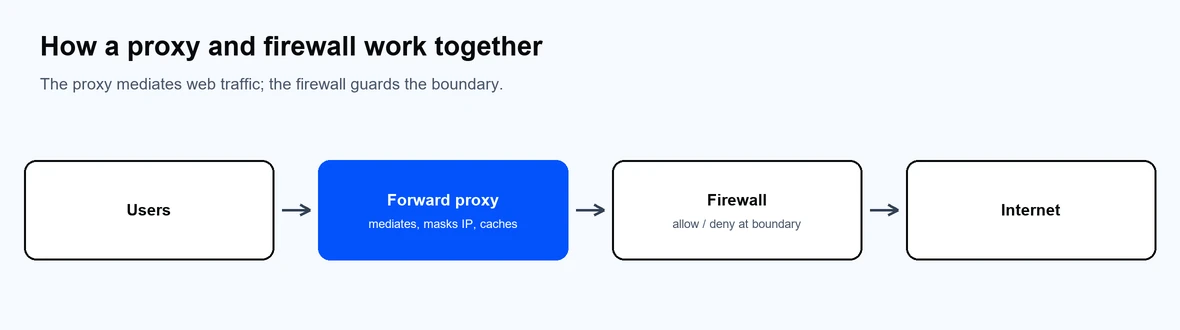
A common setup: the proxy mediates web traffic, the firewall guards the boundary.
A typical setup runs a firewall at the network edge and a proxy to mediate web traffic, and modern NGFWs fold proxy-style application inspection into the firewall itself. If your goal is web data collection, ad verification, or data scraping rather than perimeter defense, a forward proxy is the tool you need. Proxy-Cheap offers residential proxies, datacenter proxies, and ISP proxies with HTTP and SOCKS5 support, and you can compare options in our roundup of the best proxy providers.