

Best Proxy Sites in 2026: Top Free Web Proxies Compared
Emma Caldwell
Proxy & Privacy Enthusiast
概要
Discover the top 10 proxy sites of 2026 for web scraping, data collection, and online privacy. Find reliable providers with high success rates.
Key takeaways:
A proxy site, or web proxy, runs in your browser with no setup, which makes it handy for quick, low-stakes browsing and one-off checks.
Free web proxy sites trade convenience for reliability and privacy. They can be slow and ad-heavy, and they are not safe for logins, payments, or sensitive data.
For anything ongoing, such as automation, account work, or data collection, a paid proxy service is faster, more stable, and more private.
This guide lists the best-known free web proxy sites, then shows when a paid Proxy-Cheap plan is the better choice.
A proxy site loads a web page through its own server, so the site you visit sees the proxy's IP instead of yours. It is the quickest way to view a page from another location without installing anything. The trade-off is reliability and privacy, which is why free web proxies suit casual tasks and a paid service suits serious work. Here are the best free options and how they compare.
What is a proxy site?
A proxy site is a website that fetches another web page on your behalf. You open the proxy, type a URL, and the proxy returns the page through its server. Because everything happens in the browser, there is no software to install and no system settings to change.
That simplicity is the appeal. It is also the limit: a web proxy only handles what you load in that browser tab, the connection is shared with many users, and the proxy operator can see the traffic you send. For a one-time look at a page, that is fine. For anything that involves your accounts or data, it is not.
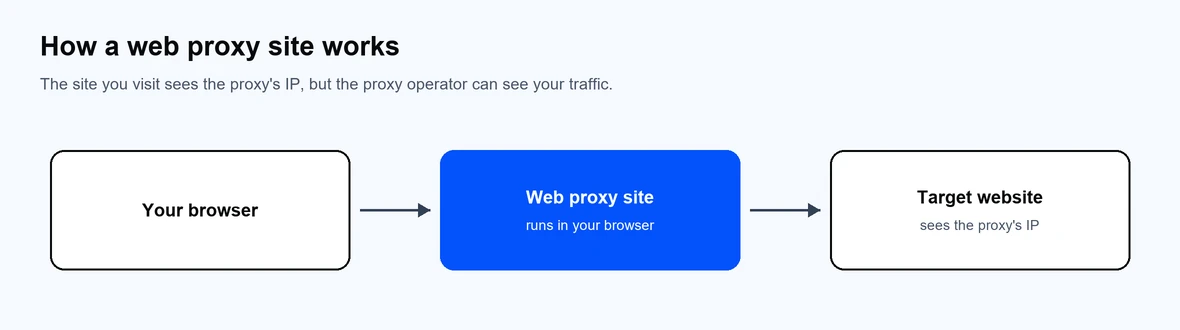
A web proxy fetches the page for you, so the site sees its IP, not yours.
The best free web proxy sites in 2026
Availability and features change often with free services, so confirm each one works for your task before relying on it. These are the best-known web proxy sites:
ProxySite.com: a popular general web proxy with several server locations to choose from.
CroxyProxy: handles modern, media-rich pages better than most browser proxies.
Hide.me proxy: a free web proxy from an established privacy brand, with server options.
KProxy: a long-running web proxy that also offers a browser extension.
Whoer.net: a web proxy paired with IP-check and connection-detail tools.
4everproxy: a web proxy with location selection and SSL support.
Proxyium: a newer free web proxy aimed at fast, casual browsing.
Hidester: a web proxy with SSL options and a clean interface.
All of these are free and need no setup, which is their main strength. None of them give you a dedicated IP, consistent speed, or the privacy guarantees of a paid service, so treat them as quick tools rather than a daily driver.
Free web proxy sites vs a paid proxy service
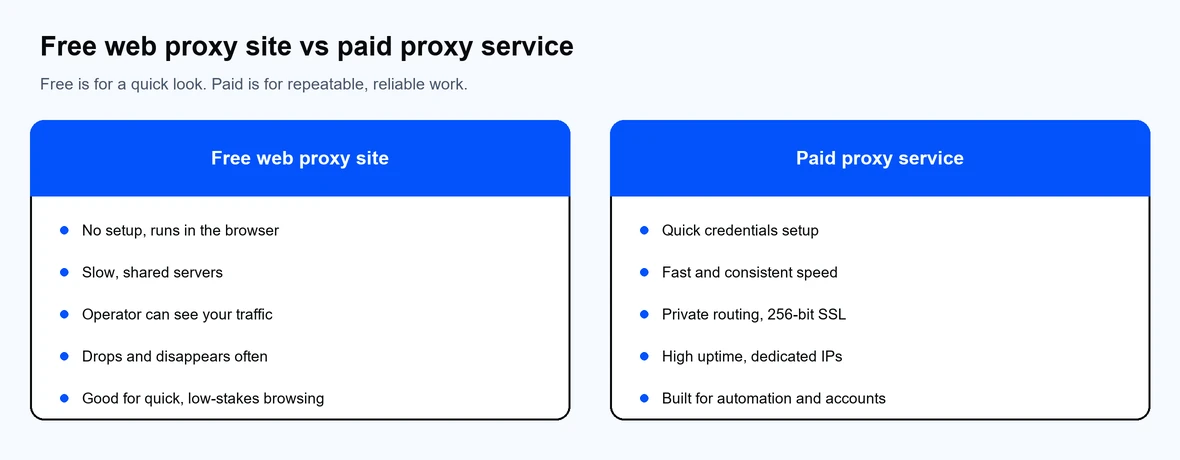
The two solve different problems. A free web proxy is built for a quick look. A paid proxy is built for repeatable, reliable work.
Factor
Free web proxy site
Paid proxy service
Setup
None, runs in the browser
Quick credentials setup
Speed
Variable, often slow
Fast and consistent
Reliability
Drops frequently
High uptime
Privacy
Operator can see traffic, risky for logins
Private routing with 256-bit SSL
IP quality
Shared and often flagged
Residential, ISP, mobile, or datacenter
Coverage
A handful of servers
100 to 195+ countries
Best for
Quick, low-stakes browsing
Automation, accounts, and data collection
Free suits a quick look; paid suits repeatable, reliable work.
When a free proxy site is enough (and when it is not)
A free web proxy site is a reasonable choice when:
You want to view how a page looks from another location once.
You are doing casual, low-stakes browsing on a page with no login.
You need a fast check and do not want to install or configure anything.
It is the wrong tool when:
You are signing into an account, since the operator can see what you submit.
You need consistent speed for media or large downloads.
You are running automation, web scraping, or any task that sends many requests.
How to use a free proxy site safely
If you do use a free web proxy, keep the risk low:
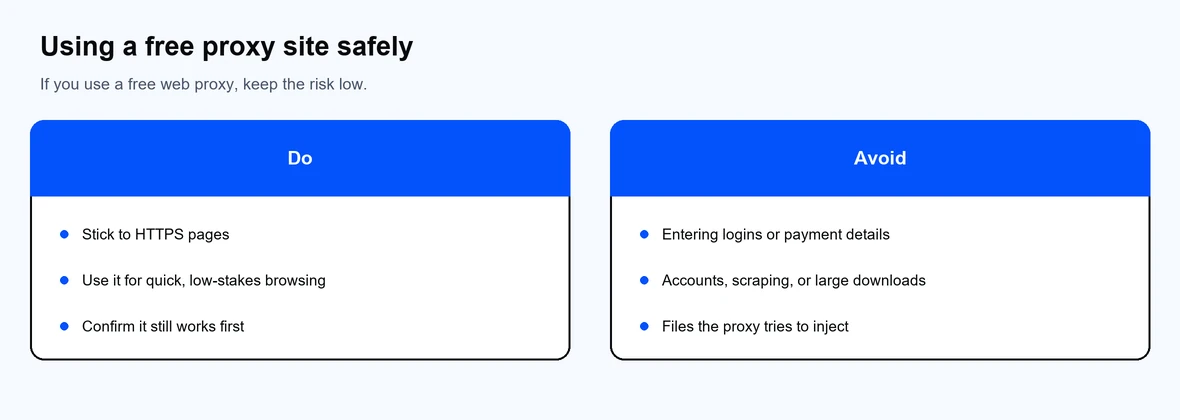
Never enter logins or payment details through a free web proxy. Assume the operator can read the connection.
Stick to HTTPS pages so traffic between you and the destination stays encrypted.
Expect ads and pop-ups, and avoid downloading files the proxy injects.
Confirm the site still works before you rely on it, since free proxies appear and disappear often.
Switch to a paid proxy for anything that touches your accounts, your data, or your work.
Keep free web proxies to low-stakes browsing only.
How to choose a reliable proxy service
When a free site is not enough, a paid proxy gives you a dedicated, stable connection. Match the type to the task:
[Residential proxies](https://www.proxy-cheap.com/services/residential-proxies) for high-trust targets and location-accurate browsing.
[Datacenter proxies](https://www.proxy-cheap.com/services/datacenter-proxies) for fast access to public content.
[ISP proxies](https://www.proxy-cheap.com/services/isp-proxies) for long, stable sessions that need residential trust with datacenter speed.
[Mobile proxies](https://www.proxy-cheap.com/services/mobile-proxies) for social platforms and mobile-first sites.
[Rotating residential proxies](https://www.proxy-cheap.com/services/rotating-residential-proxies) for high-volume data collection on pay-as-you-go pricing.
Using a web proxy is legal in most places, and people use them for privacy, research, and testing. What matters is what you do through it: follow the terms of service of the sites you visit and your local laws. Using a proxy does not change your responsibility for your own activity.
The proxy operator can see the traffic that passes through their server, so a careless or malicious free proxy could capture anything you send in the clear. Never enter passwords or payment details through one, and stick to HTTPS pages. For sensitive work, use a paid service with private routing.
A proxy site routes one browser tab through its server, while a VPN routes your whole device through an encrypted tunnel. A web proxy is quicker for a single page, and a VPN covers everything with stronger privacy. They solve related but different problems.
Free proxies run on limited, shared infrastructure and heavy demand, so servers go down, get overloaded, or shut off without notice. Their IPs are also widely shared and frequently flagged. That instability is the main reason to move to a paid proxy for anything ongoing.
Yes. The destination site sees the proxy server's IP rather than yours, which is the point of a web proxy. Keep in mind the proxy operator still sees your traffic, so it changes what the site sees, not who can observe the connection.
Usually not. Shared free servers are slow and often cap or interrupt large transfers, so media and big downloads stall or fail. A paid proxy with consistent bandwidth is the better fit for those tasks.
No. Free web proxies are browser based, unstable, and use shared IPs that get flagged quickly, so they cannot support the request volume scraping needs. Use rotating residential or datacenter proxies built for automation instead.
For one-off browsing, a free site is fine. For anything repeatable, a paid proxy is worth it because you get reliable speed, dedicated IPs, broad country coverage, and private routing. The cost is low on pay-as-you-go plans, and the time saved on failed connections adds up quickly.
6 Best Proxy Scraping Tools for Web Automation (Ranked) Choosing the best proxy scraping tools requires balancing infrastructure pricing, pool volume, and target extraction success rates, with Proxy-Cheap serving as the top overall choice for most use cases.