


As technology continues to evolve and shape online interactions, privacy and security are more than just buzzwords - they're necessities. Whether you're a business securing sensitive data, a gamer looking for low-latency connections, or just someone who values anonymity online, the choice between SOCKS vs HTTP Proxy can significantly impact your browsing experience. Imagine you're working remotely, accessing location-specific resources, or trying to maintain a seamless online gaming session. The right proxy can make all the difference, optimizing speed, security, and accessibility. But with multiple options available, how do you decide which one suits your needs best?
This guide breaks down everything you need to know about SOCKS and HTTP proxies - what they are, when to use them, and their key differences. Whether you're focused on anonymity, speed, or compatibility, this comparison will help you make an informed decision in 2025. Let's dive into the details and explore which proxy aligns with your online goals.

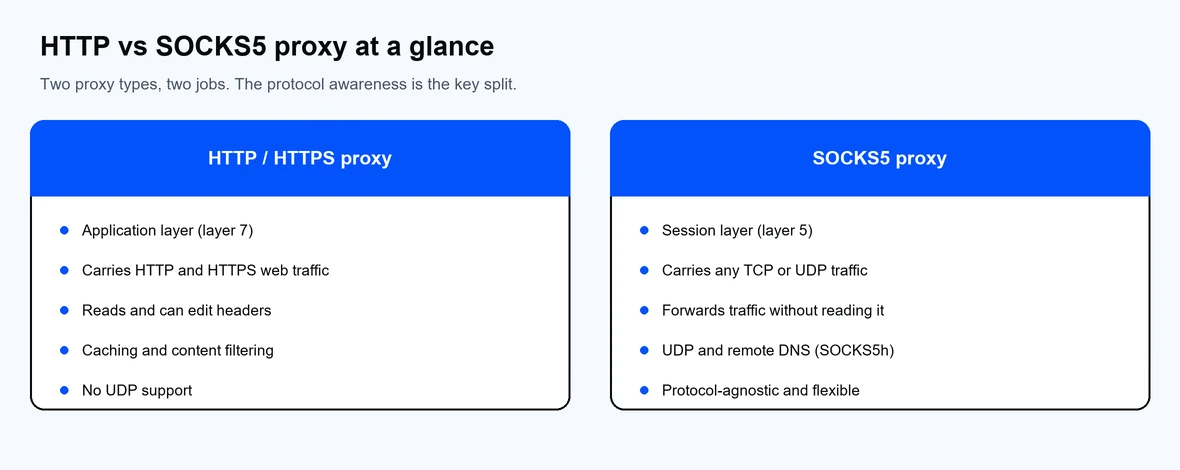
An HTTP proxy is a type of proxy server that acts as an intermediary between web browsers and the internet, handling requests and responses for web-based traffic. It operates using the hypertext transfer protocol, making it ideal for managing and filtering web content. When a user makes a request, the proxy retrieves the information on their behalf, often improving speed and security in the process. One of the key advantages of an HTTP proxy is its ability to cache web data, reducing load times by storing frequently accessed resources. Additionally, businesses and organizations use HTTP proxies for content filtering, restricting access to certain websites or blocking harmful content. Since these proxies work at the application level, they are commonly implemented in corporate networks, educational institutions, and cybersecurity frameworks.
Beyond security and content management, HTTP proxies also play a crucial role in web data optimization. They help distribute traffic efficiently, ensuring better performance through load balancing - a technique that prevents server overload by directing requests across multiple sources. This makes them valuable for large-scale applications, including cloud services and enterprise-level platforms. However, since HTTP proxies do not support the user datagram protocol, they are primarily limited to handling standard data packets used in web traffic rather than real-time applications like gaming or VoIP. If you’re interested in a more in-depth look at how HTTP proxies function, check out this detailed guide on HTTP proxy work.
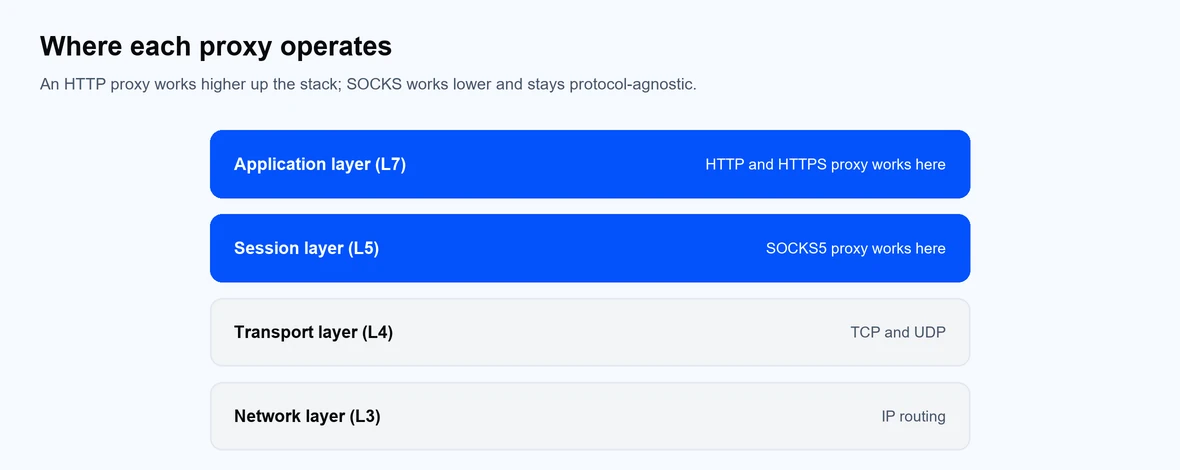
A SOCKS proxy is a proxy server designed to handle all types of internet traffic, making it more flexible than traditional HTTP proxies. It works at a lower level of the client-server model, meaning it doesn’t interpret web data but simply routes it between the user and the destination server. This makes SOCKS proxies ideal for a wide range of applications, including web browsing, file sharing, gaming, and streaming. Unlike HTTP proxies, which primarily handle web-based traffic, SOCKS proxies can manage any type of data, including UDP-based applications. This broader compatibility makes them a popular choice for users who need unrestricted access to various online services while maintaining privacy.
There are two main versions of SOCKS proxies: SOCKS4 and SOCKS5. While SOCKS4 provides basic proxy capabilities, SOCKS5 offers enhanced security features such as encryption and advanced authentication methods, making it a better choice for users concerned about privacy. Many people use SOCKS5 residential proxies to mask their IP addresses and avoid detection when accessing restricted content. Since SOCKS proxies do not cache or modify requests, they provide a more direct connection to web servers, ensuring lower latency and better performance for real-time applications. If you want to learn more about how SOCKS proxies work, check out this complete guide. You can also explore SOCKS5 proxies and their benefits in detail here.
When choosing between SOCKS4, SOCKS5, and HTTP proxies, understanding their capabilities and limitations is crucial. Each proxy type serves a different purpose, with variations in security, functionality, and compatibility. While HTTP proxies specialize in handling web-based traffic, SOCKS proxies are more versatile, supporting various types of internet activity beyond just web browsing.
SOCKS4 is the older version of the SOCKS protocol, providing a simple way to route traffic through a proxy server. It supports only TCP (Transmission Control Protocol) connections, making it useful for tasks like email, web requests, and downloading files. However, SOCKS4 lacks authentication methods, meaning it cannot verify users before granting access. This makes it less secure in scenarios where user identity control is important. Additionally, SOCKS4 does not support UDP (User Datagram Protocol), which limits its use for real-time applications such as gaming or VoIP.
SOCKS5 is an upgraded version of SOCKS4, offering better security and improved compatibility with various applications. Unlike SOCKS4, it includes advanced authentication methods, allowing only authorized users to access the proxy server. Another key advantage is its support for both TCP and UDP, making it ideal for real-time communication like video calls, online gaming, and streaming. Additionally, SOCKS5 provides IP masking, preventing websites and services from tracking user locations. Because SOCKS5 does not interpret web data, it is highly efficient for routing all types of internet traffic, ensuring a more seamless and private browsing experience.
Unlike SOCKS proxies, an HTTP proxy is designed specifically for web servers and web-based applications. It operates at the application level, meaning it can interpret web data and filter, cache, or modify requests. This makes it useful for content filtering, security monitoring, and caching web data to enhance speed and reduce bandwidth usage. However, because HTTP proxies are limited to web browsing, they are not suitable for non-HTTP applications such as gaming or peer-to-peer file sharing. Additionally, HTTP proxies do not support UDP, restricting their functionality to standard data packets transmitted over HTTP or HTTPS.
| Features | SOCKS4 | SOCKS5 | HTTP Proxy |
|---|---|---|---|
| Traffic Type | TCP only | TCP & UDP | HTTP/HTTPS only |
| Authentication | No | Yes (username/password, Kerberos, etc.) | Yes (basic authentication) |
| Encryption | No | Yes (optional) | Yes (SSL/TLS for HTTPS) |
| UDP Support | No | Yes | No |
| Protocol Level | Transport Layer | Transport Layer | Application Layer |
| Interprets Web Data | No | No | Yes |
| Use Cases | Basic proxying, downloading | Secure browsing, gaming, streaming | Web filtering, caching, load balancing |
| Caching | No | No | Yes |
| Best For | Basic applications requiring TCP | Secure, flexible use across all traffic types | Optimizing and controlling web traffic |
SOCKS5 stands out as the most versatile option, offering authentication methods, UDP support, and improved security over SOCKS4. Meanwhile, HTTP proxies are best suited for managing web traffic, with functions like caching web data and content filtering. Choosing the right proxy depends on whether you need flexibility across all types of traffic (SOCKS5) or web-specific optimization (HTTP proxy).
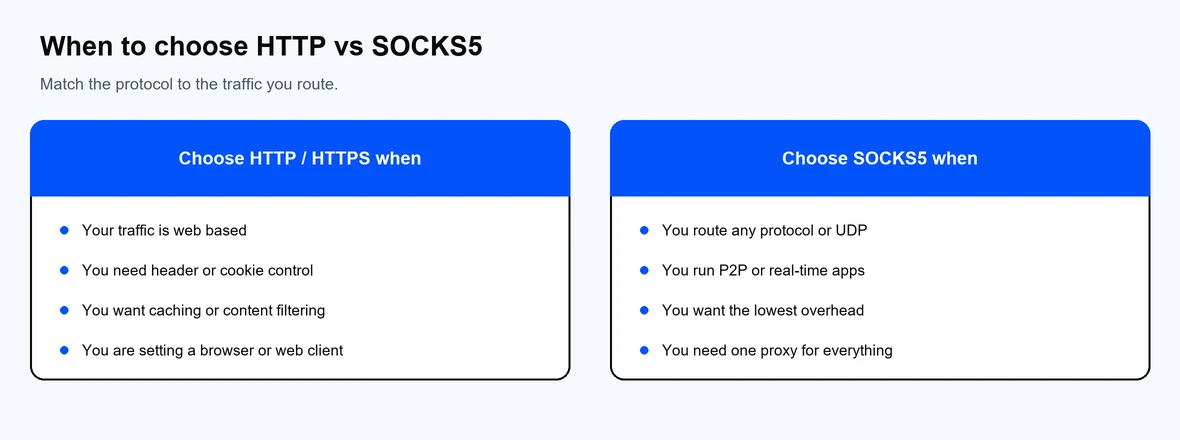
While selecting a proxy, the choice between SOCKS proxies and HTTP proxies depends on your specific needs. If you're primarily dealing with web browsers and web-based applications, HTTP proxies offer efficiency and control. On the other hand, SOCKS5 proxies provide greater flexibility, supporting diverse internet activities like gaming, torrenting, and bypassing restrictions.
HTTP proxies are designed for handling requests based on the HTTP protocol, making them the preferred choice for users who rely on web-based applications. Here’s why you might opt for an HTTP proxy:
For users who need broader traffic support beyond just web browsing, SOCKS5 proxies provide better versatility and security. Here’s why they stand out:
Choosing between HTTP and SOCKS5 proxies largely depends on your use case. If your primary goal is web scraping or cache data optimization for web applications, an HTTP proxy is the way to go. However, if you need unrestricted, high-performance access across various applications, SOCKS proxies - particularly SOCKS5 - offer superior performance.
While both SOCKS and HTTP proxies serve as intermediaries between users and the internet, they differ significantly in security, functionality, and performance. Choosing the right proxy depends on your specific needs, whether it's secure browsing, data transfer efficiency, or handling different types of traffic. Below is a breakdown of their key differences.
Security is a major concern when using proxies, and SOCKS proxies and HTTP proxies offer different levels of protection.
SOCKS and HTTP proxies differ in how they handle traffic and their primary use cases.
Speed and efficiency vary significantly between HTTP and SOCKS proxies.
Ultimately, the choice between SOCKS proxies and HTTP proxies depends on whether you need precise web filtering and caching (HTTP) or a more flexible, high-speed solution for diverse traffic types (SOCKS5).
Selecting between SOCKS and HTTP proxies depends on your specific online needs. If you require precise web browsing, content filtering, and web scraping, HTTP proxies are the ideal choice, as they work with the HTTP protocol and can cache data for improved performance. However, if you need a more flexible solution that supports diverse internet traffic, including gaming, torrents, and VoIP, SOCKS5 proxies are the better option due to their TCP connection and socket secure design.
For reliable, high-performance proxy solutions, Proxy-Cheap offers a diverse range of affordable proxies, including residential proxies, datacenter proxies, mobile proxies, and rotating residential proxies. With coverage in 180+ locations, 99.9% uptime, and a user-friendly platform, Proxy-Cheap ensures seamless access to location-specific resources, international market research, and uninterrupted connectivity - all at budget-friendly prices. Whether you're an individual or a business, Proxy-Cheap makes it easy to find the right proxy for your needs.
The choice between SOCKS and HTTP proxies depends on your needs. HTTP proxies are best for web browsing, caching, and content filtering, as they work specifically with web data. SOCKS proxies, especially SOCKS5, are more versatile, handling all types of internet traffic, including gaming and P2P file sharing. If you need speed and flexibility, SOCKS5 is a better option, while HTTP proxies are ideal for structured web-based tasks.
Yes, SOCKS is a type of proxy, but it functions differently from HTTP proxies. Unlike HTTP, which works only with web-based traffic, SOCKS proxies operate at a lower level and can handle various internet protocols, making them more versatile for different applications like email, streaming, and VoIP.
You should use a SOCKS proxy when you need high-speed, unrestricted access to various types of internet traffic. It is ideal for bypassing firewalls, torrenting, online gaming, and VoIP services. SOCKS5 is particularly useful when authentication and UDP support are required for a smoother and more secure connection.
Yes, SOCKS5 is a proxy, but it is more advanced than its predecessor, SOCKS4. It supports TCP and UDP connections, offers authentication methods for better security, and does not alter or interpret web data - making it a great choice for fast and unrestricted internet access.