

Buying your first proxy is mostly a sequence of small decisions: what the proxy is for, which type matches that job, who to buy it from, and how you want to pay. This guide walks through each decision in order, then shows how to set up and test the proxy you buy. By the end you will know exactly what to look for and how to get a working proxy in a few minutes.
Buying a proxy means paying a provider for the right to route your internet traffic through one or more of their IP addresses. In return you get a connection endpoint (a gateway hostname or a dedicated IP), a port, and credentials. When you point a browser, script, or app at that endpoint, the target website records the proxy IP for your request instead of your own. A proxy server sits in the middle and forwards each request on your behalf.
Yes, you can buy a proxy, and most providers sell self-serve. You create an account, pick a product and a plan, pay, and generate credentials in the dashboard, usually in a few minutes. There is no hardware to install and no contract to sign for pay-as-you-go plans.
The five steps below take you from "I think I need a proxy" to a working, tested connection.
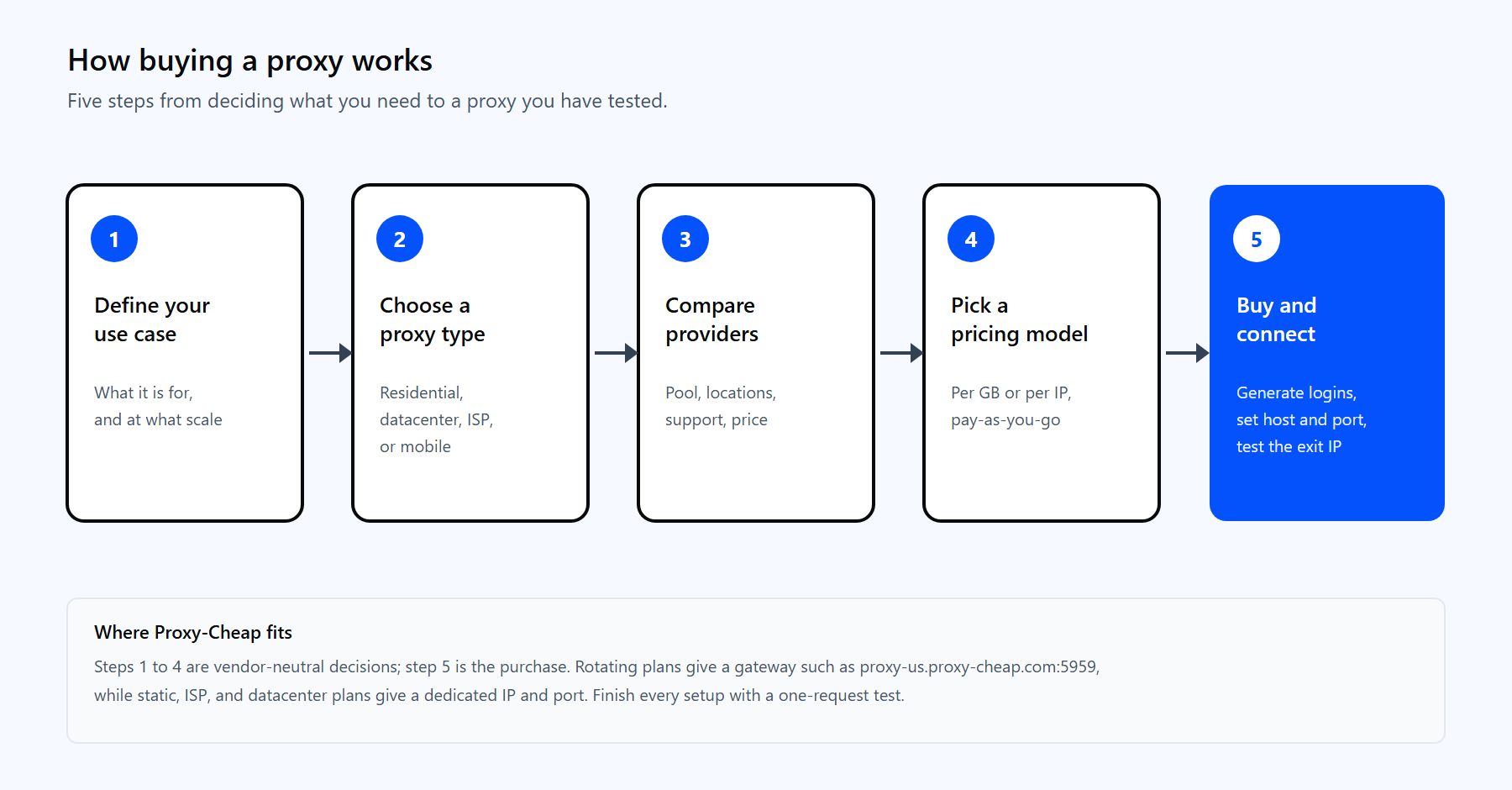
The five steps of buying a proxy, from deciding what you need to a connection you have tested.
The use case decides everything else, so start here. Write down the single task you want the proxy to handle first. A proxy that is ideal for one job can be the wrong tool for another, and the type you choose in Step 2 follows directly from this answer.
Common reasons people buy a proxy include:
Be specific about scale and location too. A one-off check from a single country needs far less than a daily job that pulls thousands of pages across many regions. Those two details, volume and geography, shape both the type and the budget.
Proxies differ by where the IP comes from, whether it changes, and which protocol it speaks. Here are the four types you will choose between, followed by three quick decisions that refine the pick.
A residential proxy uses a real IP assigned by an internet service provider to a home connection. Because the IP looks like an ordinary household visitor, success rates stay high on consumer-facing sites. Residential IPs suit price monitoring, ad verification, and gathering publicly available data across many regions.
A datacenter proxy comes from a server in a hosting facility rather than a home line. These IPs are fast and economical, with predictable per-IP pricing, and they deliver high throughput on documentation, public catalogs, and other unprotected content. They are the best-value option when the origin of the IP is not the priority. If you are weighing the two most common types, the datacenter vs residential proxies guide compares them in depth.
A mobile proxy routes through a 3G, 4G, 5G, or LTE connection on a real carrier network. Many real users share each carrier IP, so mobile IPs carry high trust. They fit social media management, ad checks, and testing on mobile-first platforms.
A static residential proxy, also called ISP, is a fixed IP hosted in a datacenter but registered to an internet service provider. You get residential-level trust with datacenter speed, and the same IP stays with you for the whole plan. That makes it ideal for account-bound tasks and session-aware dashboards.
Once the type is clear, three smaller choices finish the job:
Once you know the type, compare a short list of providers on the points that affect daily use. Price matters, but it is one line on a longer checklist. Run each candidate through the same questions:
A provider that scores well across every line, rather than only on price, is the one worth buying from.
Proxy pricing follows two main models, and the right one depends on the product you picked in Step 2.
To estimate cost, multiply your expected monthly data by the per-GB rate for bandwidth plans, or your IP count by the per-IP rate for subscription plans. Many providers add a 7-day trial on static products and volume discounts on bulk IPv6, so a small test order is cheap. Pay-as-you-go billing keeps the entry cost low: no setup fee, and you cancel when the project ends. Broad payment options, including major cards, PayPal, and crypto, make checkout flexible.
With the type, provider, and pricing model decided, the purchase itself is quick. The flow is similar across self-serve providers:
A rotating residential gateway is the clearest example. The Proxy-Cheap US endpoint is proxy-us.proxy-cheap.com:5959 and the EU endpoint is proxy-eu.proxy-cheap.com:5959, and every request through the gateway gets a fresh exit IP. For a dedicated IP from the static, ISP, or datacenter lines, copy the exact host and port shown in your dashboard. If your server runs from a fixed IP, add that IP to the allowlist and you can connect without typing credentials.
Always confirm the proxy works before you build it into a real job. The fastest check sends one request through the proxy and reads back the exit IP. If the IP that returns is the proxy IP and not your own, the proxy is working.
Test it with cURL. The -x flag sets the proxy host and port, and -U passes the username and password in separate fields:
| curl -x proxy-us.proxy-cheap.com:5959 -U <your-proxycheap-username>:<your-proxycheap-password> https://api.ipify.org |
A working proxy returns the exit IP assigned to your request. In Python, the requests library takes the same details in a proxies dictionary:
import requests
# Keep credentials in their own variables, not inside the host string. proxy_user = "<your-proxycheap-username>" proxy_pass = "<your-proxycheap-password>" proxy_host = "proxy-us.proxy-cheap.com:5959"
proxy = "http://%s:%s@%s" % (proxy_user, proxy_pass, proxy_host) proxies = {"http": proxy, "https": proxy}
resp = requests.get("https://api.ipify.org?format=json", proxies=proxies, timeout=15) print(resp.json()) # prints the proxy exit IP, which confirms the proxy works |
If the request returns a 407 status, the credentials are wrong or in the wrong field. If it times out, check the host and port and whether your IP needs to be on the allowlist. Once the exit IP comes back clean, the proxy is ready for the real workload.
The best proxy to buy is the one that matches your main task. Use the matrix below to map a task to a first choice, then refine by rotation, protocol, and IP version using the three quick decisions from Step 2.
| Your main task | First choice | Also works |
|---|---|---|
| Large-scale public-web data collection | Rotating residential | Datacenter |
| Account-bound tasks and logins | Static residential (ISP) | Mobile |
| Social media and app testing | Mobile | Static residential (ISP) |
| High-throughput public crawls | Datacenter | IPv6 |
| Localized pricing and ad checks | Rotating residential, geo-targeted | Mobile |
| Bulk jobs on IPv6-ready sites | IPv6 | Datacenter |
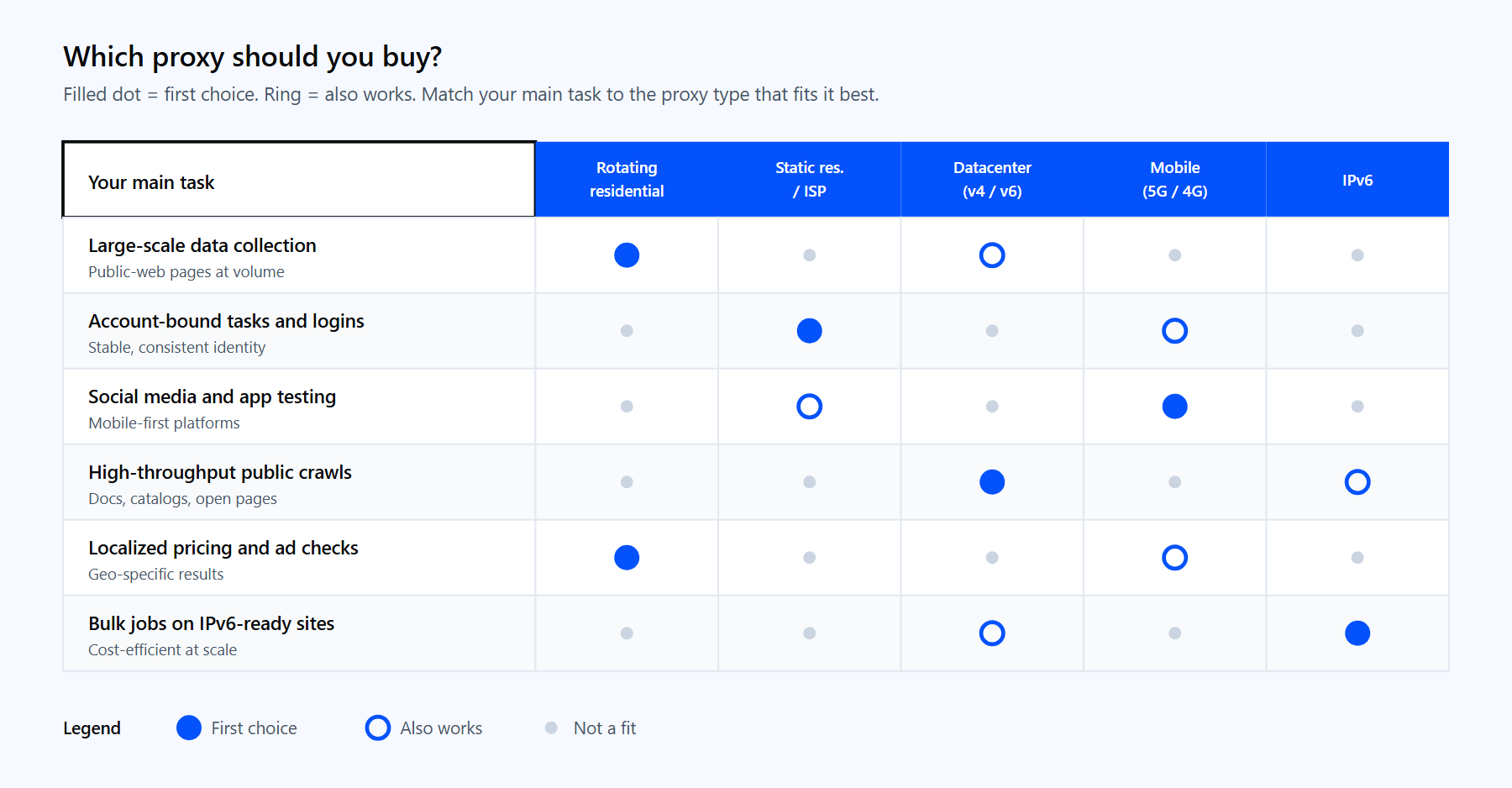
Match your main task to the first-choice proxy type, then refine by rotation, protocol, and IP version.
Whichever type fits, Proxy-Cheap offers it on pay-as-you-go billing with no setup costs and no monthly commitment. Compare the options on the pricing page and start with the proxy type that matches your first project.