

Logo
Data Scraping
March 2, 2026
15 min

The 8 best Instagram proxies in 2026, ranked and compared

Jason Wright
Jason Wright
Copywriting & Data Intelligence Specialist
The 8 best Instagram proxies in 2026, ranked and compared
Resumen
Compare the 8 best Instagram proxies of 2026 for running multiple accounts, with mobile and residential options, setup steps, and pay-as-you-go pricing.

Key takeaways

  • Mobile and residential proxies are the strongest fit for Instagram because their IPs come from the same carrier and home networks real users connect from.
  • Instagram ties activity to IP addresses, so multi-account operators give each account a consistent, location-accurate IP to keep accounts in good standing.
  • Proxy-Cheap ranks first for value: mobile, rotating and static residential, ISP, and datacenter lines on pay-as-you-go pricing with 24/7 support.
  • Reserve datacenter proxies for public research and monitoring, and use mobile or residential IPs for logging in and managing accounts.

Picking an Instagram proxy is mostly a question of which IP type the platform trusts and how many accounts you plan to run. The guide below ranks eight established providers, explains the proxy types that work for account tasks, and walks through setup so each account stays on its own clean IP.

What is an Instagram proxy?

An Instagram proxy is an intermediary server that routes your connection through a different IP address before it reaches Instagram. Instead of the platform seeing the IP your device was assigned, it sees the proxy’s IP. That single layer changes what Instagram associates with your activity: the network, the location, and the session that travels with each request.

For Instagram, the IP type matters more than it does on almost any other site. Instagram is a mobile-first platform, so it places the most trust in IPs that come from real mobile carriers and home internet connections. A good Instagram proxy gives each account an IP that matches the kind of network a real user in that market would connect from, plus the choice to keep that IP fixed (static) or refresh it on a schedule (rotating), depending on the task.

Why use a proxy for Instagram?

Most people who buy Instagram proxies are not doing anything secretive. They are running more accounts than one home connection can support. Instagram links activity to IP addresses, so logging into ten accounts from a single IP looks nothing like ten separate users. Proxies let each account sit on its own market-matched IP.

The common, terms-respecting use cases:

  • Multiple-account management. Agencies, resellers, and growth teams keep each brand profile on a steady IP. This is the core job behind creating and running multiple accounts and ongoing Instagram account management.
  • Growth automation and scheduling. Tools that post, comment, or message on a schedule connect through a per-account proxy, so activity stays tied to one identity instead of one shared server.
  • Market and competitor research. Pull public profile, hashtag, and ad data from different regions to inform strategy.
  • Ad verification. Review how Instagram ads render to users in specific markets for ad verification and quality assurance.

What type of proxy is best for Instagram?

Four proxy types show up in Instagram workflows. Here is how they compare for account work.

Mobile proxies route through real 5G, 4G, and LTE carrier IPs. Because many real users share a single mobile IP at any moment, mobile is the IP type Instagram treats with the most trust, and it is the first choice for creating and warming new accounts.

Rotating residential proxies use real home-internet IPs and refresh on a schedule or per request. They suit research and spreading activity across many IPs. Proxy-Cheap rotating residential proxies cover 180+ countries with country and city targeting.

Static residential and ISP proxies give each account one fixed, location-accurate IP for long, consistent sessions, which is what most account managers want day to day. Compare static residential proxies and read static vs rotating proxies to pick a session style.

Datacenter proxies deliver high throughput from data-center IPs. Reserve datacenter proxies for high-volume public research and monitoring. For logging into and managing accounts, choose mobile or residential IPs that match the networks real users connect from.


Proxy typeHow the IP behavesBest Instagram use
Mobile (5G/4G/LTE)Shared real carrier IP, high trustCreating, warming, and running accounts
Rotating residentialReal home IP, refreshes on a scheduleResearch and broad public data collection
Static residential / ISPFixed real-network IP, long sessionsDay-to-day management of specific accounts
DatacenterFast data-center IP, public targetsHigh-volume research and monitoring


How many Instagram accounts can you run per proxy?

There is no official public number, but Instagram clearly caps how many accounts one IP can comfortably support. Inside the app you can link a small group of accounts (often around five) to a single login, and pushing far past that from one IP is what tends to get accounts flagged or rate-limited.

Practical guidance:

  • Static residential or ISP IP: keep the count low, often one to three for high-value profiles and up to around five for lower-risk ones. ISP proxies give each account a dedicated static IP.
  • Mobile IP: because the carrier already shares that IP among many real users, a single mobile proxy tolerates more accounts, which is why agencies favor mobile for scale.
  • Warm up gradually: new accounts on a new IP should ramp activity slowly rather than posting and following at full speed on day one.
  • Keep the pairing stable: once an account lives on an IP, keep it there. Constantly switching IPs under one account is a stronger signal than a steady one.

The 8 best Instagram proxies in 2026

These providers are ranked on the factors that decide Instagram outcomes: whether they offer the mobile and residential IPs the platform trusts, pool size and country coverage, session control (sticky or rotating), pricing model, and support. Every option here is an established network. The order reflects overall fit for Instagram account work, starting with the best value.
1. Proxy-Cheap

Proxy-Cheap pairs the two IP types Instagram trusts most, mobile and residential, with pay-as-you-go pricing and no monthly commitment, which makes it a strong starting point for solo creators and agencies alike. Mobile proxies span 100+ countries on real 5G, 4G, and LTE carrier IPs. Rotating residential covers 180+ countries with country and city targeting, while static residential and ISP options give each account a fixed, location-accurate IP for long sessions.
  • Key features: mobile, rotating and static residential, ISP, and datacenter lines; HTTP and SOCKS5; sticky or rotating sessions; instant credentials; 24/7 support; crypto checkout.
  • Best for: operators who want account-grade IPs without enterprise minimums. You can manage profiles straight from the browser with the Chrome proxy extension.

2. Decodo (formerly Smartproxy)

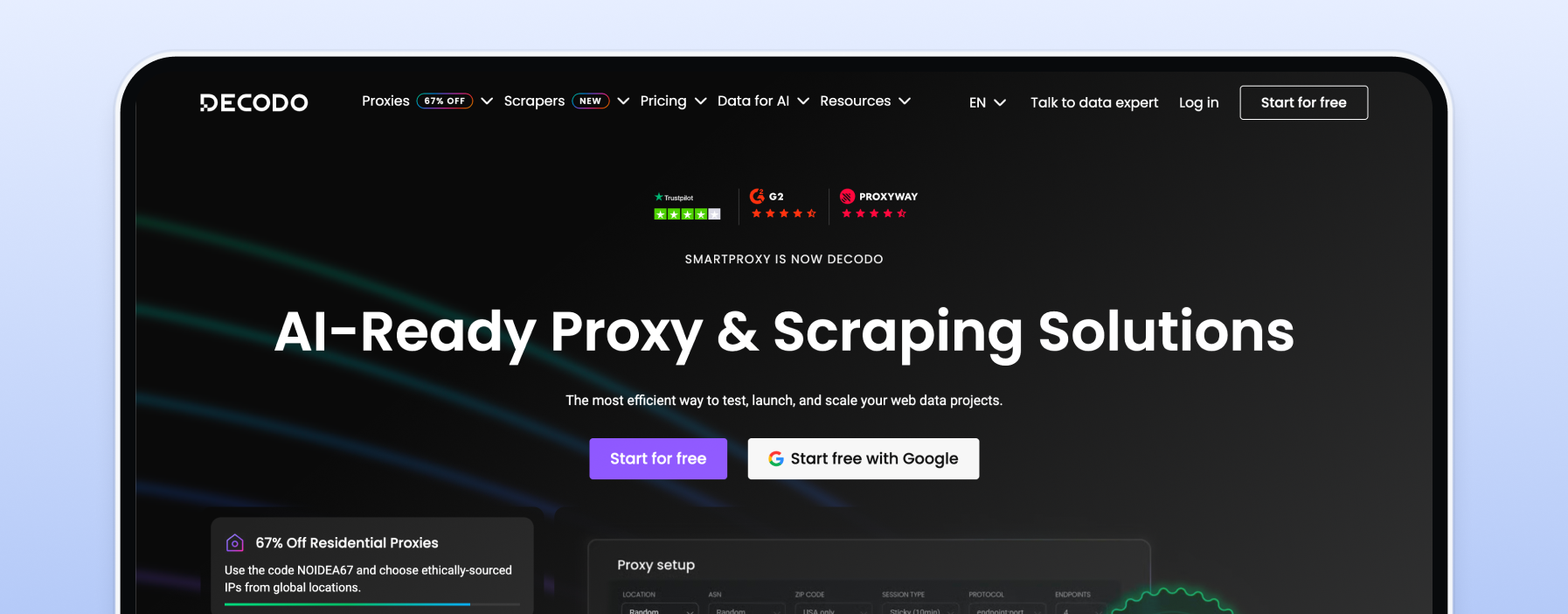
A polished, beginner-friendly platform with a large residential and mobile pool (around 115M+ IPs) and a clean dashboard. Sticky sessions and flexible targeting make it comfortable for managing a handful of accounts.
  • Best for: teams that value easy onboarding and a mature self-serve interface.

3. Bright Data

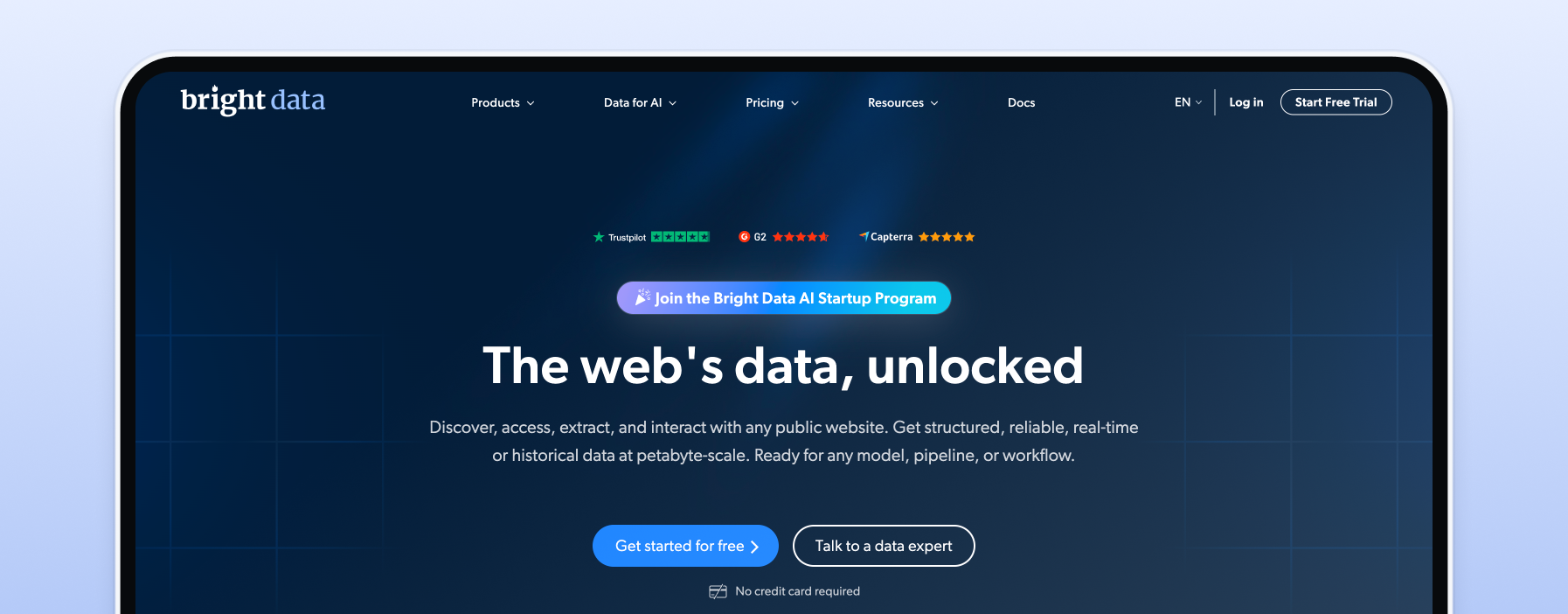
The enterprise-scale option, with one of the industry’s largest networks (roughly 72M residential and 7M mobile IPs), granular targeting, and a free trial. Setup is more involved and pricing sits at the premium end.
  • Best for: large operations that need scale, compliance tooling, and fine-grained control.

4. IPRoyal

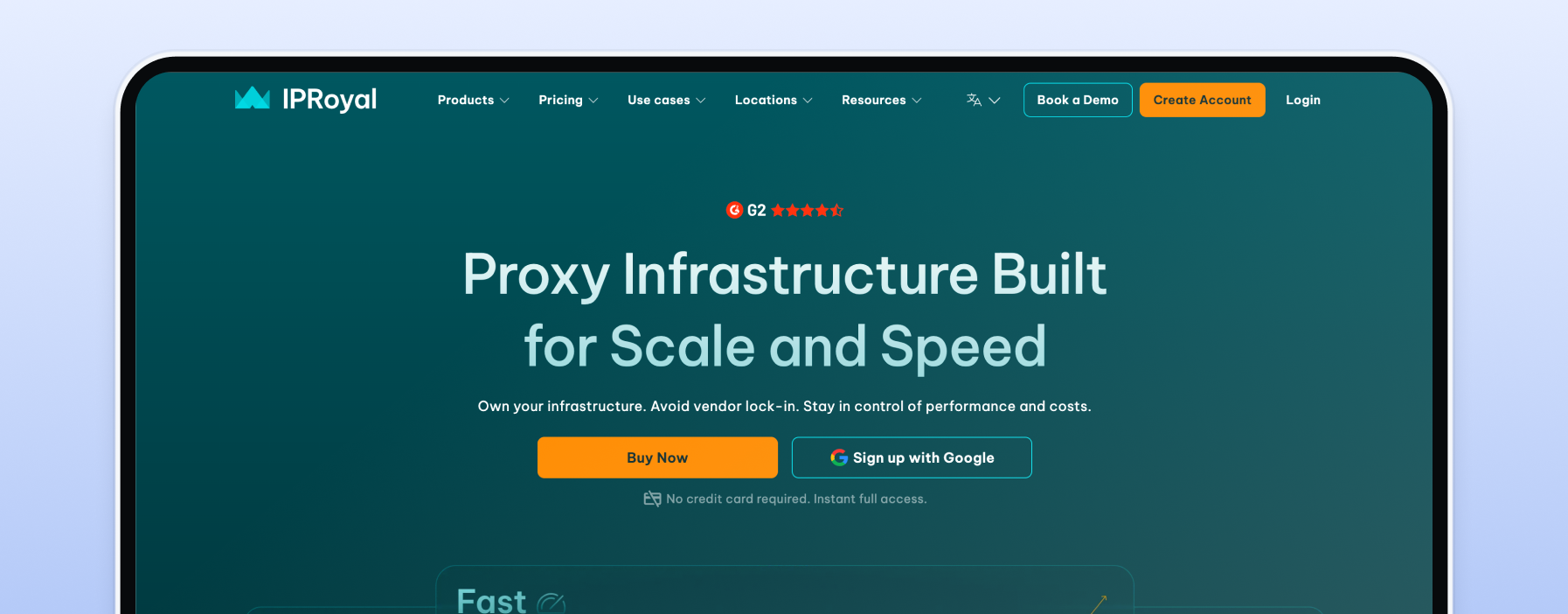
A value-focused provider popular with social-media users. Its Royal Residential pool offers pay-as-you-go pricing, and mobile options suit account work.
  • Best for: budget-conscious operators who still want real residential and mobile IPs.

5. Webshare

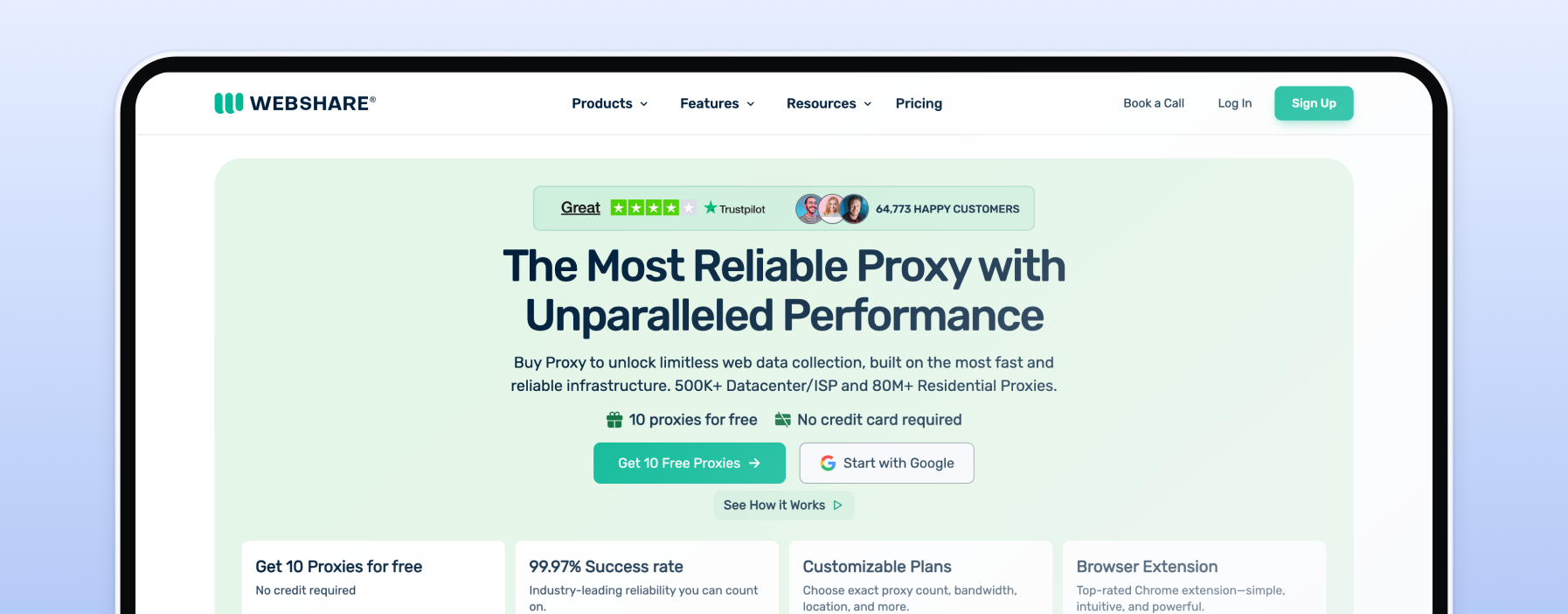
A self-serve favorite with a free tier, low entry pricing, a strong API, and a simple dashboard. Its core strength is affordable datacenter and residential IPs.
  • Best for: developers and testers who want cheap, scriptable proxies and use the residential line for account logins.

6. SOAX

A clean residential and mobile network with flexible, location-level targeting and a reputation for pool quality.
  • Best for: research and account tasks that need precise geo-targeting.

7. NetNut

Known for ISP-based residential IPs that combine home-network trust with datacenter speed and stable, long-lived sessions.
  • Best for: operators who want fast, persistent IPs for always-on account management.

8. Froxy

A growing residential and mobile provider with per-GB pricing and granular targeting, positioned as a flexible mid-market option.

  • Best for: teams scaling from a few accounts to many who want straightforward bandwidth pricing.

How to set up an Instagram proxy

Setup follows the same shape whether you connect a phone, an antidetect browser, or an automation tool. Five steps:

  1. Pick the right product. For account management, choose a mobile or static residential / ISP plan so each account gets a trusted, consistent IP.
  2. Generate credentials. In the dashboard, open the proxy and copy its host, port, username, and password. Rotating residential uses a shared regional gateway, while static products give you a unique host and port per IP.
  3. Enter the proxy in your tool. Put the host and port in the connection fields, and the username and password in their own fields, never inside the URL. A rotating residential connection looks like this:

Host: proxy-us.proxy-cheap.com

Port: 5959

Username: <your-proxycheap-username>

Password: <your-proxycheap-password>

For the EU gateway, use proxy-eu.proxy-cheap.com on the same port.
  1. Assign one IP per account. In an antidetect browser, create a separate profile for each Instagram account and attach its own proxy to each profile. This keeps every account on a stable identity.
  2. Test before you log in. Load the profile, confirm the IP and location resolve to the country you expect, then sign in and warm the account up gradually.

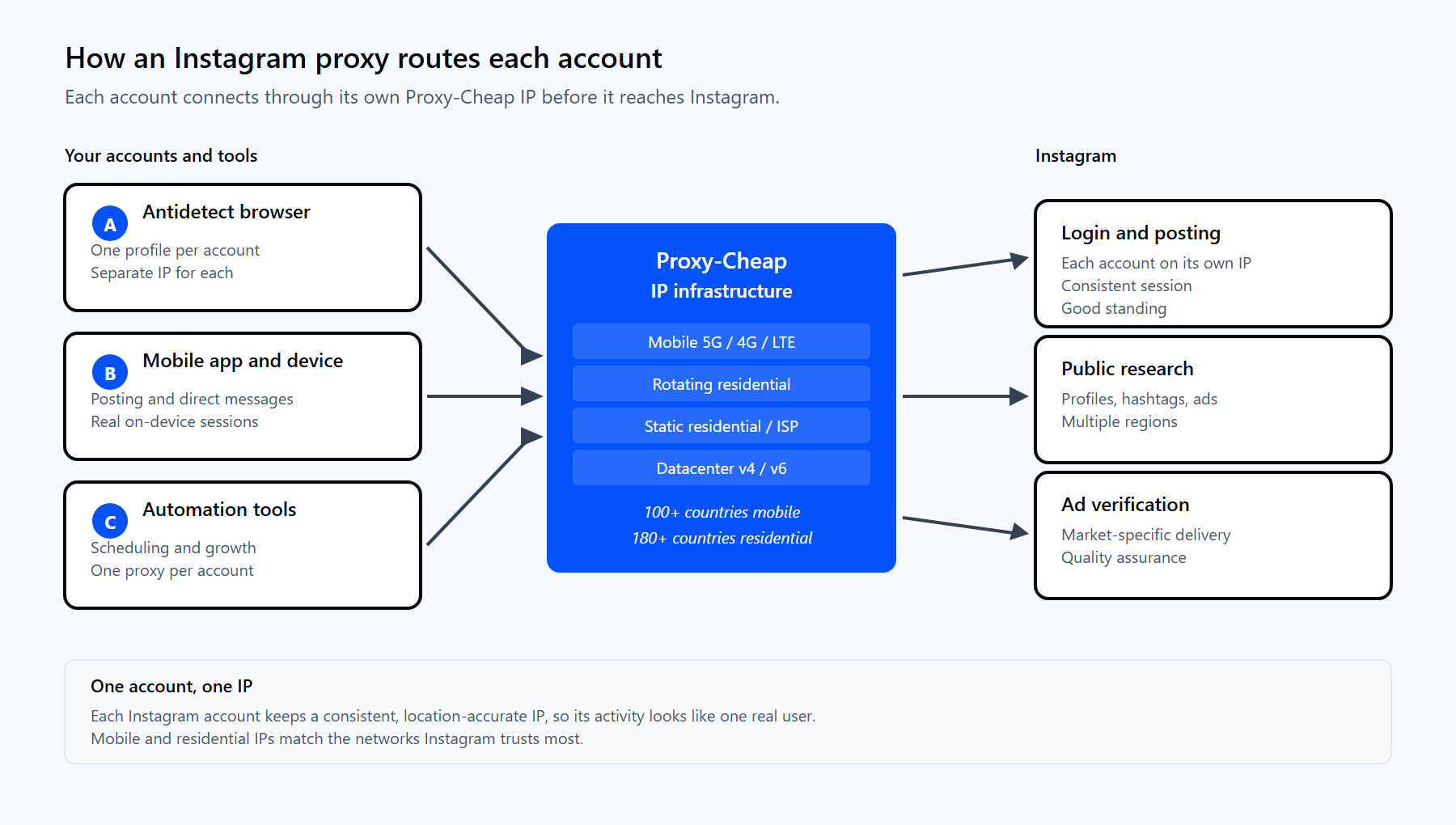
Request flow for an Instagram proxy: an antidetect browser and phone send each account through the Proxy-Cheap gateway to Instagram and back, one IP per account.

How an Instagram proxy routes each account’s session through a Proxy-Cheap IP before it reaches Instagram.

Instagram proxy options by use case

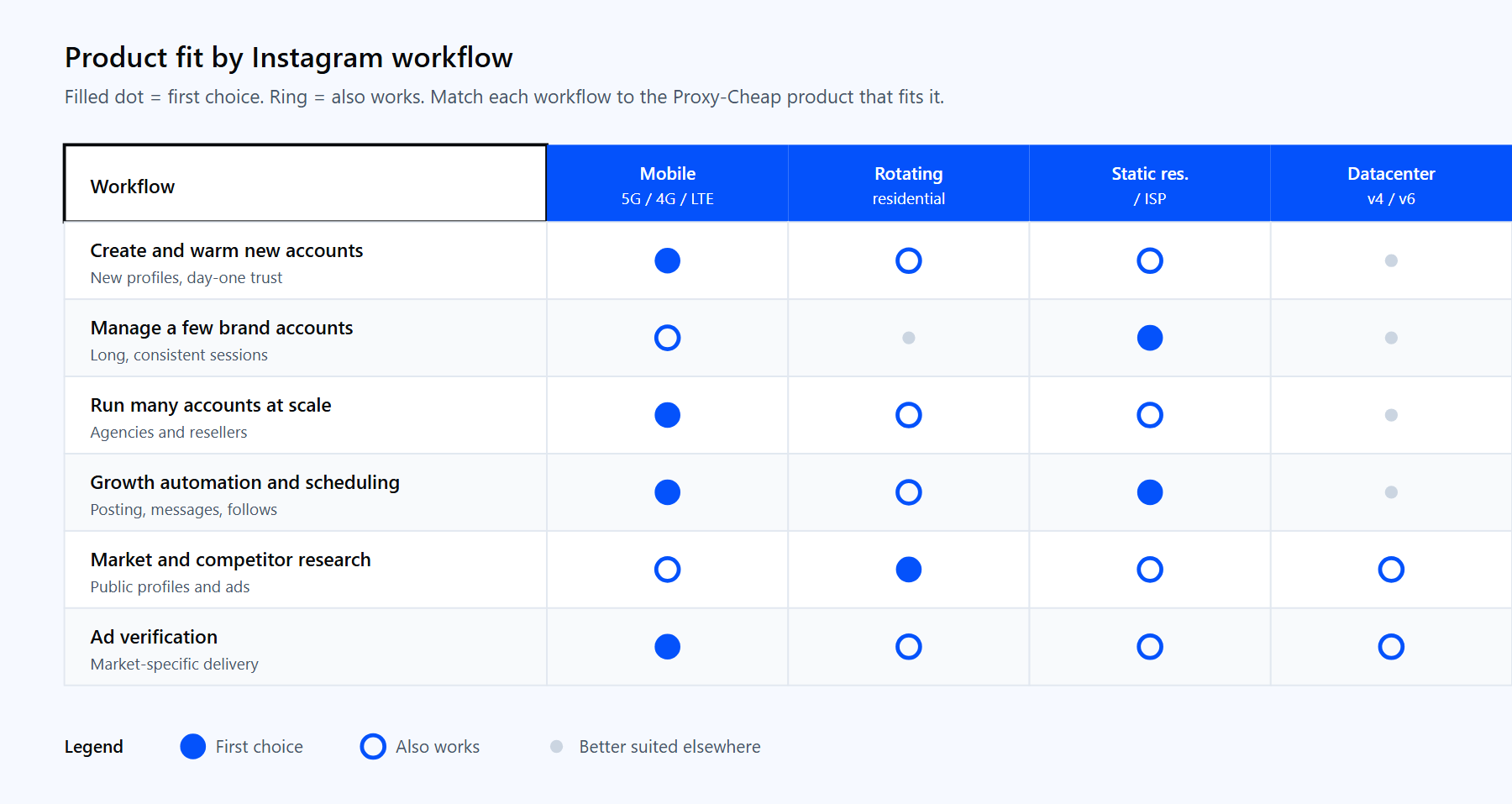
Different Instagram jobs reward different IP types. This matrix maps the most common workflows to the Proxy-Cheap product that fits each one.

WorkflowMobileRotating residentialStatic residential / ISPDatacenter
Create and warm new accountsFirst choiceAlso worksAlso worksBetter suited elsewhere
Manage a few brand accountsAlso worksBetter suited elsewhereFirst choiceBetter suited elsewhere
Run many accounts at scaleFirst choiceAlso worksAlso worksBetter suited elsewhere
Growth automation and schedulingFirst choiceAlso worksFirst choiceBetter suited elsewhere
Market and competitor researchAlso worksFirst choiceAlso worksAlso works
Ad verificationFirst choiceAlso worksAlso worksAlso works


Product-fit matrix mapping Instagram workflows such as running many accounts, managing brand accounts, automation, research, and ad verification to Proxy-Cheap mobile, residential, ISP, and datacenter proxies.

Match each Instagram workflow to the Proxy-Cheap proxy type that fits it best.

For most Instagram teams, the simplest path is to start with Proxy-Cheap mobile proxies for account creation and scale, add static residential or ISP IPs for the brand accounts you manage long term, and pay only for what you use.

Preguntas frecuentes

Instagram’s terms govern how you use accounts, not the network you connect from, and many legitimate teams use proxies to manage multiple brand accounts and run research. The proxy provides a clean, consistent IP, while staying in good standing still depends on how you post and engage. Use proxies together with normal, policy-respecting account behavior.

Free and public proxy lists exist, but they are shared by many people, slow, and short-lived, which makes them a poor fit for account work. For real accounts, a low-cost mobile or residential plan is far more reliable and keeps each account on a stable IP. Reserve free proxies for throwaway tests.

Pricing depends on the IP type. Rotating residential and mobile are usually billed per GB on pay-as-you-go plans, while static residential, ISP, and datacenter IPs are billed per IP per month. For exact figures, check the live product page, since per-GB and per-IP rates change with promotions and volume tiers.

If you only run one account from your normal phone or home connection, you usually do not need a proxy. A proxy becomes useful once you manage a second or third account, log in from changing networks, or want a fixed, location-accurate IP for a brand profile.

For day-to-day management, a static IP per account is usually best, because a steady IP looks like a normal user who signs in from the same place each time. Rotating IPs fit research and broad data collection rather than long-lived logins. Keep high-value accounts on their own static IP.

Match the IP location to the account’s audience and the place the account claims to operate from. A profile aimed at a US audience should sit on a US IP, and a local business account should use an IP in its own city or country. Consistency matters more than any single best country.

Datacenter proxies are fast and economical, which makes them a good fit for high-volume public research and monitoring. For logging into and managing accounts, mobile or residential IPs match the networks real users connect from and are the safer choice for account work.

Yes, in most cases. Tools that post, follow, or message on a schedule generate a lot of activity from one place, so pairing each account with its own proxy keeps that activity tied to a single, consistent identity rather than one shared server IP.

A single residential or mobile IP can serve more than one platform, but keep one identity per IP. Mixing many unrelated accounts on the same IP raises the activity on it, so most operators dedicate an IP, or a small set, to each account or brand.