
Proxy-Cheap
Tích hợp
Proxy integration with TexAU: complete 2026 setup guide

TexAU Proxy Integration

Set up proxy integration with TexAU: add a proxy under Preferences, test and assign one IP per account, pick the right Proxy-Cheap type, and fix common errors.
Nhận proxy cho Proxy integration with TexAU: complete 2026 setup guide
Proxy integration with TexAU: complete 2026 setup guide
What is TexAU?
TexAU is a no-code growth automation platform for lead generation, data extraction, and social media outreach, running workflows on its own cloud infrastructure. Because automations run on TexAU's servers rather than your machine, the proxy you assign decides the IP and location every connected account and target site sees. Pairing each account with a dedicated Proxy-Cheap IP keeps login sessions consistent and extraction runs geo-accurate.

Key takeaways

  • TexAU is a no-code growth automation platform. TexAU V2 runs 180+ prebuilt automations for X, Google Maps, Reddit, and more, with a proxy manager built into the dashboard.
  • Add a proxy in TexAU under Preferences > Proxies: choose HTTP or SOCKS, enter the host, port, username, and password, then click Test Proxy before saving.
  • Assign one dedicated IP to each connected account. Static residential and mobile proxies fit logged-in accounts, while rotating residential fits high-volume data extraction.
  • TexAU is changing in 2026: V2 Cloud winds down on August 10, 2026, and the new V2 Desktop app runs the same automations locally on your own machine.

TexAU sits in an unusual spot among automation tools. It runs your growth workflows in the cloud, on TexAU's infrastructure, which means the IP address your accounts and targets see is decided by your proxy configuration, not by your home connection. This guide walks through the full proxy integration with TexAU: what the platform does, where the proxy manager lives, how to connect Proxy-Cheap proxies step by step, and how to match each proxy type to the automations you run.

What is TexAU?

TexAU is a growth automation platform built for lead generation, data extraction, and social media outreach. Its core product, TexAU V2, is a cloud application at app.texau.com paired with a Chrome extension that syncs your logged-in browser sessions. V2 ships more than 180 prebuilt, no-code automations across X (Twitter), Google Maps and Search, Reddit, Product Hunt, Slack, GitHub, and Quora, and lets you chain them into multi-step workflows.

The product family is in transition in 2026, and it pays to know the timeline before you build anything:

  • TexAU V2 Cloud (app.texau.com) is the version with the in-app proxy manager this guide covers. TexAU has announced it winds down on August 10, 2026.
  • TexAU V2 Desktop shipped on July 1, 2026 as a one-time-license app for Windows and macOS. It runs every V2 automation locally, including LinkedIn, Sales Navigator, and Recruiter, using your own machine and your own IP, and it imports the workflows you already built in the cloud.
  • The new TexAU platform (the current texau.com flagship) is a GTM data engine for lead enrichment with 32 integrations, 200+ actions, a REST API, and an MCP server. It runs on credits rather than execution hours and documents no proxy layer.

One more piece of history that shapes how people use the tool: TexAU retired LinkedIn automations from the cloud product in August 2025. LinkedIn workflows now belong to the Desktop app, while the cloud version focuses on X, Google, Reddit, and the other supported platforms. Proxy integration remains a V2 concept, and V2 Cloud is still live today, so everything below reflects the current dashboard.

What is TexAU used for?

TexAU's automations cluster around a few repeatable jobs:

  • Lead generation. Extract profile lists, followers, group members, and event attendees from social platforms, then enrich them with emails and firmographic data.
  • Public data extraction. Pull Google Maps listings, Google Search results, reviews, Reddit threads, and Product Hunt launches into spreadsheets for market research.
  • Outreach and engagement. Auto-engage with posts, send connection or follow requests, and run drip campaigns within each platform's daily limits.
  • Multi-account operations. Agencies connect several client accounts to one workspace and run scheduled workflows for each, a workflow pattern covered in depth on the social media management use case page.
  • Workflow chaining. Feed the output of one automation into the next, for example extracting a follower list, filtering it, then engaging each profile on a randomized schedule.

The common thread is volume. Every one of these jobs sends far more requests than a human clicking around, which is exactly why the platform ships with proxy support at the account and automation level.

Key features of TexAU

The features that matter most when you plan a proxied setup:

  • 180+ prebuilt automations across the supported platforms, plus a visual workflow builder to chain them.
  • Cookie-sync onboarding. The TexAU Chrome extension connects an account by syncing its session cookies. Teams can also use Share Via Magic Link, which lets a client authorize their account from their own browser without sharing passwords.
  • Per-account proxy assignment. Each connected account row in the Accounts section has its own Proxy field, so different accounts can run through different IPs.
  • Per-automation proxy selection. Automation setup screens include a Proxy dropdown, useful for one-off data extraction runs.
  • A workspace proxy manager under Preferences > Proxies, with a Test Proxy button that verifies the connection before you save.
  • Scheduling with randomized delays so workflows run on human-paced timing rather than in bursts.
  • Limits per account. V2 workspaces support up to 5 connected accounts, each with its own cookies, limits, and variables.

Is TexAU free to use?

TexAU is a paid product with a trial. The current platform offers a 14-day trial with no credit card, then credit-based plans: at the time of writing, Solo at $79 per month, Starter at $199, and Teams at $549, with annual discounts. The API tier includes 50 free credits on signup.

TexAU V2 Desktop is sold as a one-time perpetual license (a founder price of $1,499 applied before June 11, 2026, and $1,999 after), with 5 years of updates and a 14-day money-back guarantee from its July 1, 2026 release.

During the V2 Cloud era, trial and paid plans included residential proxies automatically, while free-plan users brought their own. Verify current plan details on the live TexAU pricing page before you commit, since the lineup is actively changing through 2026.

How to get started with TexAU

Because TexAU V2 is a cloud app, there is nothing to install beyond the browser extension. Getting to your first automation takes four steps:

  1. Create an account at app.texau.com and set up your workspace.
  2. Install the TexAU v2 Chrome extension.
  3. Open the Accounts section and click the blue + Add New button. The Connect New Account popup offers two methods: Add Account, which syncs the session cookies of the platform you are logged into, or Share Via Magic Link, which generates a link a teammate or client opens in their own browser to authorize their account.
  4. Pick an automation from the Automation Store, connect it to the account, and run it.

One habit worth forming from day one: decide which IP each account will use before you run anything. The account row shows a Proxy column and a Location column for a reason. Connecting an account from one region and then running its automations through infrastructure in another region is the single most common self-inflicted problem in cloud automation, and it is much easier to prevent than to repair.

Does TexAU come with built-in proxies?

In the V2 Cloud product, yes. TexAU's own documentation states that residential proxies are included automatically on trial and paid plans, with additional proxies available from the Add-ons section if you use up the included allocation. Free-plan users did not receive included proxies. TexAU also explicitly gives you full flexibility to use external proxies from any provider.

So why bring your own? Control. The built-in allocation decides for you; an external proxy lets you choose:

  • The exact country, state, or city the IP sits in, so each account runs from a market that matches its audience or its owner's real region.
  • Static or rotating behavior. A logged-in account wants one steady IP for months. A scraping automation wants a fresh IP on every request. The included pool does not give you that dial.
  • Dedicated use. With your own dedicated static residential IPs, each address serves your account and nobody else's, which keeps its reputation entirely in your hands.
  • Portability. The same credentials work in TexAU, your antidetect browser, and any other tool, so one account keeps one IP across every touchpoint.

Why you need a proxy with TexAU

Three concrete reasons, in order of how often they matter:
  1. Session consistency for logged-in accounts. TexAU authenticates through session cookies synced from a real login. Platforms compare each new request's IP and location against that session's history, and a sudden jump from a Berlin login to a US datacenter range invites a security review or a forced re-login. A dedicated proxy in the account's home region keeps every automated session consistent with the human one.
  2. One IP per account. Social platforms associate accounts that share an IP address. Run five client accounts through one connection and a single flagged account can pull the other four into review with it. Give each account its own dedicated IP and its standing stays independent. The best social media proxies guide covers this principle across every major platform.
  3. Stable success rates on data extraction. Google Maps, Search, and Reddit throttle repeated requests from one IP. Distributing extraction traffic across a rotating pool keeps response quality high across long runs and returns geo-accurate results for the markets you actually target.

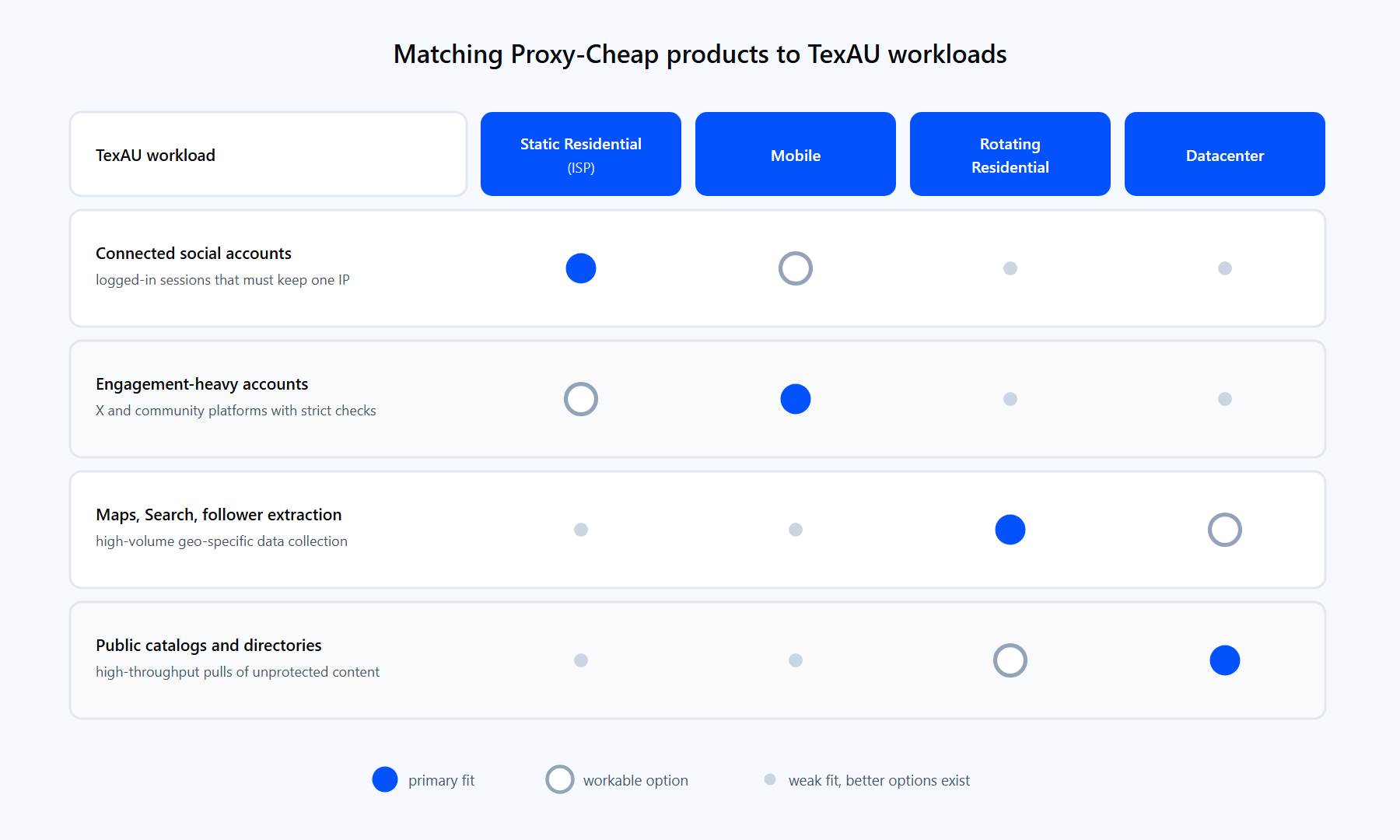
Matrix mapping TexAU workload types to Proxy-Cheap product lines: static residential, mobile, rotating residential, and datacenter.

Each Proxy-Cheap product line maps to a different TexAU workload. Filled dots mark the primary fit, rings mark a workable secondary option.

Here is how the Proxy-Cheap product lines line up against TexAU workloads:

  • Static residential proxies: the default for connected social accounts. One fixed, ISP-assigned IP per account, held for months, in the region where the account lives. The line spans 24+ countries and 37+ ISPs with unlimited bandwidth on every plan.
  • Mobile proxies: real 3G/4G/5G carrier IPs across 100+ countries for the platforms that trust mobile networks most. The strongest choice for X and other engagement-heavy accounts.
  • Rotating residential proxies: 155M+ IPs across 180+ countries with automatic rotation per request or sticky sessions of around 30 minutes. Built for Maps, Search, and follower extraction at volume.
  • Datacenter proxies: high throughput at the lowest cost per IP for public data pulls where the target is not picky about IP type, like documentation sites or public directories.

For most TexAU users the split is simple: static residential or mobile for every account you log into, rotating residential for every extraction job.
How to set up a proxy with TexAU

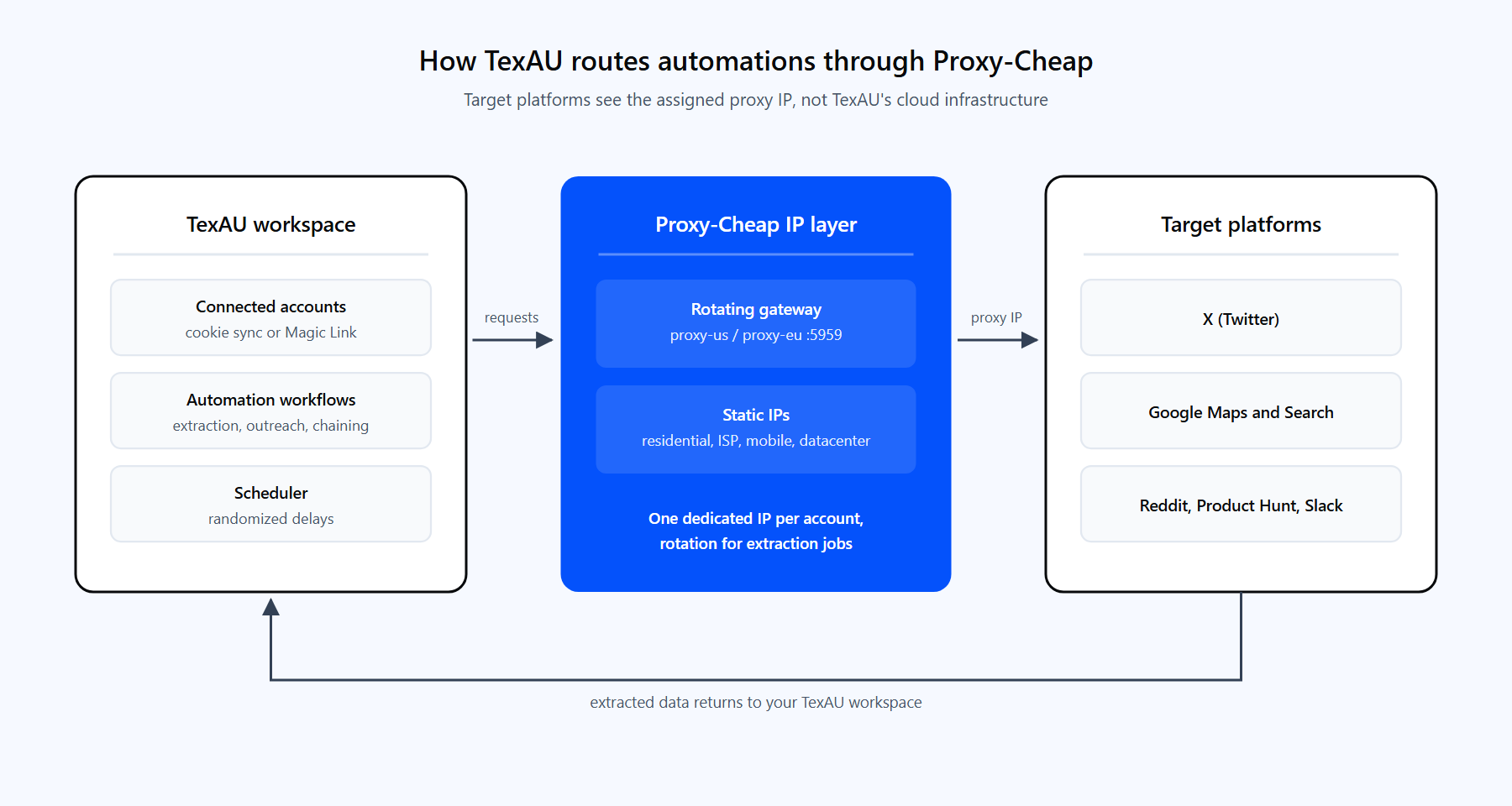
Diagram of a TexAU automation routing through a Proxy-Cheap gateway to X, Google Maps, and Reddit, returning extracted data.

TexAU cloud automations route each request through your assigned Proxy-Cheap IP, so target platforms see the proxy's location, not TexAU's servers.

Step 1: get your Proxy-Cheap credentials.

Order the proxy type you picked above, then open the Setup Credentials panel in the dashboard. The Proxy-Cheap dashboard guide walks through credential generation in detail. The endpoint format depends on the product line:

  • Rotating residential uses a single shared hub: thehub.proxy-cheap.com on port 8080, with your username and password. You choose the country in the dashboard credential generator, so there is no separate US or EU gateway. Every request through the hub exits from a fresh IP automatically.
  • Static residential, ISP, datacenter, and mobile each come with a unique host and port shown in the dashboard. Copy them exactly as displayed.

Optional but recommended: verify the credentials from any terminal before touching TexAU, so a typo never masquerades as a TexAU problem.

# Verify a Proxy-Cheap rotating residential gateway over HTTP.
# Credentials go in the -U flag, not inside the URL.
curl -x http://thehub.proxy-cheap.com:8080 \
  -U "<your-proxycheap-username>:<your-proxycheap-password>" \
  https://httpbin.org/ip
 
# Static residential, ISP, datacenter, or mobile over SOCKS5.
# Copy <host> and <port> from the dashboard Setup Credentials panel.
curl --max-time 10 \
  -x "socks5://<user>:<pass>@<host>:<port>" \
  https://httpbin.org/ip

If the command returns a JSON object with an IP that is not your own, the proxy works.

Step 2: add the proxy in TexAU.

  1. Log in to your TexAU dashboard.
  2. In the left-side menu, open Preferences (newer builds label it Settings with a gear icon) and select Proxies.
  3. Click Add Proxy (shown as New Proxy in recent builds) to open the configuration form.

Fill in the fields. TexAU keeps them separate rather than accepting a single pasted string:

  • Proxy Type: choose HTTP for the rotating hub thehub.proxy-cheap.com Port: 8080 for the rotating hub, or the port shown in your dashboard for static products.
  • IP Address: the host. For rotating residential, paste the gateway hostname thehub.proxy-cheap.com; the field accepts hostnames as well as raw IPs.
  • Port: 8080 for the rotating gateways, or the port shown in your dashboard for static products.
  • Username and Password: your Proxy-Cheap credentials.

Click Test Proxy. TexAU sends a request through the proxy and confirms the connection; a successful test shows a confirmation message. Then click Save, and the proxy appears in your Proxies list.

Step 3: assign the proxy to an account or automation.

Adding a proxy stores it at the workspace level; nothing uses it until you assign it.

  • Per account: open the Accounts section, click the pencil icon on the account row, scroll to the Proxy section, and pick your saved proxy from the dropdown. Every automation that account runs now routes through that IP.
  • Per automation: open the automation from the Automation Store, scroll to the Proxy dropdown in its setup screen, and select the proxy for that run. This suits one-off extraction jobs that do not belong to a logged-in account.

Click Save, run the automation, and TexAU routes all its requests through the assigned proxy.

Rotating and static proxies with TexAU

TexAU's own documentation notes that the platform supports rotating proxies for bulk tasks, and the distinction between rotation and a fixed IP is the most consequential choice in this whole setup.

Rotation belongs to extraction. Point a Google Maps or follower-list automation at the rotating residential gateway and the rotation happens server-side: each request exits from a different IP in the pool, so no single address absorbs the whole run. You add one entry in TexAU and the gateway does the rest. If a job needs the same IP across a short sequence of requests, sticky sessions hold one exit IP for around 30 minutes.

Logged-in accounts want the opposite. An account that hops IPs mid-session looks like a hijacked session to the platform's security systems. Assign each connected account a static residential or mobile IP and leave it alone for the life of the account. The static vs rotating proxies comparison breaks down the decision in more depth.

A practical workspace pattern combines both: one static IP saved per connected account, plus one rotating gateway entry saved for extraction automations, all living side by side in the Proxies list and assigned per account or per run.

Advanced: matching proxy location to each account

This is the detail most TexAU guides skip entirely, and it is the one that decides whether a proxied account stays healthy.

When you connect an account, the TexAU extension syncs cookies from a session that was created somewhere specific: your office in Amsterdam, a client's home in Austin. The platform recorded that context at login. If the automations then run through an IP on another continent, the session's history contradicts itself, and contradictions are what security systems act on.
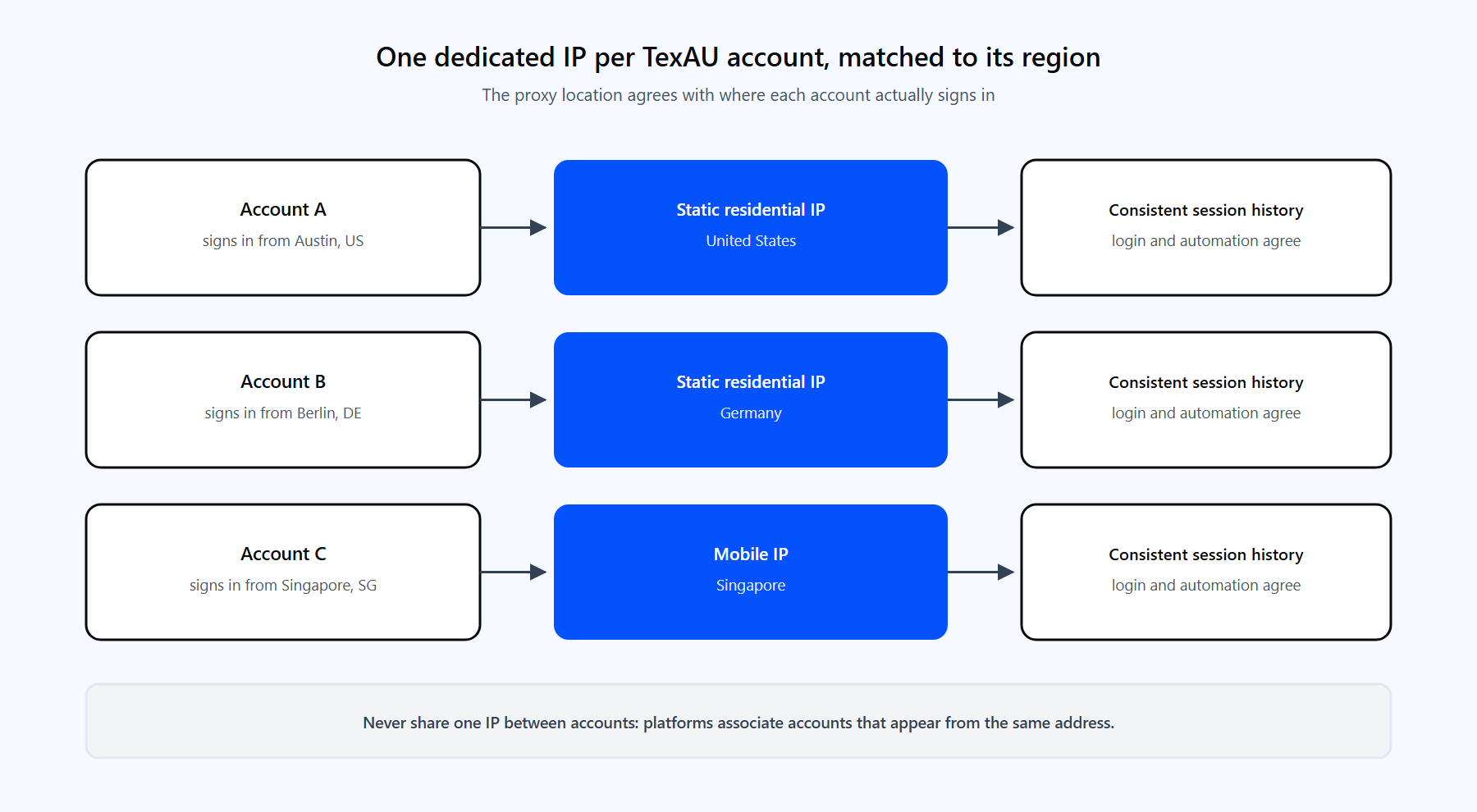
Diagram showing three TexAU accounts each assigned a dedicated proxy IP matched to its login region.

One dedicated IP per connected account, in the region where each account actually signed in, keeps every session's story consistent.

The playbook:

  1. Match the region before the first run. Buy each account's proxy in the country (ideally the city or state) where the account's real user logs in. Proxy-Cheap's rotating residential and mobile lines offer country, state, and city targeting; static residential offers country and ISP targeting.
  2. Assign the proxy before running any automation on a newly connected account, so the very first automated request already comes from the right place.
  3. Use Magic Link for client accounts. The client authorizes from their own browser in their own city, and you pair the account with a proxy in that same city. The session's origin and its automation traffic then agree from day one.
  4. Warm up gradually. Start new account-plus-proxy pairs at low daily volumes and scale over two to three weeks. IP consistency does not compensate for a volume spike.
  5. Never share an IP between accounts. One account per dedicated IP, with no exceptions, is the rule every serious multi-account operator follows. Agencies running many accounts often pair TexAU with the best antidetect browsers and reuse the same one-IP-per-profile discipline across both tools.

Common TexAU proxy errors and how to fix them

1. Test Proxy fails immediately. Usually a transcription problem: host pasted with a stray space, wrong port, or the Proxy Type set to SOCKS for an HTTP endpoint (or the reverse). Re-copy the host and port from the Proxy-Cheap dashboard and re-check the type. If it still fails, run the curl test from Step 1; if curl succeeds while TexAU fails, recreate the proxy entry from scratch.

2. Authentication errors (407). The proxy is reachable but rejected the credentials. Check for swapped username and password fields and for an expired plan. Keep credentials in the Username and Password fields rather than appended to the host string, since TexAU expects them separately. For TexAU cloud runs, username-and-password authentication is the dependable choice: IP-allowlist authentication would need the allowlist to cover the infrastructure the requests actually leave from, which is TexAU's cloud rather than your own machine.

3. The test passes but the location looks wrong. The Test Proxy check confirms connectivity, not geography. If a run returns results for the wrong market, confirm the proxy's country in your Proxy-Cheap dashboard and, for extraction jobs, order the proxy with explicit country targeting rather than relying on a generic pool.

4. The proxy works but the account still gets warnings. The proxy is not the whole story. Check the three usual causes in order: the IP's region does not match where the account normally signs in, more than one account shares the IP, or daily automation volume is set too high. Fix the mismatch, isolate the account on its own static IP, and cut volumes roughly in half, then scale back up slowly.

5. Slow runs or timeouts mid-automation. Cloud automations queue, and a single proxy carrying several concurrent jobs multiplies latency. Keep one or two concurrent automations per proxy, and for big extraction jobs let the rotating gateway spread the load instead of pushing one static IP.

6. An account keeps disconnecting or asking to re-sync cookies. Frequent forced re-logins usually mean the platform keeps seeing the session from unexpected places. Re-connect the account with the extension from a browser session in the account's home region, assign the matching-region proxy, and the cookie churn typically stops.

Is TexAU good? Pros and cons

For teams that want no-code growth automation with real control over their network identity, TexAU remains one of the most capable options, with the important caveat that the product line is mid-transition in 2026.

Pros

  • 180+ prebuilt automations plus workflow chaining covers most lead generation and extraction jobs without code.
  • Proxy support is native and granular: workspace-level proxy storage, per-account assignment, and per-automation selection.
  • Cookie-sync and Magic Link onboarding make multi-client agency setups practical.
  • Scheduling with randomized delays paces workflows sensibly by default.
  • A one-time-license Desktop app now exists for teams that prefer running automations on their own hardware.

Cons

  • The 2026 transition demands attention: V2 Cloud winds down August 10, 2026, so cloud users need a migration plan to Desktop or the new platform.
  • Reviewers note automations can break when a target platform changes its interface, a trait shared by every tool in this category.
  • V2 workspaces cap out at 5 connected accounts, so large agencies juggle multiple workspaces.
  • The new credit-based platform prices for teams, which is a step up from V2-era hobbyist budgets.

Weigh it against the workload you actually run. If your pipeline depends on extraction plus a handful of well-tended accounts, TexAU with dedicated IPs per account is a proven pattern. Whichever direction the product family takes after August 2026, the proxy fundamentals in this guide travel with you: the Desktop app runs from whatever network you give it, and every other automation tool worth using accepts the same host, port, username, and password. If you want a steady, ISP-grade IP for each account that outlives any single tool, ISP proxies with flexible per-IP plans you can cancel anytime are the natural place to start.

Câu hỏi thường gặp

Yes, for small runs. V2 Cloud trial and paid plans included residential proxies automatically, and light extraction jobs complete fine on the defaults. Once you connect accounts you care about or scale extraction volume, a dedicated external proxy per account gives you the location control the included pool cannot.

No. Platforms associate accounts that appear from the same IP address, so one flagged account can drag the others into review. Give every connected account its own dedicated static residential or mobile IP.

TexAU retired LinkedIn automations from the cloud product in August 2025. LinkedIn, Sales Navigator, and Recruiter automations moved to TexAU V2 Desktop, released July 1, 2026, which runs them locally on your own machine and IP.

TexAU has announced V2 Cloud winds down on that date. V2 Desktop is the designated successor for automation workloads: it runs every V2 automation locally and imports the workflows you already built.

V2 workspaces support up to 5 connected accounts. Each account row carries its own proxy, location, cookies, limits, and variables, so agencies typically run one workspace per client or spread accounts across workspaces.

No. The extension only syncs session cookies from your own browser, over your own connection. The assigned proxy applies when TexAU's cloud runs the automations. That split is exactly why the proxy's region should match the region where the cookies were created.

The Proxy Type dropdown in the TexAU proxy form offers HTTP and SOCKS. Proxy-Cheap products support HTTP and SOCKS5 across the line, so use HTTP with the rotating hub and either protocol with static products, matching the host and port shown in your dashboard.

Automation always sits within each platform's terms, so treat volume settings as the primary safety control. Keep daily actions conservative, use randomized delays, warm new accounts up slowly, and pair each account with a dedicated IP in its home region. Account health problems almost always trace back to volume, shared IPs, or location mismatches.

Both run no-code growth automations in the cloud. TexAU differentiates with visual workflow chaining, per-account proxy assignment in the dashboard, and, since July 2026, a one-time-license Desktop app that runs automations locally instead of in the cloud.

Yes. The current TexAU platform exposes a REST API with webhook support on Starter plans and above, plus an MCP server for AI-assisted workflows. The API tier starts with 50 free credits on signup, no credit card required.