Proxy-Cheap
Integrações
How to set up an Antik Browser proxy (step-by-step guide)

Antik Browser Proxy Integration

How to set up an Antik Browser proxy: create a profile, add HTTP or SOCKS5 credentials, and test the IP. Works with Proxy-Cheap residential and mobile IPs.
Obter proxies para How to set up an Antik Browser proxy (step-by-step guide)
How to set up an Antik Browser proxy (step-by-step guide)
What is Antik Browser?
Antik Browser is a multi-profile browser that gives each profile its own fingerprint, cookies, and proxy, so separate accounts stay cleanly separated on one machine. It runs on Windows and macOS, with a built-in proxy manager for adding and checking proxies in bulk. Pairing it with a dedicated Proxy-Cheap IP per profile keeps each account's location signals consistent.

Key takeaways

  • Antik Browser is an antidetect browser for Windows and macOS that gives every profile its own fingerprint, cookies, and proxy, so multiple accounts stay cleanly separated on one machine.
  • The proxy is the piece that fixes each profile to a location. Assign a dedicated IP per profile so each account reads as a separate person in a separate market.
  • Add a proxy inside the profile's Proxy section: pick HTTP, HTTPS, or SOCKS5, paste host:port:username:password, run Check all proxy, then launch once the status turns green.
  • Match the Proxy-Cheap product to the job. Static Residential (ISP) or mobile gives one steady identity per account, rotating residential covers many regions, and datacenter handles high-volume, low-sensitivity profiles.

Antik Browser does one thing well: it runs many accounts from a single computer without those accounts looking like one person. The proxy is half of that equation. This guide covers what Antik Browser is and how to install it, then the part most tutorials rush, which is attaching a proxy to a profile the right way and picking the right proxy type for the work.

What is Antik Browser?

Antik Browser is an antidetect browser built for multi-account management. It runs on Windows 10 or higher, macOS (Intel), and macOS (M-series). Instead of one shared browser, you create many isolated profiles, and each profile keeps its own cookies, local storage, and browser fingerprint.

That fingerprint is the important part. Every profile presents its own user agent, screen size, time zone, WebGL hash, canvas hash, GPS coordinates, and font set. Because each profile is self-consistent and different from the next, the accounts you run inside them do not share one machine identity.

Antidetect browsers all share that core idea, so it helps to see how they differ before you commit. This breakdown of how antidetect browsers like Incogniton and Multilogin compare shows where each one fits. Antik Browser sits at the affordable end, with a clean profile manager, team sharing, and a Local API for automation.

What is Antik Browser used for?

Antik Browser is used anywhere one person or team needs to operate many accounts that platforms expect to belong to different people. The common applications:

  • Social media multi-account management. Run several profiles per platform, each tied to its own IP, in line with each platform's terms.
  • E-commerce and marketplaces. Manage multiple seller or buyer accounts across regions without them being associated.
  • Affiliate and ad campaign work. Keep ad accounts and landing-page tests separated by client or geo.
  • Agency operations. Hand specific profiles to specific team members through profile sharing.
  • Market and price research. Open the same site from many regions to capture what local users actually see.
  • Bonus and traffic campaigns. Keep promotional accounts cleanly partitioned.

The thread through all of these is account separation. Antik Browser handles the fingerprint side; a proxy handles the network side.

Key features of Antik Browser

The features that matter once you start running real volume:

  • Per-profile fingerprints. Canvas hash, WebGL hash, user agent, time zone, GPS, and OS preset are all configurable per profile.
  • Profile organization. Unlimited folders and tags help you group profiles by client, platform, or campaign.
  • Team mode and profile sharing. Hand profiles to teammates without sharing raw passwords.
  • Mass profile creation. Spin up large batches of profiles at once instead of one by one.
  • Built-in proxy manager. Paste proxies in bulk, then use Check all proxy to confirm which ones are live.
  • Local API and API token. Drive profile creation and launches programmatically for automation pipelines.
  • Type As Human. An input helper that types text at a human cadence.

Is Antik Browser free?

Antik Browser is a paid tool with a free trial. You can try it for up to 7 days at no cost, then choose a plan based on how many profiles you need to run at once.

At the time of writing, the published tiers are Lite at $20 per month for 30 profiles, Solo at $40 for 150 profiles, and Pro at $80 for 300 profiles. Team plans add unlimited team members: Team 500 at $149 per month and Team 1000 at $299. Custom plans are available for larger operations.

Pricing and profile limits change, so confirm the current numbers on the Antik Browser site before you buy. Your proxy spend is separate, and that is where matching the proxy type to the workload keeps costs sensible.

How to install Antik Browser

Installation is quick on either operating system.

  1. Create an account on the Antik Browser website.
  2. Download the build for your platform: Windows 10 or higher, macOS (Intel), or macOS (M-series).
  3. Run the installer and sign in with your account.
  4. The app opens on the profile manager, which is where you will create profiles and add proxies.

Keep your account credentials and API token in a password manager. The API token, copied from your account screen, is what later unlocks the Local API for automation.

Quickstart: create your first browser profile

Before any proxy, you need a profile to attach it to. Creating one takes under a minute.
  1. In the profile manager, click Create to start a new profile.
  2. Give the profile a clear name and assign it to a folder so it is easy to find later.
  3. Pick an OS preset (Windows or macOS) that matches the device identity you want the profile to present.
  4. Antik generates a fingerprint automatically. You can adjust time zone, language, and WebRTC so they line up with the region you plan to operate in.
  5. Save the profile.

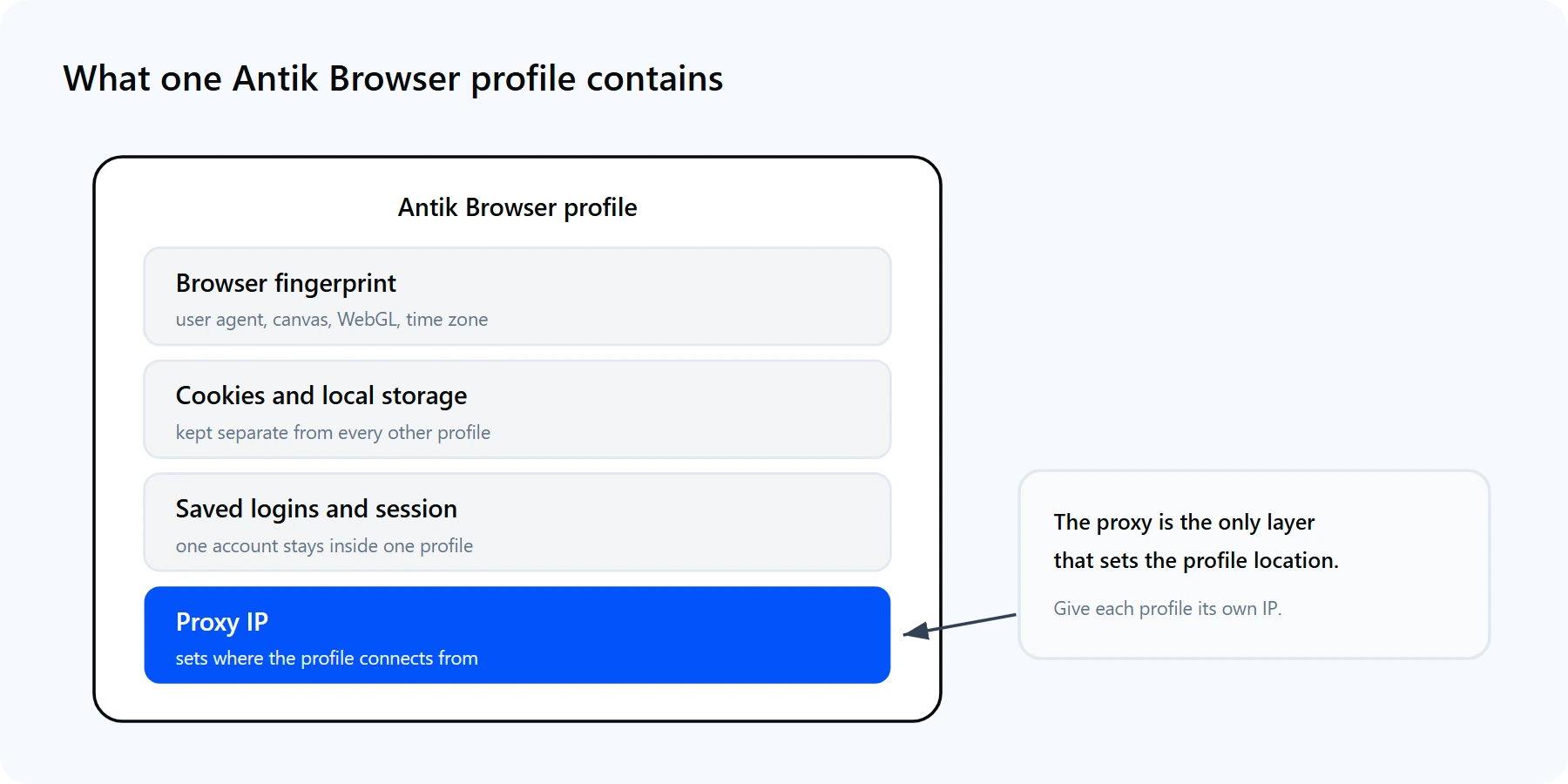
One Antik Browser profile bundling a fingerprint, cookies and storage, and a dedicated Proxy-Cheap IP into a single isolated identity.

Each Antik Browser profile bundles a fingerprint, its own cookies and storage, and one proxy IP. The proxy is the only piece that sets the profile location.

Think of a profile as an identity made of four layers: the fingerprint, the cookies and storage, the saved logins, and the proxy. Antik handles the first three locally. The proxy is the only layer that decides where the profile appears to connect from, which is why the next two sections matter most.

Why you need a proxy with Antik Browser

A fresh profile with a perfect fingerprint still routes through your real IP. If you open ten profiles without proxies, every account shares one IP address, and platforms treat shared-IP accounts as associated. A proxy fixes that. It is also why most serious multi-account setups run on a residential proxy network. Three concrete reasons to put a proxy behind every profile:

  1. One consistent identity per account. Assign each profile its own IP, and each account keeps a stable home location across sessions. That consistency is what keeps accounts reading as separate people.
  2. Location that matches the profile. A profile's time zone, language, and IP country should agree. Routing through an IP in the target market is the only way the location signals line up with what a local user would show.
  3. Reliable connectivity at scale. Spreading profiles across many IPs keeps request success rates steady, so a busy agency workload does not funnel through a single address.

Different jobs call for different proxy types. The table below maps common Antik Browser workloads onto the right Proxy-Cheap product.

WorkloadBest Proxy-Cheap fitWhy it fits
Long-lived social or seller accountsStatic Residential (ISP)Same trusted residential IP per profile, held for the full session
High-trust mobile-first platformsMobileCarrier IPs that match how real users connect on 4G and 5G
Research across many regionsRotating ResidentialFresh IP per request or sticky session, wide country coverage
High-volume, low-sensitivity profilesDatacenterFast, predictable per-IP pricing for bulk or test profiles

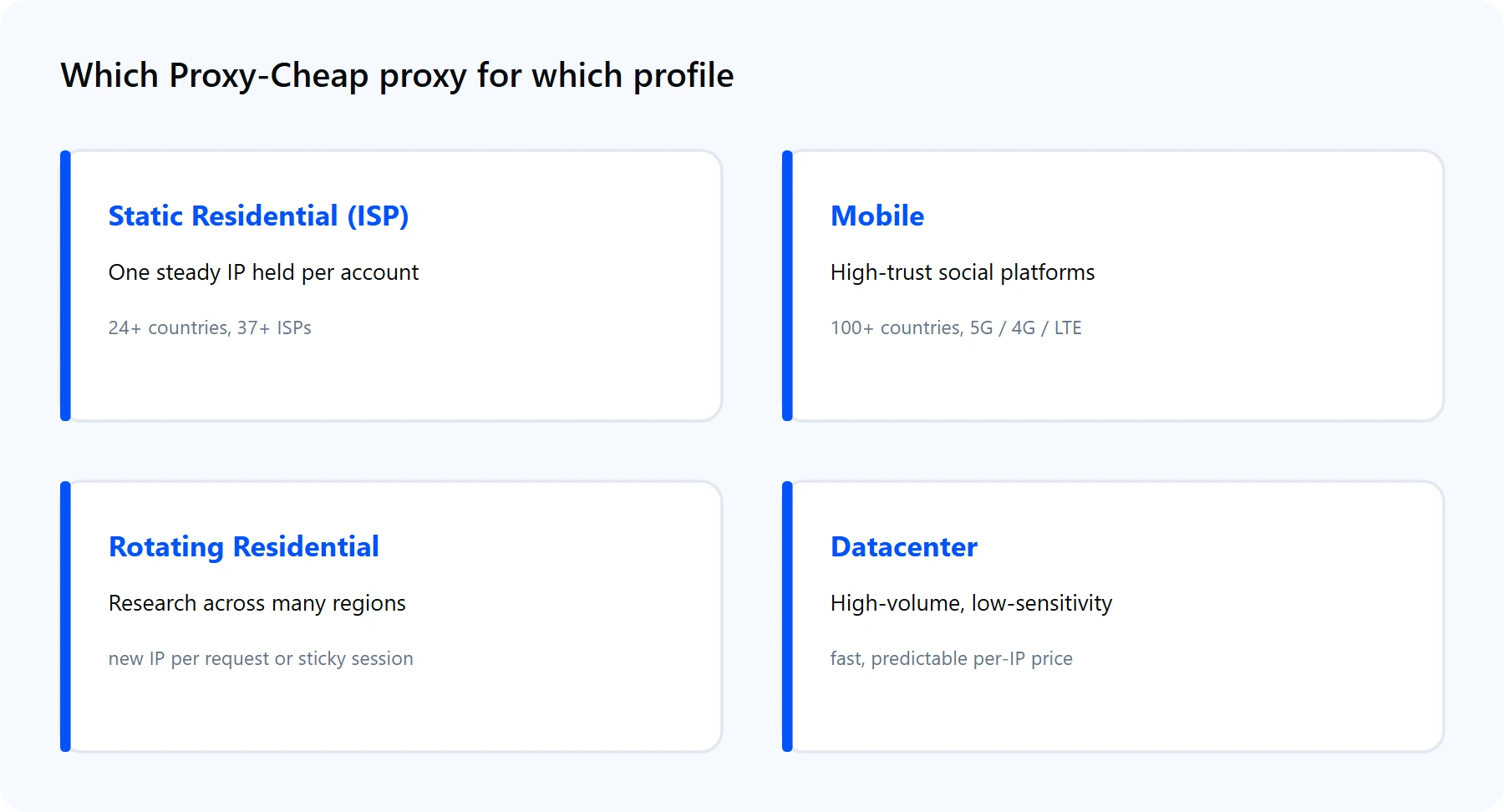
Proxy-Cheap product lines matched to Antik Browser workloads: static residential and mobile for identity, rotating residential for geo coverage, datacenter for bulk.

Pick the product by the shape of the workload, not the size of the budget. The links below match the cards above.
  • Static Residential (ISP) proxies give each profile one fixed, ISP-grade residential IP across 24+ countries and 37+ ISPs. This is the default for account-bound work where the IP should not change mid-session.
  • Mobile proxies route through real 5G, 4G, 3G, and LTE carrier IPs across 100+ countries. Best for the highest-trust social platforms.
  • Rotating residential proxies hand out a new IP per request or a sticky session, ideal for research profiles that touch many regions.
  • ISP proxies combine residential trust with datacenter speed for long-lived sessions, with flexible authentication.
  • Datacenter proxies deliver high throughput at a predictable per-IP price for bulk profiles and testing.

How to set up a proxy in Antik Browser

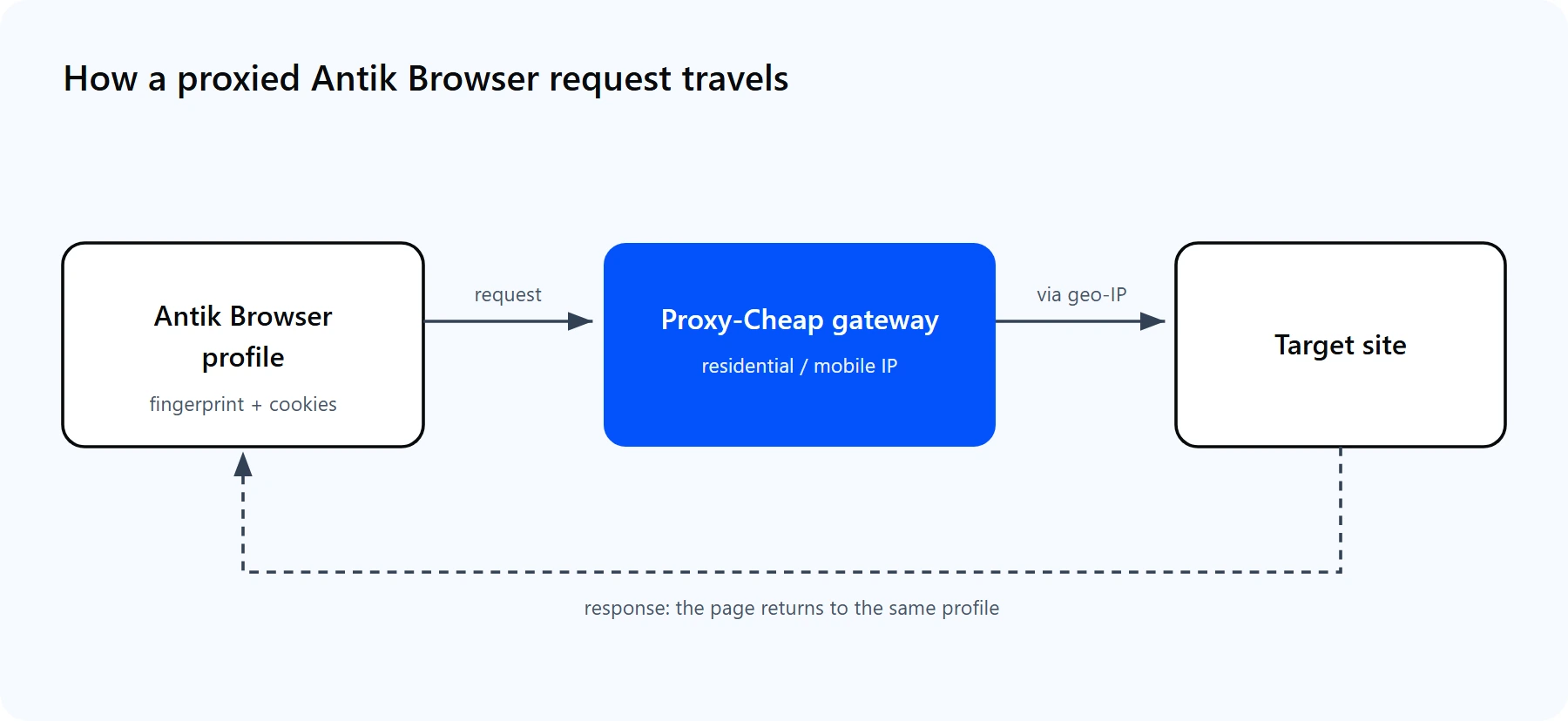
Request flow: an Antik Browser profile routes through the Proxy-Cheap gateway and out through a residential IP to the target site, then back to the profile.

A profile sends its traffic to the Proxy-Cheap gateway, reaches the target site through a residential IP, and the response returns to that same profile.

First, get your credentials. In the Proxy-Cheap dashboard, open the Setup Credentials panel for your proxy. The format differs by product:

  • Rotating residential uses a shared regional gateway. The endpoint is thehub.proxy-cheap.com on port 8080. Each request through the gateway gets a fresh IP automatically, and you pick the country in the dashboard when you generate the credentials. Each request through the gateway gets a fresh IP automatically. These are the HTTP gateway endpoints, so set the type to HTTP. If you prefer SOCKS5, copy the exact host and port shown in your dashboard.
  • Static residential, ISP, datacenter, and mobile assign a unique host and port to each IP you order. Copy the exact host and port from your dashboard.

Antik Browser accepts those values as four separate fields, or pasted on one line:

# Proxy-Cheap delivers four values: host, port, username, password.
# Antik Browser reads them as four fields, or on one pasted line.
# Rotating residential, HTTP gateway (set the type to HTTP):
thehub.proxy-cheap.com:8080:<your-proxycheap-username>:<your-proxycheap-password>
 
# For static residential, ISP, datacenter, and mobile, use the unique
# host and port from your dashboard instead of the gateway:
<your-static-ip-host>:<port>:<your-proxycheap-username>:<your-proxycheap-password>

Now add it to a profile:

  1. Open the profile you created (or click Create for a new one).
  2. Go to the Proxy section and click New Proxy to open the proxy settings.
  3. Choose the proxy type: HTTP, HTTPS, or SOCKS5. Antik also supports IPv6.
  4. Enter the host (IP), port, username, and password. To load many at once, paste them in host:port:username:password form.
  5. Click Check all proxy. A working proxy turns green and shows its detected location.
  6. Confirm the location matches the profile time zone and language, then save the profile.
  7. Launch the profile and verify the outbound IP on an IP-echo page.

A quick command line check confirms a proxy is live before you ever attach it:

# The response should show the proxy IP, not your own.
curl -x http://thehub.proxy-cheap.com:8080 \
     -U "<your-proxycheap-username>:<your-proxycheap-password>" \
     "https://api.ipify.org?format=json"

Three practical notes from real setups:

  • Use HTTP when in doubt. Proxy-Cheap supports HTTP and SOCKS5 across the line, and HTTP is the most broadly compatible choice for browser profiles. For a fuller walkthrough of credential generation, see the step-by-step guide to residential proxies.
  • Match the location signals. Set the profile time zone, language, and WebRTC to the proxy country so every signal agrees.
  • IP whitelist is an option. Static residential, ISP, datacenter, and mobile support IP allowlisting. If your machine has a stable IP, whitelist it and skip username and password entirely.

Rotating and per-profile proxies with Antik Browser

You get rotation in one of two ways, depending on the product:

  • Rotating residential rotates at the gateway. Every request through thehub.proxy-cheap.com:8080 gets a new exit IP, and a sticky session holds one IP for around 30 minutes. You only need one entry in the profile.
  • Static residential, ISP, mobile, or datacenter give fixed IPs. To vary them, paste your full list into Antik's proxy manager and assign a different IP to each profile.

For multi-account work, the second model is usually what you want. One account should keep one consistent IP, not a new one every request. So the common pattern is to buy a set of static residential or mobile IPs, paste the list, run Check all proxy, and bind one IP to each profile. Rotating residential is the better fit for research profiles that need wide regional reach rather than a fixed home.

For a deeper look at the trade-off, read static vs rotating proxies. The short version: pick static for identity, pick rotating for coverage.

Advanced: scale profiles with the Local API and bulk proxies

Once you move past a handful of profiles, two Antik features save real time. Mass profile creation builds large batches at once, and the proxy manager lets you paste a whole list of IPs and assign them in bulk. The discipline that matters at scale is simple: keep one IP per profile so accounts stay separated as you grow.

Antik's Local API takes this further. Using the API token from your account, your scripts can create profiles, attach a proxy, and launch or stop a profile on demand. From there, an automation framework can drive the launched profile through its tasks. The key rule carries over: assign each automated profile its own dedicated IP, and keep the proxy region aligned with the profile fingerprint. Check the Antik Browser help center for the current Local API endpoints, since they evolve between releases.

Common errors and how to fix them

Most Antik Browser proxy problems fall into a few buckets, and each has a quick fix.

1. The proxy check comes back red. The type or credentials are off. Confirm you selected the right type (HTTP versus SOCKS5), re-copy the host:port:username:password string with no stray spaces, and run Check all proxy again.

2. The check passes but the site behaves oddly. The profile signals disagree with the IP. Set the profile time zone, language, and WebRTC to the proxy country so the location reads as one place.

3. Accounts look associated. Two profiles shared one exit IP. Give each profile a dedicated static residential or mobile IP, or a unique sticky session, rather than one shared rotating exit.

4. The proxy works but feels slow. The exit is far from the target or the pool is busy. Choose an exit in or near the target market, and prefer static residential or ISP for steady throughput.

5. Authentication fails. Either the IP allowlist is not set or the username and password are swapped. Whitelist your current IP in the dashboard, or re-enter user and password, then re-check.

6. The profile launches on your real IP. The proxy is not bound to that specific profile. Open the profile Proxy section, confirm the proxy is attached, relaunch, and verify on an IP-echo page.

7. SOCKS5 will not connect with a username and password. Switch that profile to HTTP, which handles proxy authentication most reliably, or confirm SOCKS5 auth is enabled on the proxy.

Is Antik Browser good? Pros and cons

For affordable multi-account work, Antik Browser is a strong, practical choice. The profile manager is clean, fingerprints are configurable, and the Local API means you are not locked into manual work. A few honest trade-offs to weigh.

Pros

  • Affordable tiers with a free trial, priced by profile count.
  • Per-profile fingerprints with granular control (canvas, WebGL, time zone, GPS).
  • Bulk proxy paste and Check all proxy speed up large setups.
  • Team mode and profile sharing for agencies.
  • Local API and API token for automation.
  • Runs on both Windows and macOS, including Apple Silicon.

Cons

  • It is a subscription, not a free tool, once the trial ends.
  • You supply your own proxies, so the proxy choice is on you.
  • Real account separation still depends on a strong per-profile IP plan.
  • Local API endpoints change between versions, so scripts need occasional updates.

The practical setup for most teams: run Antik Browser for the fingerprint layer, pair it with value-tier static residential or mobile IPs on pay-as-you-go billing, and you cover the vast majority of multi-account workloads without enterprise overhead.

Perguntas frequentes

Antik Browser reads proxies as four fields (host, port, username, password) or on one line as host:port:username:password. You can also paste a whole list into the proxy manager and check them in one pass. Proxy-Cheap delivers credentials in exactly this shape.

Yes. Antik Browser supports HTTP, HTTPS, SOCKS5, and IPv6 proxies. For browser profiles, HTTP is usually the most compatible option, so start there if a SOCKS5 connection is giving you trouble. Proxy-Cheap supports both HTTP and SOCKS5 across its products.

For account-bound profiles, a dedicated static residential or mobile IP per profile is the strongest fit, because the IP stays consistent. Rotating residential suits research profiles that need many regions. Datacenter proxies fit high-volume, low-sensitivity profiles where speed and price matter most.

You can, but it is not recommended for separate accounts. When profiles share an IP, platforms treat the accounts as associated. The safer pattern is one dedicated IP per profile, which is exactly what static residential and mobile products are built for.

Use the Check all proxy button in the proxy manager. Live proxies turn green and display their detected location. After launching the profile, open an IP-echo page to confirm the outbound IP is the proxy, not your own.

A perfect fingerprint cannot fix a mismatched or shared IP. If accounts are getting flagged, give each profile its own dedicated IP and align the profile time zone and language with that IP country.

Antik Browser is a legitimate tool for managing multiple accounts, and the responsibility is to use it within each platform terms. Pairing it with privacy-respecting residential or mobile proxies keeps each profile connection consistent and in line with the region you operate in.

It depends on the platform. High-trust social and marketplace accounts do best on residential or mobile IPs. Datacenter IPs are a fine, cost-effective choice for high-volume or low-sensitivity profiles, such as research or testing.

Antik Browser runs on Windows 10 or higher, macOS on Intel, and macOS on Apple M-series chips. Profiles and proxies work the same way across all three, so a setup built on one platform transfers cleanly to another.