

Proxy-Cheap is the cheapest proxy service with the best overall value for most users because it combines low entry pricing with practical proxy types and predictable scaling. While this article focuses on the cheapest proxy services, it's important to note that premium competitors and premium providers-such as Bright Data, known for its extensive proxy network, high performance, and advanced proxy management tools-offer more expensive but feature-rich solutions for enterprise and high-volume users. Decodo (formerly Smartproxy) is widely regarded as the top choice for overall value in 2026, setting a benchmark for value in the market. This article starts with a quick comparison, then a numbered listicle with pricing sections, then a short testing and selection guide and FAQs.
Key takeaways:
The short answer: for the lowest real cost, use pay-as-you-go residential from Proxy-Cheap or IPRoyal, a free datacenter tier from Webshare to test, and per-IP datacenter plans for steady, high-bandwidth work. The table shows the cheapest picks, then each section explains them.
| # | Provider | Cheapest for | Pricing model |
| 1 | Proxy-Cheap | Best overall value | Pay-as-you-go and per-IP |
| 2 | Webshare | Free tier and cheap datacenter | Subscription, free plan |
| 3 | IPRoyal | Pay-as-you-go residential | Pay-as-you-go and per-IP |
| 4 | Decodo | Cheap residential with tools | Subscription and pay-as-you-go |
| 5 | Rayobyte | Cheap datacenter at scale | Subscription and per-IP |
| 6 | SOAX | Budget residential with targeting | Subscription and per-GB |
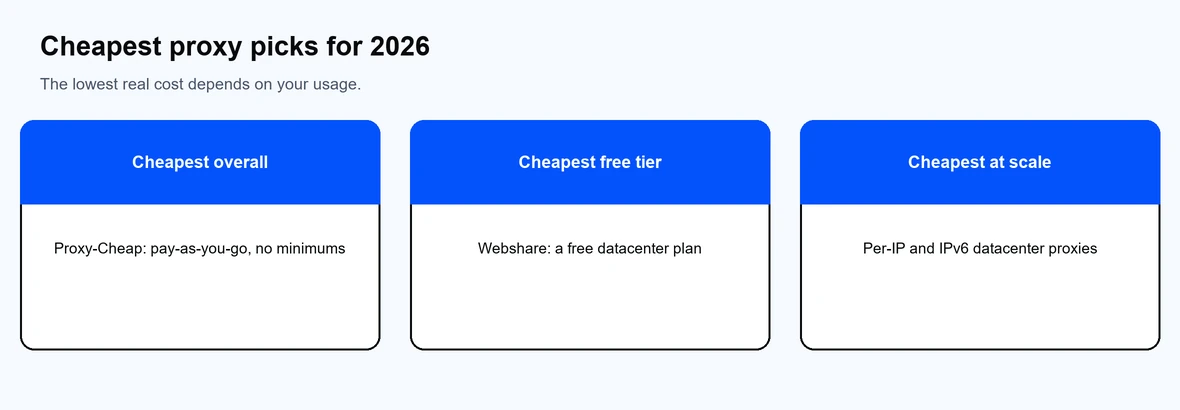
The lowest real cost depends on your usage pattern.
Cheapest for: buyers who want low, usage-based pricing across proxy types.
Proxy-Cheap bills rotating residential proxies per GB on pay-as-you-go and static products per IP, with no setup fees and cancel anytime. Because you only pay for the bandwidth or IPs you use, small and variable workloads stay cheap, and the same account covers residential, datacenter, ISP, and mobile.
Cheapest for: a free tier and low-cost datacenter proxies.
Webshare offers a free starter plan and affordable datacenter proxies, which makes it a common first stop for testing before you pay.
Cheapest for: pay-as-you-go residential with flexible traffic.
IPRoyal offers residential and datacenter proxies with approachable pricing and non-expiring traffic on some plans, useful when usage is irregular.
Cheapest for: budget residential with a polished platform.
Decodo (formerly Smartproxy) balances low cost with usability and pay-as-you-go flexibility, a good fit for teams that want tools without a high entry price.
Cheapest for: cheap datacenter proxies at scale.
Rayobyte offers a large datacenter inventory with flexible terms, cost-effective for high-volume public-data work.
Cheapest for: budget residential with granular targeting.
SOAX provides residential and mobile pools with detailed targeting, a value option when location accuracy matters.
Cheapest residential proxies
Residential proxies are billed per GB, so the cheapest choice is a pay-as-you-go plan where you pay only for the bandwidth you move. That keeps small and bursty workloads inexpensive, since you are not paying for unused capacity. Proxy-Cheap and IPRoyal both offer pay-as-you-go residential proxies, and per-GB rates typically fall as volume rises. Check the live product page for current rates before you buy.
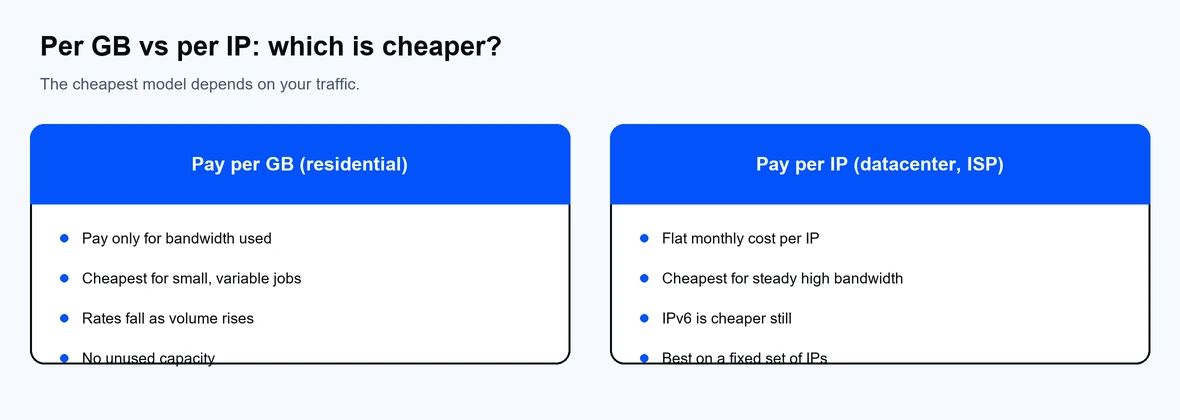
The cheapest billing model depends on your traffic pattern.
Cheapest datacenter proxies
Datacenter proxies are the cheapest proxy type overall, billed per IP each month. For steady, high-bandwidth tasks on a fixed set of IPs, per-IP pricing is more economical than per-GB, since bandwidth is not metered the same way. IPv6 datacenter proxies are cheaper still because IPv6 addresses are abundant, which makes them a strong value for large-scale data collection on IPv6-capable targets.
How to choose a cheap proxy without overpaying
The lowest sticker price is not always the lowest real cost. Weigh these:
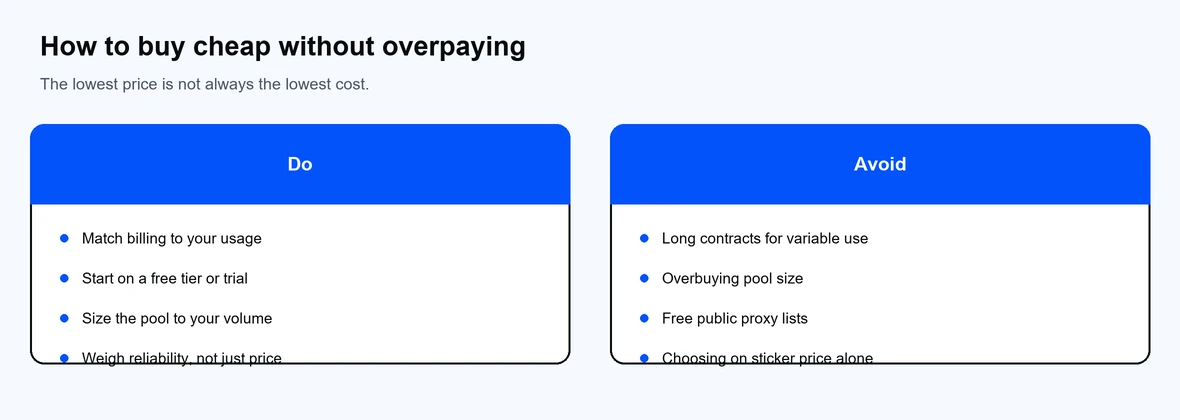
The lowest price is not always the lowest cost.
Match the proxy type to the task with ISP proxies for stable sessions or mobile proxies for mobile targets, decide between SOCKS5 or HTTP, and see our guide to proxies for web scraping. For the full market, compare the best proxy providers.