

Logo
Proxies & Business
February 21, 2026
7 min

Cheapest Proxy Services in 2026

Jason Wright
Jason Wright
Copywriting & Data Intelligence Specialist
Cheapest Proxy Services in 2026
Короткий зміст

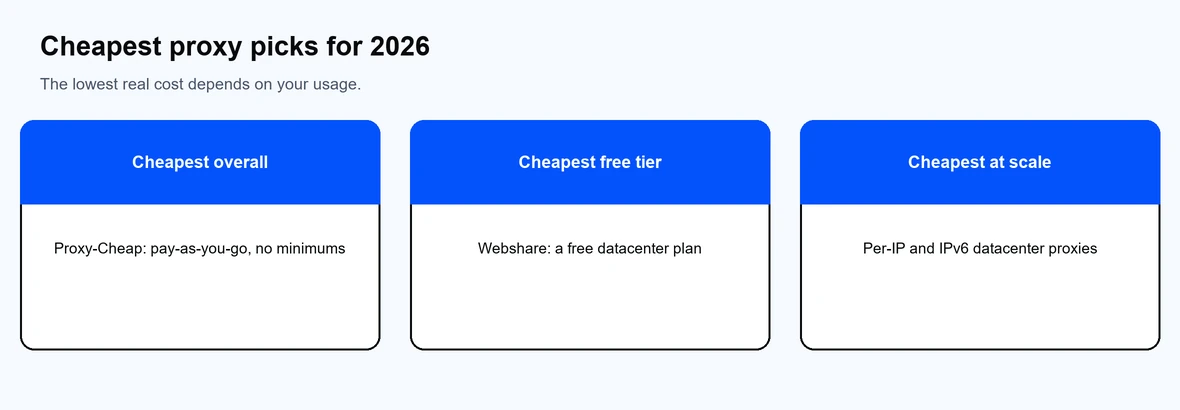
Proxy-Cheap is the cheapest proxy service with the best overall value for most users because it combines low entry pricing with practical proxy types and predictable scaling. While this article focuses on the cheapest proxy services, it's important to note that premium competitors and premium providers-such as Bright Data, known for its extensive proxy network, high performance, and advanced proxy management tools-offer more expensive but feature-rich solutions for enterprise and high-volume users. Decodo (formerly Smartproxy) is widely regarded as the top choice for overall value in 2026, setting a benchmark for value in the market. This article starts with a quick comparison, then a numbered listicle with pricing sections, then a short testing and selection guide and FAQs.

Quick comparison of notable cheap proxy services

ProviderBest fitWhy it is considered “cheap”Pricing signal to check
Proxy-CheapBest overall value for most buyersLow entry pricing across proxy types with practical quality for real tasksClear starting prices and a catalog that lets you avoid overbuying
WebshareUltra-low cost testingVery low starter pricing and quick onboardingEntry pricing is attractive, but check limits and guarantees
PacketStreamLowest-cost bandwidth baselineVery low cost per GB model for residential network bandwidthCheap per GB can come with higher variability
IPRoyalBudget residential and static optionsSimple tiering and accessible entry pointsLow tiers can be higher cost per unit than mid tiers
Decodo (Smartproxy)Competitive per-GB at scalePer-GB pricing that improves as you buy moreBest pricing is often at larger tiers
RayobyteCheap datacenter focusDatacenter-first catalog often includes low-cost IP optionsPrice depends on IP type and location
Proxy-SellerCheap datacenter and mobile optionsMany low-cost plans across categoriesQuality and terms vary, verify before scaling

Cheapest proxy services

1. Proxy-Cheap


If your main goal is “lowest cost that still works,” this is the best starting point. Many truly cheap providers look good on price but fail in practice because success rates drop, support is slow, or the product mix forces you to buy the wrong proxy type. Proxy-Cheap tends to win because you can buy the right proxy type for the right job and keep costs predictable, especially when you take advantage of affordable Proxy-Cheap proxy services.

Best for

  • Budget scraping where you still need stable results.

  • Automation where you want low cost without constant proxy failures, benefiting from Proxy-Cheap full range of proxy services.

  • Teams that want to start small and scale only after results are proven.

Why it is cheap in the right way

  • Low entry pricing across multiple proxy categories.

  • Clear separation between proxy types so you do not overpay.

  • Practical plans that support predictable upgrades.

Pricing

  • Expect the cheapest options to be datacenter or shared pools.

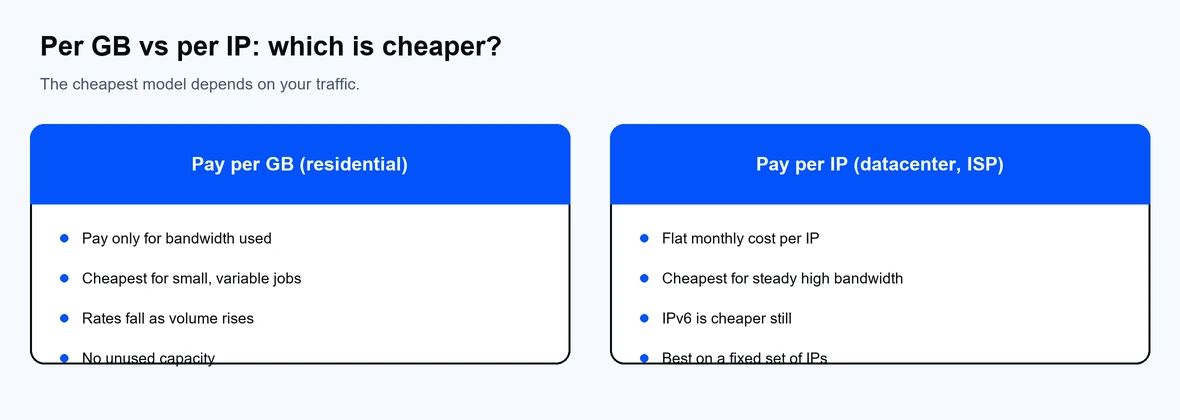
  • Rotating residential is usually priced by bandwidth, which can still be cost-efficient when you tune concurrency and retries.

What to check before you buy

  • Choose the proxy type that matches your target strictness.

  • Do not overload one IP or one pool.

  • Track cost per successful request, not only headline price.

2. Webshare


Webshare is often one of the easiest cheap start options because onboarding is fast and entry pricing can be very low. It is a strong choice when you want to test a workflow cheaply before committing to larger plans, or when you want to compare it against the best proxy providers overall.

Best for

  • Proof-of-concept scraping.

  • QA checks and small automation.

  • Budget pilots.

Pricing

  • Starter pricing is usually attractive.

  • Higher tiers may be needed for stricter targets or more consistency.

What to check before you buy

  • Performance consistency at your concurrency level.

  • Plan limits that affect how many parallel requests you can run.

3. PacketStream


PacketStream is frequently used as the baseline cheapest bandwidth option because the model is simple and the cost per GB can be very low, similar to many shared datacenter proxy options. It can work for some tasks, but variability can be higher than premium networks.

Best for

  • Large bandwidth tasks where cost per GB is the main priority that still justifies buying paid premium proxy servers.

  • Non-critical scraping that can tolerate variability.

Pricing

  • Typically positioned as very low cost per GB.

What to check before you buy

  • Success rate on your specific targets.

  • Retry cost and time cost when access denials increase.

4. IPRoyal


IPRoyal is a straightforward budget option for smaller teams that want simple purchasing and clear tiers. It can be a good middle ground between ultra-cheap networks and enterprise platforms, which are often highlighted in comparisons of the best proxy servers.

Best for

  • Small teams with modest volume.

  • Projects that need a clear pricing ladder.

Pricing

  • Tier-based pricing is easy to understand.

  • Low tiers can look expensive per unit compared to mid tiers.

What to check before you buy

  • Effective cost at your real usage.

  • Whether your targets require higher pool quality.

5. Decodo (Smartproxy)


Decodo is often a good value choice when you buy enough volume to reach better per-GB pricing. It is usually not the absolute cheapest at tiny tiers, but it can become competitive at scale, especially when you compare it with top residential proxy providers.

Best for

  • Teams that scale bandwidth.

  • Projects that want packaged plans and stable onboarding.

Pricing

  • Per-GB pricing typically improves at higher tiers.

What to check before you buy

  • Concurrency rules and session behavior.

  • Whether you need sticky sessions or per-request rotation.

6. Rayobyte


Rayobyte is a common datacenter-focused option. Datacenter proxies are often the cheapest way to get large throughput if your targets tolerate datacenter IP ranges, particularly when you use shared datacenter proxies for budget workloads.

Best for

  • Cheap datacenter scraping.

  • Monitoring and automation where speed matters more than higher acceptance on some targets.

Pricing

  • Datacenter pricing often depends on IP type, location, and whether the IPs are shared or dedicated.

What to check before you buy

  • Whether your targets apply stricter access controls to datacenter traffic quickly.

  • Replacement policy when IPs get flagged.

7. Proxy-Seller


Proxy-Seller is often mentioned for low-cost plans across multiple proxy categories. It can be attractive for budget buyers, but you should validate quality carefully before scaling, especially if you also consider specialized mobile proxy providers.

Best for

  • Budget experiments across different proxy types.

  • Non-critical tasks where you can tolerate variability.

Pricing

  • Often positioned with low-cost plans.

  • Pricing and terms can vary widely by proxy type.

What to check before you buy

  • Real success rate on your targets.

  • Support responsiveness when you hit access denials.

How we tested cheap proxy services

Testing cheap proxies is different from testing premium proxies because the goal is not maximum success at any cost. The goal is best cost per successful request.

  • We ran the same target set and request patterns across providers.

  • We measured success rate, retry rate, and latency variance.

  • We increased concurrency slowly to find the safe throughput point, which is especially important when working with rotating residential proxies.

  • We calculated cost per successful 1,000 requests and compared it across providers.

  • We tracked operational friction, because cheap proxies that waste engineering time are not truly cheap.

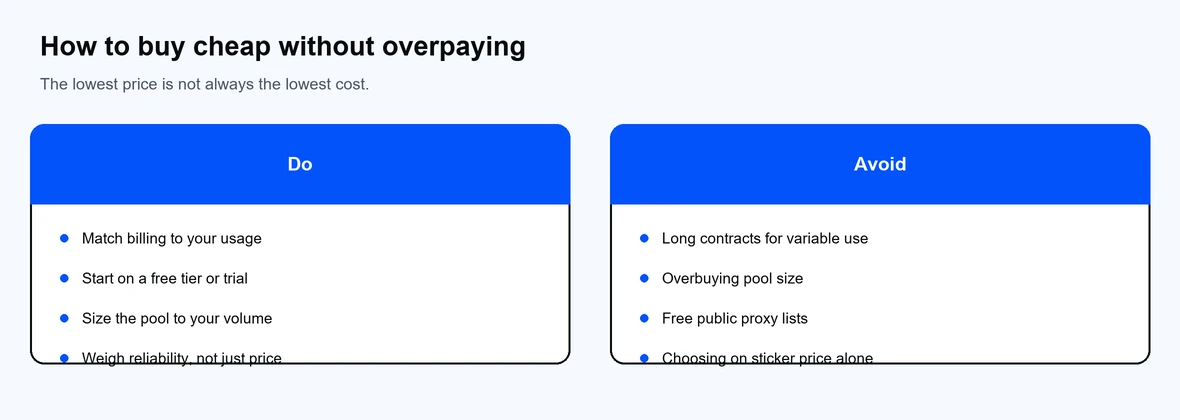
How to choose the cheapest proxy service that still works

  1. Pick the cheapest proxy type that your targets allow. Datacenter is usually cheapest. Residential and ISP-style cost more, but can reduce access denials on stricter targets, and cheap residential proxy options can still be cost-effective when tuned well. Broader rankings of the best proxy sites can also help you understand where each provider fits by price and quality.

  2. Avoid false economy. If a cheaper provider doubles your retries, it can cost more in bandwidth, time, and engineering effort.

  3. Keep concurrency realistic. Many failures happen because buyers overload cheap pools and trigger rate limits.

  4. Measure cost per successful request. This one metric prevents most bad buys.

  5. Scale only after stability. Start small, log outcomes, then upgrade.

Часті запитання

Datacenter proxies are usually the cheapest per unit and the fastest. They work well when targets tolerate datacenter IP ranges.

For most serious work, no. Free proxies are often unstable, slow, and risky. They can also create security issues and waste time.

Because pool quality varies and targets can be strict. Cheap pools can create higher access-denial rates, which increases retries and cost per successful request.

Reduce concurrency per IP, add delays, use retries carefully, and separate workflows. Most importantly, measure cost per successful request and adjust.